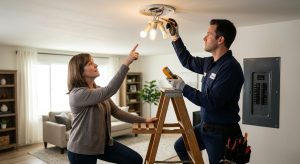
Electrical safety in Goleta takes on special urgency in summer. When temperatures climb and air conditioning runs continuously, older panels and circuits that have been managing adequately through the mild seasons face their heaviest loads of the year. The warning signs that were easy to ignore in February — the breaker that tripped once, the outlet that felt slightly warm — become acute problems in July when the same system is running at maximum capacity for hours every day. This guide covers the electrical safety checks and practices that Goleta homeowners should prioritize before and during the summer season, along with the warning signs that warrant immediate professional attention.
Understanding Summer Electrical Load in Goleta Homes
The summer electrical load in a typical Goleta home is substantially higher than in winter or spring. Central AC systems draw 15 to 30 amps of continuous current depending on unit size and age. When that AC runs alongside a refrigerator, dishwasher, washing machine, and the standard mix of household electronics, the total demand on an older 100-amp panel can approach or exceed its safe operating capacity.
This is not a theoretical concern. From our service calls in Goleta during summer months, the pattern is consistent: calls spike in June through August, and the most common findings are breakers that have begun to fail after years of thermal cycling, panels that show heat stress at the bus bar, and wiring connections that have loosened over time from repeated expansion and contraction during seasonal load cycles.
Key Electrical Safety Checks Before Summer Peak Season
Before the hottest months arrive, these are the checks every Goleta homeowner should run:
Check Your Panel’s Condition
Open your electrical panel and do a five-minute visual inspection. You are looking for:
- Any darkening, scorching, or discoloration around breaker terminals or the bus bar
- Breakers that are not sitting squarely in the on position — some older breakers lose the positive click that confirms they are fully engaged
- Any unusual smell of plastic or burning coming from the panel area
- Circuit labels that are missing or inaccurate — you need to know which breaker controls which area, especially in an emergency
If you see any discoloration, smell anything unusual, or find breakers that don’t seat positively, call a licensed electrician before running AC at full load. A panel assessment by a licensed electrician costs less than $200 and can identify conditions that, left unaddressed, could become emergencies during peak summer use.
Test Your GFCI Outlets
GFCI outlets — the ones with TEST and RESET buttons, found in kitchens, bathrooms, and outdoor areas — can fail silently. A failed GFCI will still pass power to devices but will not trip when a ground fault occurs. Test each GFCI by pressing the TEST button. The outlet should go dead. Press RESET to restore power. If any GFCI does not trip when tested, it needs to be replaced. Outlet repair for a failed GFCI is a quick, inexpensive professional job.
Test Your Smoke Detectors
Electrical fires can start in walls and panels before smoke is visible in living areas. Working smoke detectors are your safety backup when panel problems are not caught before they escalate. Press and hold the test button on each detector. If it does not sound, replace the battery. If it still does not sound with a fresh battery, replace the unit. California requires working detectors in every sleeping area and outside each sleeping area.
Check Extension Cords and Power Strips
Summer brings portable fans, window AC units, and outdoor entertaining setups — all of which tend to involve extension cords and power strips. Check that:
- No extension cord is running under a rug or carpet — this traps heat and can cause a fire
- No extension cord is being used permanently — if you need a circuit in a location, add an outlet rather than running an extension cord indefinitely
- Power strips are not “daisy-chained” — one power strip plugged into another — which overloads the circuit connection
- Outdoor extension cords are rated for outdoor use — indoor cords used outdoors are a safety hazard in wet conditions
“The calls we get in July are predictable — the same panel that was ‘fine’ all spring starts tripping when the AC runs all day. The panel was not fine. It was borderline, and summer loads pushed it over the edge. The time to fix borderline is before summer, not during it.”
— Edgar, Blue Moon Electrical
Visually inspect panel for darkening, burning smell, or unseated breakers
Test all GFCI outlets: press TEST, confirm outlet goes dead, press RESET
Test smoke detectors; replace any unit that does not respond to fresh battery
Remove extension cords from under rugs; replace permanent cords with outlet installation
Check outdoor outlets are GFCI protected and weatherproof for summer entertaining
Schedule panel assessment if home is pre-1985 and has not been professionally evaluated recently
AC Installation and Electrical Safety
Window air conditioning units and portable ACs are common in older Goleta homes and rental units that do not have central AC. These units draw significant current — a 10,000 BTU window unit typically draws 10 to 12 amps — and are frequently plugged into outlets on circuits that are already partially loaded.
Key safety practices for AC unit installation:
- Check the circuit capacity before plugging in a window AC. A 15-amp kitchen or bedroom circuit that already serves a refrigerator (7 amps) cannot safely support a 12-amp AC unit simultaneously.
- Do not use an extension cord with a window AC unit — ACs should always be plugged directly into a wall outlet.
- If you need a dedicated circuit for a window AC, that is a job for a licensed electrician. Circuit installation for a dedicated AC outlet is a permitted job in Goleta.
- Window units should be in units designed for AC loads — a standard NEMA 5-15 outlet. High-BTU portable ACs may require a 240-volt circuit — verify before purchasing.
Outdoor Electrical Safety for Summer Entertaining
Summer in Goleta means outdoor living — patios, gardens, and entertaining spaces that need outdoor lighting, power for music, and charging stations. Outdoor electrical safety practices:
- All outdoor outlets must be GFCI protected. If your outdoor outlets do not have GFCI protection (no TEST/RESET buttons and not on a GFCI circuit), have them upgraded before connecting outdoor equipment in wet conditions.
- Outdoor lighting circuits should use weatherproof fixtures and outdoor-rated wiring. Indoor fixtures and indoor extension cords are not safe for permanent outdoor installation.
- String lights and temporary outdoor lighting should be specifically labeled for outdoor use — not just labeled for indoor or “dry location” use.
- Outdoor outlet covers should be the “in-use” bubble covers that protect the plug connection even when a device is plugged in, rather than the standard flat covers that only protect an empty outlet.
Fire Prevention: Electrical Safety Around the Home
The NFPA reports that electrical failures and malfunctions cause approximately 51,000 home fires per year in the United States. In Goleta, where summer heat accelerates the degradation of aging electrical insulation and increases the frequency of overload conditions, the fire prevention value of basic electrical safety practices is meaningful. In addition to the panel checks described above:
- Never store combustible materials near your electrical panel — the space around the panel should be clear of boxes, cloth, and other materials that could ignite from a panel fault.
- Do not use the oven or stove to heat a room — these appliances are designed for cooking, not space heating, and using them for heating creates both electrical and fire safety risks.
- Have surge protection installed if you are in an area with frequent power fluctuations — whole-home surge protectors installed at the panel protect all circuits from voltage spikes that can damage electronics and contribute to wiring degradation.
For all summer electrical safety concerns in Goleta — panel assessment, GFCI upgrades, outlet additions for outdoor or AC circuits, or anything that raised a flag during your pre-summer inspection — contact Blue Moon Electrical at (805) 222-7592.
When to Call an Electrician vs. Handle It Yourself
The line between homeowner maintenance and licensed electrical work is worth being clear about during summer safety preparations:
- Homeowner tasks: Resetting tripped breakers, testing GFCI outlets with the TEST button, testing smoke detectors, replacing smoke detector batteries, replacing light bulbs.
- Licensed electrician tasks: Everything else — opening the panel, replacing breakers, replacing outlets or switches, adding circuits, any work involving wire connections inside an electrical box or panel.
If your summer preparations reveal electrical conditions that need professional attention, act on them before the heat peaks. The busiest weeks for electrical contractors in Goleta are July and August — the weeks when delayed electrical problems become emergency calls. Scheduling a professional assessment now, before those peak weeks, ensures you have the problem addressed on your schedule rather than in a crisis.