Signs you need an electrical panel upgrade rarely show up as one dramatic event. More often it’s a breaker that trips a little too often, a light that dims when the microwave kicks on, or a panel that just feels warm to the touch. Homeowners tend to explain these things away, which is understandable: nobody wants to think about the wiring behind their walls. But a panel that’s struggling to keep up with a modern home is trying to tell you something, and the sooner that message gets read correctly, the cheaper and safer the fix tends to be.
Signs You Need an Electrical Panel Upgrade Often Start With Breaker Trips
A breaker that trips once in a while, usually because a hair dryer and a space heater ended up on the same circuit, isn’t unusual. A breaker that trips every week, or every time the air conditioner and the oven run together, is a different story. That pattern usually means the circuit, or the panel as a whole, is carrying more load than it was designed for.
Resetting the breaker and moving on is the most common mistake homeowners make. A breaker is a safety device, not an inconvenience to work around. Every time it trips, it’s interrupting a circuit that was about to draw more current than the wiring could safely handle.
Older homes are especially prone to this. Circuits that were sized decades ago for a handful of lamps, a television, and a window unit are now asked to run flat-screen TVs, computers, space heaters, and kitchen appliances all at once. The panel hasn’t changed, but the load absolutely has.
Flickering and Dimming Lights Are a Capacity Problem, Not a Bulb Problem
Lights that dim briefly when the refrigerator compressor kicks on, or flicker when the air conditioner starts, are showing a voltage drop. That drop happens when a large appliance pulls a sudden surge of current and the electrical system can’t distribute it smoothly.
Occasionally the cause is simple: an LED bulb that isn’t compatible with an older dimmer switch. But if the flickering happens across multiple rooms and lines up with appliances turning on, the panel is the more likely culprit, not the light fixture.
Left alone, this kind of voltage fluctuation doesn’t just annoy the people in the house. It also puts stress on the sensitive electronics plugged into those circuits, from routers to refrigerator control boards, gradually shortening their lifespan.
“If a breaker keeps tripping, don’t just keep resetting it. That breaker is doing exactly what it’s supposed to do: it’s telling you the circuit is overloaded, and repeated resets without a look from a licensed electrician are how a small, cheap fix turns into a much bigger repair.”
Victor, Blue Moon Electrical
Rust, Buzzing, Heat, and Burning Smells Are Never Cosmetic
Some warning signs are audible or physical rather than electrical. A panel that buzzes, hums, or crackles usually has a loose connection somewhere inside, and loose connections generate heat. Heat is the mechanism behind the majority of electrical fires: resistance builds at a weak connection, and that resistance keeps climbing until something ignites.
A panel cover that’s warm to the touch, rust or water staining around the enclosure, or any hint of a burning smell near the panel are not things to wait on. These are the kinds of signs licensed electricians treat as urgent, not routine.
Rust is particularly telling because it usually points to a moisture problem, such as a roof leak, condensation, or an improperly sealed exterior panel, that’s been compromising the metal and the connections inside for a while before it became visible.
Fuse Boxes and Older Panel Brands: A Higher-Risk Category
If a home still has a fuse box rather than circuit breakers, that alone is a strong signal it’s time for an upgrade. Fuse boxes predate most modern safety requirements and typically can’t support the number of circuits a contemporary household needs.
Certain older panel brands deserve even closer attention. Federal Pacific Electric “Stab-Lok” panels, widely installed from the 1950s through the 1980s, were the subject of a federal safety investigation after testing found a meaningful share of their breakers failed to trip properly under overload conditions. The investigation was ultimately closed without a formal recall, according to the federal consumer product safety investigation, but independent testing since then has continued to raise concerns, and most licensed electricians recommend replacement rather than repair when one of these panels turns up in an older home.
In our inspections, mislabeled circuits are one of the most common issues we find in panels that were swapped out by a previous owner: a breaker marked “AC” that’s actually feeding the dryer, for example. A panel being newer doesn’t automatically mean it was installed correctly, which is one more reason a full evaluation matters more than just checking the manufacture date.
When Modern Power Demands Outgrow an Older Panel
Every decade, the average home asks more of its electrical system. Central air conditioning, larger kitchen appliances, home offices with multiple monitors, and now electric vehicles have all added meaningful load to houses that were never wired with that demand in mind.
Central AC and Everyday Appliances
A central air conditioning system is one of the largest single loads in a typical home, and its compressor draws an even bigger surge for a second or two every time it starts. Add a refrigerator, a couple of window units, and standard kitchen appliances, and an older 100-amp panel can end up running close to its limit during peak afternoon hours without anyone realizing it.
Older homes carry a second, less obvious risk alongside a straining panel: the wiring behind the walls. Homes built in the late 1960s and early 1970s sometimes used aluminum wiring instead of copper. Aluminum wiring isn’t automatically dangerous, but it needs to be properly mitigated, with copper pigtailing, CO/ALR-rated devices, or an antioxidant compound at the connections, and unmitigated aluminum at outlets and switches is a genuine fire risk that a panel upgrade alone won’t fix.
EV Charging and the 200-Amp Question
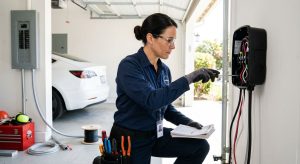
A Level 2 EV charger is one of the more common reasons homeowners look into a panel upgrade. According to federal guidance on home EV charging capacity, a home generally needs at least 200 amps of service and two open slots for a double-pole breaker to comfortably add Level 2 charging, and older homes built with 60 or 100-amp service often fall short of that. A licensed electrician can run a load calculation to determine whether the existing panel has room, or whether an upgrade or a load-management device makes more sense.
Fires that start inside an electrical panel or inside a wall often burn quietly for several minutes before there’s any visible sign, which is part of why the early, easy-to-dismiss signs matter so much. National home fire data shows electrical distribution and lighting equipment consistently ranks among the leading causes of home structure fires in the United States, with an annual average in the tens of thousands.
How Old Is Too Old? Panel Age, Amperage, and Goleta’s Housing Stock
Most electrical panels have a useful lifespan of somewhere between 25 and 40 years. Past that point, internal components such as bus bars, breaker contacts, and insulation have simply seen enough thermal cycling that failure becomes more likely, even without any obvious symptoms yet.
Age matters especially in a city like Goleta, where local housing age data puts the median year of construction around 1973. A panel original to a home built in that era is now well past the point most electricians consider safe to leave untouched, particularly if it hasn’t been inspected or upgraded since.
In our experience working on Goleta rentals and long-owned single-family homes, it’s common to find circuits that were never touched when a unit was remodeled or converted: new flooring and cabinets went in, but the panel behind the wall is the same one from the original build. Amperage matters too: 60-amp service was standard decades ago, but most modern homes need at least 100 amps, and often 200, to run central air, an electric range, and any future EV charging comfortably.
What a Professional Panel Evaluation Actually Involves
A proper panel evaluation goes beyond glancing at the amp rating stamped on the main breaker. A licensed electrician will typically check for double-tapped breakers, mismatched wire gauge and breaker size, a missing bonding screw, and any sign of previous amateur work, all things that can look fine from the outside while creating a real hazard inside the enclosure.
Thermal imaging is a useful tool in this process. A thermal camera can spot a breaker or connection that’s running hotter than it should, long before that heat becomes visible or produces a smell, which is especially valuable during a pre-sale inspection or a routine safety check.
A wire gauge tester is another simple but effective tool electricians use during an evaluation. It slides over the insulation to quickly flag mismatched wire gauge and breaker amperage, 14-gauge wire behind a 20-amp breaker, for example, without needing to pull every wire out of the panel to check. It’s a small step that catches one of the more fire-relevant issues an evaluation is meant to find.
If an upgrade is recommended, the process generally follows a predictable order: an eligibility and load-calculation review, permitting with the local jurisdiction, the physical panel replacement (which typically requires a several-hour power shutoff), and a final inspection. For electrification projects, a heat-pump HVAC system or a heat-pump water heater paired with a panel upgrade, there are sometimes utility or state incentive programs worth checking; availability and amounts vary and change often, so it’s worth asking early rather than assuming a specific rebate will apply.
New Code Requirements Worth Knowing Before You Upgrade
Anyone planning a panel replacement in the near future should know that recent National Electrical Code changes now require the service disconnect for one- and two-family homes to sit in a readily accessible outdoor location, clearly marked so first responders can find it quickly in an emergency. Replacing the service panel itself triggers this requirement, even if it didn’t apply when the home was originally wired. It’s a detail worth asking about when getting a panel upgrade quote, since it can affect the scope and cost of the job.
Arc-fault protection is another area that’s evolved steadily since it first entered the code. Code history from the national homebuilders’ association shows arc-fault circuit interrupters were first required in bedroom circuits starting in 2002, then expanded room by room in later code cycles. A home built before that point almost certainly doesn’t have this protection anywhere, which is worth factoring in if flickering or a suspected loose connection has already raised concerns.
Homeowners planning to add EV charging should also know that newer code cycles are tightening the listing and safety requirements for EV charging receptacles specifically, so it’s worth confirming that any circuit installed today, or in the last year or two, meets current standards rather than the ones in place when the home’s other outlets were wired.
DIY Fixes vs. When to Call a Licensed Electrician
Some electrical fixes are genuinely fine for a confident homeowner: replacing a light switch, swapping an outlet cover, or resetting a tripped breaker once. Panel work is not on that list. Anything involving the panel itself, adding a circuit, addressing a tripped main breaker, or investigating a buzzing sound, carries a real risk of shock or arc flash and should go to a licensed electrician.
A simple home test can help in the meantime: an outlet tester can quickly flag an open ground or reversed polarity, and a thermal-imaging check during a professional visit can catch problems no visual inspection would find. But once any of the signs above are present, the safest and most cost-effective move is a full evaluation rather than a piecemeal fix.
If your home matches several of the signs described here, such as frequent trips, flickering lights, an aging fuse box, or simply a panel that’s decades older than the roof over it, it’s worth having it looked at before it becomes an emergency rather than after. Blue Moon Electrical provides electrical services in Goleta, including panel evaluations, panel upgrade and replacement services, EV charger installation, and electrical safety inspections for homeowners across the area. If your evaluation turns up wiring that hasn’t kept pace with the panel, our rewiring services can address that at the same time.