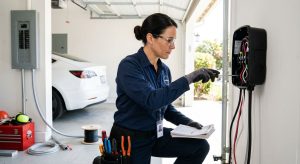
An electrical panel upgrade for EV charger Irvine homeowners ask about most often comes up the same way every time: someone buys an EV, calls an electrician to install a Level 2 charger, and learns mid-conversation that the garage circuit they had in mind depends on how much spare capacity their panel actually has left. That single question, spare capacity or not, decides whether the project is a same-day install or a bigger job involving new panel hardware.
Our electricians serving Irvine field this question constantly, and Irvine is a useful case study because the city contains two very different electrical realities under one municipal boundary. Planned communities built after 2010, including the Great Park neighborhoods, Portola Springs, and Stonegate, were largely built to a 200-amp standard with real headroom to spare. Meanwhile, Turtle Rock, University Park, and older pockets of Woodbridge date back to the 1970s and 1980s, when 100-amp and 125-amp panels were standard and nobody was planning for a car that plugs into the wall. Neither situation is a problem on its own. The problem is guessing which one applies to your house instead of having it measured.
Why a Level 2 charger changes the math on your panel
A Level 1 charger uses a standard 120-volt outlet and barely registers on a panel’s total load. A Level 2 charger is a different animal entirely. It runs on a dedicated 240-volt circuit and typically draws 32 to 40 amps continuously, which under code means the breaker and wiring serving it need to be sized for 125 percent of that draw, usually landing on a 40 or 50-amp dedicated breaker. That is a meaningful chunk of a 100-amp panel’s total capacity, especially once you add in the air conditioning, an electric range, a pool pump, or a growing number of smart-home devices that Irvine’s newer builds increasingly include standard.
The way an electrician determines whether your panel can absorb that load is a load calculation, not a guess based on the panel’s rated amperage alone. A 100-amp panel that is lightly loaded can sometimes take a Level 2 circuit safely. A 200-amp panel that is already carrying a heat pump, an electric dryer, and a home office’s worth of equipment might have less room than the number on the panel door suggests. This is why a proper in-person assessment, not a phone estimate, is the right first step for anyone in Irvine planning an EV charger installation.
Turtle Rock and University Park: the older-panel reality
Homes in Turtle Rock and University Park were mostly built in the 1970s and 1980s, an era when 100-amp and 125-amp service was the norm and detached or side-entry garages were common. Two things tend to complicate an EV charger installation in these neighborhoods specifically: the panel’s available capacity, and the physical distance between the panel and the garage, which affects conduit runs and labor time. A charger installed thirty feet from the panel, routed through a finished wall, costs more in labor than one installed six feet away in an attached garage, independent of whatever panel work is also required.
If a load calculation shows insufficient spare capacity, the typical path forward is a panel upgrade from 100 or 125 amps to 200 amps. That is not a small project, but it is also not purely an EV-charger expense. A 200-amp panel supports the EV charger, gives headroom for a future heat pump or induction range, and generally satisfies a home inspector or an insurance underwriter who flags an aging panel during a refinance or sale, which is a common trigger point for these upgrades in older Irvine neighborhoods.
Great Park, Portola Springs, and other post-2010 communities
Homes in the newer planned communities on Irvine’s east side tell a different story. California’s Title 24 building energy code has required EV-ready wiring in new single-family construction since 2023, meaning many homes in Great Park neighborhoods like Pavilion Park, Cadence Park, and Beacon Park already have a dedicated 240-volt circuit and an empty breaker slot sitting in the garage, waiting for a charger to be connected. For homeowners in these communities, the job is frequently limited to mounting the charger unit itself and connecting it to existing infrastructure, without any panel work at all.
The gap between these two experiences, essentially a one-day mount-and-connect job on one side of the city and a panel upgrade plus install on the other, is exactly why a generic “how much does an EV charger cost” answer is close to useless for Irvine specifically. The honest answer depends entirely on when and where the house was built.
What a load calculation actually checks
- Total connected load already on the panel, including HVAC, water heating, kitchen appliances, and any existing 240-volt circuits
- Available bus bar space for a new double-pole breaker
- Main breaker rating versus actual continuous demand once the EV circuit is added
- Condition of the panel itself, since some older panels have known reliability issues independent of amperage
That last point matters more than most homeowners expect. During panel inspections, electricians commonly find double-tapped breakers where two wires were terminated under a single screw, a shortcut some prior owner or contractor took when adding a circuit without expanding the panel. It is a widespread issue in older homes and it is exactly the kind of finding that turns a simple “add an EV circuit” conversation into a broader panel-safety conversation, which is worth knowing before you budget for the project.
What the work actually costs in Irvine
For homes with adequate spare capacity, a straightforward EV charger installation, including the charger unit, permit, and electrician labor, generally runs in the low thousands of dollars depending on charger brand and conduit distance. Add a full electrical panel upgrade from 100 to 200 amps, which is the scenario many Turtle Rock and University Park homeowners are quoted, and the total project cost increases substantially because you are now paying for new panel hardware, a service disconnect, additional permit fees, and a longer job.
The 2026 National Electrical Code adds one more consideration worth knowing about upfront: it now requires the service disconnect for one- and two-family dwellings to be located outside the building. That requirement is triggered specifically when the service panel itself is replaced, not when only the meter or riser is touched, so a full panel upgrade in Irvine may now include adding or relocating an outdoor disconnect labeled for first responders. It is a modest add to the scope, but it belongs in the estimate rather than showing up as a surprise on the invoice.
One detail that catches many Turtle Rock and University Park homeowners by surprise, in a good way, is the City of Irvine’s One Irvine permit-fee holiday, which waives certain permit fees for sustainability upgrades, including EV charger installations, on homes built before 1980. That fee waiver stacks with whatever utility rebate applies, so it is worth asking about specifically rather than assuming standard permit pricing applies.
Whichever side of that chart your home falls on, the installation itself should always go through the City of Irvine’s Community Development permit process. Skipping the permit is one of the more common shortcuts homeowners are tempted by, usually to save time, and it is also one of the more expensive mistakes to unwind later if the work needs to be inspected retroactively during a home sale.
The SCE Charge Ready Home rebate, and what it actually covers
Irvine sits within Southern California Edison’s service territory, and SCE’s Charge Ready Home program offers eligible, income-qualified, single-family homeowners a rebate of up to $4,200 toward the cost of the panel upgrade required to support a Level 2 EV charger. This is specifically aimed at the panel-upgrade portion of the project, which is good news for Turtle Rock and University Park homeowners who are more likely to need that work in the first place.
Rebate programs like this change terms, funding levels, and eligibility criteria over time, so treat any dollar figure as informational rather than guaranteed, and confirm current details directly with SCE before finalizing a budget. It is also worth knowing that the federal 30C tax credit that once applied to home EV charging equipment expired for new installations after June 30, 2026, so it is no longer part of the savings picture for anyone starting a project now. The SCE utility rebate is the incentive that is still live and worth checking eligibility for.
“The number on the panel door tells you what it was rated for on day one, not what it can safely handle today. That’s why we run the actual load calculation before quoting anything, so the homeowner isn’t guessing and we aren’t either.”
– Sako, Blue Moon Electrical
What to ask an electrician before you commit
A homeowner evaluating quotes for an EV charger installation in Irvine should expect the electrician to walk the panel in person, not estimate from a phone description. A few questions separate a thorough quote from a rushed one: What is the current total load on the panel, and how was it calculated? If a panel upgrade is recommended, is it because of the EV circuit specifically, or because the panel has other issues that should be addressed regardless? Will the SCE Charge Ready Home rebate apply to this specific scope of work, and who handles the paperwork? Is the City of Irvine permit included in the quoted price, and will the electrician be present for the inspection?
Those questions also tend to surface whether a panel actually needs full replacement or whether a smaller intervention, like a subpanel or a load-management device that shares capacity between circuits, could get the same result at lower cost. Neither approach is universally right; the correct answer depends on the specific panel, the specific home, and how much future electrical demand the homeowner realistically expects.
Permits, inspection, and why they are not optional
Every EV charger installation and every panel upgrade in Irvine requires a permit through the city’s Building & Safety Division, along with a corresponding inspection once the work is complete. This is not a formality. It protects the homeowner directly: an uninspected panel upgrade can complicate a future home sale, can be flagged by a buyer’s inspector, and in some cases can affect insurance coverage if a claim is ever filed involving the electrical system. Licensed, permitted work with a documented inspection is the version of this project that holds up when it matters.
It is also worth confirming that any electrician performing panel work in California holds an active C-10 electrical contractor license, which can be verified directly through the California Contractors State License Board. This single check takes a few minutes and avoids the far more common and far more expensive problem of unlicensed panel work that later needs to be redone by a licensed contractor before a permit will even be issued.
Woodbridge is a useful middle example between the two extremes described above. Parts of the neighborhood date to the early 1980s with original 100-amp service, while other sections were remodeled or partially rewired over the decades, meaning panel condition varies block to block rather than following a single neighborhood-wide rule. This is another reason a blanket assumption based on zip code or build year is less reliable than an actual on-site assessment. Two homes built the same year on the same street can have meaningfully different spare capacity depending on what electrical work, if any, was done in the decades since.
NFPA research on home electrical fires helps explain why electricians take panel condition seriously even outside the EV conversation specifically, attributing tens of thousands of home structure fires each year to electrical failure or malfunction, with wiring and panel-related equipment among the most frequently involved components. That context does not mean an EV charger makes a home more dangerous. It means that adding a new 240-volt circuit to a panel is a reasonable moment to have the whole panel evaluated, not just the specific breaker slot the new circuit will occupy.
Planning ahead, even if you are not ready for an EV yet
For Irvine homeowners who are not buying an EV this year but expect to eventually, there is a reasonable middle path: have the load calculation and panel assessment done now, while there is no time pressure, rather than waiting until a car is already in the driveway and the charger installation becomes urgent. A panel that is upgraded proactively, on a homeowner’s own timeline, tends to go more smoothly and often costs less overall than the same upgrade done under pressure with a car that needs to be charged that week.
If your Irvine home falls into either category, an older panel that has not been assessed in years or a newer home where you are simply not sure what is already wired into the garage, the right next step is the same either way: a licensed electrician performing an actual load calculation on your specific panel, not a general estimate based on your home’s age or square footage. That is the only way to know, with certainty, what your electrical panel upgrade for EV charger Irvine project actually requires before a single wire is touched.