An electrical panel for a home recording studio has to carry a different load than the panel that came with the house, and in Culver City that gap shows up more often than in most cities its size. Between the bungalows of Carlson Park and Sunkist Park and the studio-adjacent offices downtown, a lot of homes here are doing double duty as a residence and a small production business, and the electrical system was almost never built with that second job in mind.
Culver City’s identity as a media and production town is not incidental to this. When Metro-Goldwyn-Mayer and, later, Sony Pictures anchored the local economy, they brought decades of freelance editors, sound engineers, colorists, and independent producers who now work from home offices, garages, and converted bedrooms. A laptop and a monitor barely register on a circuit. A treated recording room with an audio interface, a couple of studio monitors, outboard preamps, a small server, and a window-unit AC running to keep the gear cool is a different story entirely.
What Makes Culver City Home Studios Different
Most residential circuits were sized around lighting, a refrigerator, a TV, and maybe a window AC unit. A production space adds continuous, simultaneous draw: computers and displays that never really turn off, studio monitors and amplifiers, outboard gear with its own transformers, and often a portable AC or mini-split because heat-sensitive gear and a warm California afternoon don’t mix. None of these draws are huge on their own, but they add up, and they add up on top of whatever else the house is already running.
The building stock compounds the problem. Culver City pairs 1940s and 1950s bungalows with newer lofts and condos, and the older half of that mix frequently still has the panel that came with the original construction or a modest upgrade from decades ago. A panel that was adequate for a 1948 bungalow with a window unit and a radio is not automatically adequate for that same bungalow with a home studio built into the second bedroom.
How Much Power Does a Home Studio Actually Use
In practice, a modest home studio setup, an audio interface, two or three powered monitors, a computer, a couple of outboard units, and task lighting, draws somewhere in the range of a large kitchen appliance running continuously rather than intermittently. That is manageable on a single dedicated 15 or 20-amp circuit in most cases. The complications start when the studio grows: a second monitor pair for surround work, a rack of outboard gear each with its own power supply, a portable AC unit to keep temperature-sensitive equipment stable, and visiting musicians who bring their own amplifiers and expect an outlet that won’t trip when everyone plugs in at once.
- Computer, monitor, and interface: a small, steady draw, but it runs for hours at a stretch
- Studio monitors and any power amp: bigger draw at volume than most people expect
- Portable or mini-split AC for gear cooling: one of the largest single loads in the room
- Outboard gear, mixers, and lighting: individually small, collectively significant
- Visiting equipment (amps, keyboards, extra monitors): unpredictable spikes on show or session days
None of that is dangerous by itself. It becomes a problem when it all lands on the same 15-amp circuit that also feeds the hallway lights and a couple of bedroom outlets, which is exactly how a lot of these rooms were wired before anyone thought to convert them.
Warning Signs Your Current Panel Can’t Keep Up
A breaker that trips every time the AC kicks on with the gear running is not a nuisance to work around, it is the panel telling you the circuit is doing more than it was built to do. Flickering lights when equipment powers on, warm outlets or switch plates near the studio, and a persistent low hum in audio gear that seems to track with what else is running in the house are all signs the circuit is being asked to do too much. This isn’t a minor concern: NFPA research on home electrical fires found that electrical distribution and lighting equipment caused an estimated 30,740 home fires a year between 2016 and 2020, with wiring and related equipment behind the majority of those. In an older Culver City bungalow, any of these signs alongside two-prong ungrounded outlets is worth a licensed electrician’s attention regardless of the studio question, since ungrounded circuits predate 1960s grounding requirements and carry their own separate risk.
A related pattern the U.S. Fire Administration’s data on residential electrical fires highlights is that these fires most often start in bedrooms, attics, and concealed wall spaces, exactly the areas a converted second bedroom or garage studio routes new wiring through, which is one more reason to have that wiring done and inspected properly rather than added piecemeal.
Subpanels vs a Full Service Upgrade
Not every home studio needs a full service upgrade. If the main panel has room, both physical breaker space and enough spare amperage, a dedicated subpanel serving just the studio room is often the more targeted, less disruptive answer. A subpanel isolates the studio’s circuits from the rest of the house, which also has a side benefit for audio quality: dedicated circuits reduce the chance of picking up electrical noise from a refrigerator compressor or an AC unit cycling on the same line as sensitive audio gear.
A full electrical panel upgrade becomes the right call when the existing service is already maxed out by the rest of the house, when the panel itself is outdated or undersized (a common finding in Culver City’s older bungalows), or when the studio build is happening alongside other additions like an EV charger or a converted garage unit. Moving from a 100-amp to a 200-amp service also happens to be the minimum capacity federal guidance requires for a panel to qualify under the 25C federal electrical panel tax credit, which is worth checking if the upgrade is happening alongside other electrification work.
EV Chargers and Other Shared Loads in Live/Work Spaces
A lot of Culver City’s live/work properties are adding a home studio and an EV charger around the same time, since both tend to come up when a homeowner starts thinking seriously about the garage. California has actively pushed to make that pairing easier on the permitting side: state law under Assembly Bill 1236 and Assembly Bill 970 requires every California city, Culver City included, to offer an expedited permitting process for EV charging stations. That doesn’t remove the electrical question, though. Whether a home studio and an EV charger can share the same panel comfortably still comes down to a load calculation, since a Level 2 charger is one of the larger continuous draws a home panel handles.
Grounding, Dedicated Circuits, and Noise Control
Beyond raw capacity, a studio build is a good moment to fix grounding issues that have nothing to do with the gear itself but affect it directly. An ungrounded or poorly grounded circuit can introduce hum and noise into audio equipment long before it trips a breaker or causes a visible problem. Dedicated 20-amp circuits, wired with a clean, independent ground path, are the standard recommendation for a serious home studio room, separate from general household circuits that also feed lighting or other appliances.
This is also where a licensed electrician catches problems that predate the studio project entirely. GFCI protection requirements apply to specific wet-area locations, not typically the studio room itself, but a whole-panel inspection during this kind of project regularly turns up double-tapped breakers or reverse-polarity outlets left over from a previous owner’s DIY work, issues worth fixing regardless of the studio.
Culver City Permits and Production-Space Considerations
New circuits and any subpanel or service work require a permit through the City of Culver City, and a licensed electrician handles that filing and schedules the inspection. For properties that combine residential and any commercial or tenant-facing production use, such as a converted garage that doubles as a rental edit bay, it’s worth confirming with the city whether the space’s use classification affects the permitting path before work begins. Getting this step right up front avoids a stalled inspection later.
| Equipment | Typical Circuit Need |
|---|---|
| Computer, monitor, audio interface | Shares a standard 15A circuit comfortably |
| Studio monitors + small power amp | Benefits from a dedicated 15-20A circuit |
| Portable AC or mini-split for gear cooling | Often needs its own dedicated 20A circuit |
| Outboard rack gear (preamps, compressors) | Adds steady load to whatever circuit it shares |
| Visiting musician amps/keyboards | Unpredictable spikes; a spare circuit avoids trips |
What a Licensed Electrician Checks Before You Build
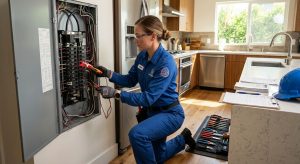
Before any wiring goes in, a proper assessment starts with the panel itself: is it a 100-amp or 200-amp service, how many open breaker slots remain, and what is the rest of the house already drawing. This matters more every year: the California Energy Commission’s most recent quarterly data shows electric vehicles alone accounting for 16.6% of new car sales statewide, and a garage studio build is exactly the kind of project where an EV charger tends to get added at the same time. From there, a load calculation accounts for the studio’s planned equipment plus headroom for what gets added later, because very few home studios stay exactly the size they started at. Subpanel installation is priced and scoped separately from a full panel swap, and an honest assessment should tell you plainly which one the house actually needs rather than defaulting to the bigger, more expensive option.
A thorough assessment goes beyond just counting amps, too. In practice, a panel that’s been touched by a prior owner or a previous contractor often turns up a few issues that have nothing to do with the studio project but are worth fixing while the panel is open anyway: double-tapped breakers, where two wires were landed under a single screw meant for one, mislabeled circuits left over from an earlier remodel, or a missing bonding screw connecting the neutral bus to the cabinet, a serious omission that breaks the fault-current path. None of these are studio-specific, but a garage or bedroom conversion is a natural point to catch them, since the electrician is already in the panel evaluating capacity.
Wire gauge is another thing worth confirming rather than assuming. A 20-amp circuit needs 12-gauge wire at minimum; running 14-gauge wire on a 20-amp breaker lets more current flow than the wire is rated to carry safely, and it’s a mismatch that isn’t always obvious without checking. For a studio room where outboard gear and a portable AC unit might all land on the same new circuit, getting the wire gauge and breaker rating matched correctly the first time matters more than it would on a lightly loaded closet outlet.
2026 Code Considerations for Studio and Garage Conversions
A few code changes are worth knowing about if the studio build coincides with a broader panel or service project. If the work touches the service panel itself, rather than just adding a downstream circuit, the 2026 National Electrical Code requires an outdoor “Emergency Disconnect,” clearly marked, so first responders can shut off power from outside the building. This doesn’t apply to every studio circuit addition, but it’s a real cost consideration if the project also involves a panel swap.
EV charging circuits are also affected by a newer high-frequency GFCI requirement taking effect for outdoor equipment in 2026, since inverter-based EV charging can create leakage current that trips a traditional GFCI even when nothing is actually wrong. If the studio project and an EV charger installation are happening together, it’s worth confirming the charger’s GFCI protection is rated for that kind of load rather than assuming any GFCI breaker will do.
“In older Culver City bungalows we still find a lot of two-prong outlets and panels that were never meant to run continuous equipment. Before we talk about adding studio circuits, we check whether the existing system is even sound.”
– Razmik, Blue Moon Electrical
Cost Factors for Culver City Studio Electrical Work
Dedicated circuit additions on an existing panel with available capacity are the least expensive path, generally a matter of running new wire, a new breaker, and grounded outlets to the studio room. A subpanel adds cost for the subpanel enclosure, feeder wiring, and its own set of breakers, but keeps the project contained to the studio rather than touching the home’s main service. A full service upgrade from 100 amps to 200 amps is the most involved option, since it touches the meter, the service entrance conductors, and often triggers a permit and utility coordination step, but it is also the option that future-proofs the whole property, not just the room you’re building today.
Whichever path fits, a home studio in Culver City deserves electrical work planned around how the room will actually be used, not a generic bedroom-outlet standard. Getting the load calculation, grounding, and permit right the first time means fewer surprises once the gear is set up and a session is underway.
If you’re planning a studio build, a garage conversion, or just want a straight answer on whether your current panel can handle it, Blue Moon Electrical’s Culver City electricians can walk the property, run the load calculation, and lay out the options plainly before any wiring starts.