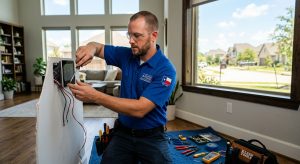
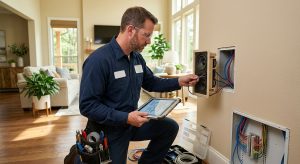
Salt air corrosion in Huntington Beach doesn’t announce itself. It works quietly on metal, moisture, and time, and by the time a homeowner notices something is wrong, the damage is often already inside the panel or behind an outlet cover. Living this close to the Pacific has real perks, but it also means the electrical system in your home is fighting a slower, steadier battle than homes even a few miles inland.
Most homeowners think about salt air in terms of what they can see: a rusty patio railing, a faded car finish, a screen door hinge that seizes up faster than it should. Electrical hardware is exposed to the exact same air, but it’s often mounted where nobody looks closely, on the side of the house, behind a meter, or tucked into an outdoor junction box. That out-of-sight placement is part of why electrical corrosion tends to get discovered late, after it’s already affected how a circuit performs rather than while it’s still cosmetic.
Why Coastal Air Is Harder on Electrical Systems
Ocean air carries fine salt particles that settle on every exposed metal surface, including the ones you never look at: panel screws, breaker terminals, outdoor outlet contacts, and junction box hardware. Combined with the Southern California marine layer’s humidity, that salt becomes a mild electrolyte film on metal, which speeds up oxidation far faster than it would happen inland.
Corrosion isn’t a cosmetic problem. According to research backed by the U.S. Federal Highway Administration and NACE International (now AMPP), corrosion costs the U.S. economy well over a couple hundred billion dollars a year, and coastal environments are consistently identified as some of the most aggressive settings for it (NACE/AMPP Cost of Corrosion Study). Electrical hardware is not exempt from that math. A connection that would last decades in Riverside can show real pitting and resistance buildup in Huntington Beach in a fraction of the time.
Where Corrosion Shows Up First in a Huntington Beach Home
Corrosion doesn’t hit every part of your electrical system equally. In our experience working on homes throughout Huntington Beach, a handful of spots consistently show wear first:
- Outdoor GFCI outlets, especially ones near a patio, pool, or anything within reach of onshore wind
- The main panel, if it’s mounted on an exterior wall facing the prevailing sea breeze
- Exterior light fixture connections and any junction boxes mounted outside
- Metal conduit and unpainted hardware around detached garages or driveway EV charging setups
- Dock, shore power, and boat lift equipment for Huntington Harbour properties
Inland tract homes built during Huntington Beach’s big 1960s and 1970s growth boom have their own separate issue: aging wiring and panels that were never designed for today’s electrical loads. Add coastal humidity into that mix, even for homes a couple of miles from the water, and you get two problems compounding each other instead of one.
Warning Signs of Salt Air Corrosion You Can Check Yourself
You don’t need to be an electrician to catch the early signs of salt air corrosion Huntington Beach homes commonly develop. Walk around your property and look for these before they turn into a bigger repair:
- A white, chalky, or greenish residue on outdoor outlet covers or panel hardware
- An outdoor GFCI outlet that won’t reset, or one that trips for no obvious reason
- Discoloration, rust streaks, or a rough “crunchy” texture on exposed screws and breaker terminals
- An outlet or switch that feels warm to the touch during normal use
- Visible pitting on the metal panel door, hinges, or the disconnect box outside
Any one of these on its own might seem minor. Together, or repeated, they’re usually a sign that moisture and salt have already found their way past the enclosure and are working on the metal underneath. A failing outdoor GFCI is one of the more common calls we get from Huntington Beach homeowners, and in most cases a straightforward GFCI outlet installation paired with a look at the wiring behind it resolves the issue for good.
Why GFCIs Fail Faster Near the Beach
Ground fault circuit interrupters are one of the most important safety devices in your home, and they’re also one of the first things salt air takes a toll on. A 2001 U.S. Consumer Product Safety Commission staff review of GFCI field failures specifically named corrosion from weather-related dampness, alongside power surges, as leading causes of GFCIs going bad in the field (CPSC GFCI Engineering Staff Position Paper). That’s exactly the environment Huntington Beach’s coastal outlets sit in every single day.
This matters because GFCI protection is not optional for outdoor circuits. The 2020 National Electrical Code expanded Section 210.8(F) to require GFCI protection on essentially all outdoor outlets at dwellings, not just the plug-in receptacles homeowners think of (NEC 210.8 GFCI Requirements, EC&M). A GFCI that’s silently failed from corrosion isn’t just an inconvenience. It’s a safety device that may no longer be doing its job in exactly the wet, high-traffic outdoor areas where it matters most.
Ground fault protection itself has an impressive track record: the Electrical Safety Foundation International notes that GFCI adoption has meaningfully reduced home electrocutions since the devices became widespread, and roughly half of American homes were built before GFCIs were standard equipment (ESFI, GFCI History and Statistics). A device that’s protected people for fifty years is worth keeping in working order, especially somewhere like Huntington Beach where the environment works against it daily.
That checklist is meant as a starting point, not a full diagnosis. Once you see two or more of these signs together, or anything at the more urgent end of the list, it’s time to bring in someone who can open the panel safely and look at what salt and moisture have actually done to the connections inside.
Downtown, Huntington Harbour, and Inland Tract Homes Face Different Risks
Not every part of Huntington Beach ages the same way electrically. Homes downtown and along the beachfront corridor take the most direct hit from onshore wind and salt spray, and anything outdoors there should be treated as high-exposure. Huntington Harbour adds a second layer: dock equipment, shore power connections, and boat lift motors sit even closer to saltwater and need marine-rated components, not standard residential hardware.
Move a few miles inland toward the neighborhoods built out east of Beach Boulevard during the 1960s and 1970s boom, and the primary issue shifts. Salt air is still present, just less aggressive, but these homes are more likely to be running on original panels and wiring that predate modern code. That combination, aging equipment plus a coastal climate, is exactly why a whole-panel evaluation makes more sense than patching one outlet at a time.
There’s also a seasonal pattern worth knowing about. Corrosion accelerates during the marine layer season, roughly late spring through early fall, when the coastal fog rolls in overnight and burns off by midday. That daily cycle of dampness and drying is actually harder on exposed metal than a steady, constant humidity would be, because the repeated wet-dry cycling keeps refreshing the electrolyte film on any unprotected surface. Homeowners in the flatter neighborhoods closer to Pacific Coast Highway tend to notice outdoor outlet issues cluster in these months, while homes further from the coast see a slower, steadier rate of wear year-round.
What a Professional Inspection Catches That You Can’t See
A visual walk-around only tells part of the story. Corrosion frequently starts inside a connection point long before it’s visible on the surface, which is part of why electrical fires involving distribution equipment and wiring remain a leading cause of home fires nationally, according to the National Fire Protection Association (NFPA Home Electrical Fires Report).
A proper electrical safety inspection includes opening the panel cover, checking breaker and neutral bus connections for pitting or looseness, and testing outdoor GFCI protection at every outlet, not just the ones that are easy to reach. Any electrician doing this work in California is required to hold a C-10 license through the Contractors State License Board, which is worth confirming before letting anyone open your panel (California C-10 Electrical Contractor License Requirements).
“If an outdoor GFCI near the beach won’t reset anymore, don’t just swap it out and move on. Corrosion at the terminal behind it can keep spreading, and a new device on top of a bad connection just delays the same problem.”
â Victor, Blue Moon Electrical
Marine-Grade Upgrades Worth Considering
For homes with direct beach or harbour exposure, standard residential-grade hardware often isn’t the right long-term fix. A few upgrades consistently hold up better in Huntington Beach’s environment:
- Weather-resistant, in-use covers on every outdoor receptacle, not just the ones exposed to direct rain
- Stainless steel screws and hardware on outdoor panels and disconnects instead of standard zinc-plated fasteners
- Sealed, gasketed panel enclosures for anything mounted on an exterior wall facing the water
- Routine replacement of outdoor GFCI devices on a shorter cycle than an inland home would need
None of these upgrades are exotic or unusually expensive, but they do require an electrician who’s specifically thinking about coastal exposure rather than applying a one-size-fits-all standard meant for an inland climate. A standard-grade panel installed by someone unfamiliar with the coastal environment may look fine on day one and start showing the same corrosion pattern within a few years, essentially repeating the original problem with new hardware.
Planning an EV Charger or Panel Upgrade Around Corrosion
Huntington Beach homeowners adding an EV charger, upgrading a panel, or adding outdoor lighting have a good opportunity to address corrosion risk proactively instead of reactively. Any time a panel is opened for other work, it costs very little extra to swap corroded hardware, add weather-resistant covers, or move a planned outdoor circuit to a more sheltered location on the house.
This is especially worth raising if you’re planning a garage or driveway EV charger installation. That circuit typically runs from the main panel to an outdoor or garage-mounted location, which means it passes through exactly the connection points most exposed to coastal air. Having an electrician evaluate panel and hardware condition as part of that install, rather than treating it as a separate errand later, saves a second service call down the road.
The same logic applies to an electrical panel upgrade. If your home is still running its original panel from the 1960s or 1970s building boom, replacing it is also the ideal moment to install corrosion-resistant hardware throughout, rather than putting a new panel behind an old, already-compromised outdoor disconnect or meter enclosure. Outdoor and landscape lighting circuits deserve the same attention; if you’re adding new fixtures along a walkway or patio, ask your electrician about outdoor lighting installation rated specifically for coastal exposure rather than standard fixtures.
Homeowners nearby dealing with plumbing issues on the same coastal-exposure timeline, corroded shut-off valves, aging fixtures, and worn seals, will recognize the pattern. If you need that side handled too, Santa Ana plumbing services cover the surrounding Orange County coastal cities including Huntington Beach.
How Often a Coastal Home Should Be Inspected
For beachfront and Huntington Harbour properties, an annual electrical safety inspection is a reasonable baseline, with a closer look at outdoor GFCIs and panel hardware anytime you notice one of the warning signs above. Inland tract homes can typically stretch that to every two to three years, unless the home still has its original 1960s or 1970s panel, in which case it’s worth treating the panel itself as the priority, not just the corrosion around it.
Homeowners considering an EV charger, a panel upgrade, or new outdoor lighting should fold a corrosion check into that project rather than treating it separately. It’s a lot easier to address pitted hardware while a panel is already open for other work than to schedule a second visit later.
If you’re noticing any of these warning signs on your property in Huntington Beach, it’s worth having a licensed electrician take a real look before a minor corrosion issue turns into a bigger repair. Blue Moon Electrical serves homeowners throughout Huntington Beach, from beachfront properties to the inland neighborhoods east of Beach Boulevard, with inspections built around exactly this kind of coastal wear.