EV charger rebates and installation cost in Thousand Oaks are usually researched in the wrong order. Most homeowners get a quote first, then go looking for rebates afterward, when the more useful approach is to check what you actually qualify for before the electrician shows up, since some incentives require enrollment or reservation before the work is done.
Thousand Oaks has one of the higher rates of EV adoption in Ventura County, and the city’s public charging network reflects that, but home charging is still where most owners do the bulk of their charging. The real planning question is not just what a Level 2 charger costs to install, it is what your existing panel can support and which rebates actually apply to your situation.
Level 1 vs. Level 2 Charging
Every EV ships with a Level 1 cable that plugs into a standard 120-volt household outlet. It works, but it is slow, typically adding only 3 to 5 miles of range per hour, which is fine for very light daily driving and frustrating for almost everyone else. Level 2 charging runs on a dedicated 240-volt circuit and delivers a meaningfully faster charge, which is why nearly every home EV charger installation in Thousand Oaks is a Level 2 conversation from the start.
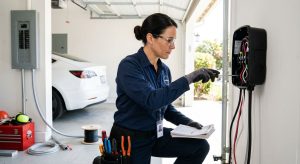
Because Level 2 charging requires a 240-volt circuit run to the garage or driveway, the installation is really an electrical project first and a charger installation second. That distinction matters when you are comparing quotes, since the bulk of the cost and the labor is in running that circuit safely and correctly, not in the charger hardware itself.
What Drives EV Charger Installation Cost
- Distance from the panel. A garage right next to the electrical panel is a much shorter, cheaper run than a detached garage or a driveway on the far side of the house.
- Panel capacity. If your existing panel does not have room for a new 240-volt circuit at the amperage the charger needs, a panel upgrade becomes part of the project.
- Permit requirements. Thousand Oaks requires a permit and inspection for EV charger circuits, which is a real cost and timeline factor, not paperwork you can skip.
- Charger hardware. Basic Level 2 units cost less than smart chargers with app connectivity, load management, or multiple charging profiles.
Many Thousand Oaks homes built in the 1970s and 1980s carry panels in the 100 to 150 amp range, which can be tight once central air conditioning, a full kitchen, and a Level 2 charger are all drawing from the same service. That is the scenario where a panel upgrade gets folded into the EV charger project rather than being a separate job down the road.
Current Rebates That Actually Apply to Home Charging
This is where most homeowners lose time chasing programs that do not actually apply to a straightforward home Level 2 install. Here is what is genuinely relevant for a Thousand Oaks homeowner adding home charging, as of this writing:
SCE Charge Ready Home Program. Southern California Edison’s Charge Ready Home program provides eligible residential customers rebates toward the cost of an electrical panel upgrade when that upgrade supports a home EV charger, according to SCE’s official program page. This is specifically a panel-upgrade rebate tied to EV charging, not a rebate on the charger hardware itself, and eligibility and reserved funding change over time, so confirming current status before starting work is worthwhile.
Federal home charger tax credit. A federal tax credit has historically covered a percentage of home EV charging equipment and installation costs, with a cap per installation. Availability and expiration dates for this credit change based on federal policy, so this is one to verify directly rather than assume is active at the time you file.
California Clean Vehicle Rebate Project and related state programs. These primarily apply to the vehicle purchase or lease rather than the home charger installation, but they are frequently confused with home-charging-specific programs, which is worth untangling before you budget.
Programs like these change eligibility criteria and funding levels regularly, and none of them guarantee a specific dollar amount for every household. The most reliable way to know what you qualify for is to check the current program page directly or ask your electrician to help confirm eligibility as part of the quote process, before committing to a scope of work.
General Process for Applying Rebates to a Home EV Charger Project
General sequence only; each program sets its own specific requirements and timelines.
Signs Your Panel May Not Be Ready for a Charger
- Your panel is original to the home and the home was built before 1990.
- You already experience occasional breaker trips when running AC and other large appliances together.
- Your panel is rated 100 amps or less and you also run central air conditioning, an electric range, and multiple large appliances.
- There is no open breaker slot available, or the panel is already at a busbar’s practical limit.
- A previous electrician or home inspector has already flagged the panel as undersized.
Any one of these on its own does not automatically mean you need a panel upgrade, but it does mean a load calculation should happen before, not after, you commit to a charger purchase. This is a quick assessment for a licensed electrician and it is the single best way to avoid discovering mid-installation that the scope just doubled.
How Charging Speed Actually Plays Out
Most Level 2 home chargers add somewhere in the range of 20 to 30 miles of range per hour, though the exact number depends on the charger’s amperage rating and your vehicle’s onboard charger capacity. For most households, an overnight charge on Level 2 fully replenishes a typical day’s driving many times over, which is why speed beyond Level 2 rarely matters for home charging. DC fast charging, the kind you see at public stations, is not something residential electrical service supports, and is not a realistic or necessary target for a home installation.
This matters for cost planning because there is little practical benefit to overspending on a higher-amperage circuit than your vehicle can actually use. Your electrician should size the circuit to match your vehicle’s onboard charger rating plus reasonable headroom for a future vehicle, not to the maximum the panel could theoretically support.
Choosing Between a Basic and a Smart Charger
Basic Level 2 chargers are simple, reliable, and typically the lower-cost hardware option. Smart chargers add app-based monitoring, scheduled charging to take advantage of off-peak utility rates, and in some cases load management that can share capacity with other high-draw circuits in the home. For a household on a time-of-use electricity plan, a smart charger that automatically shifts charging to the cheapest overnight window can offset its higher upfront cost over time, though the payback period depends on your specific utility rate structure and driving habits.
Does Your Panel Need an Upgrade First
This is the single biggest variable in the actual cost of adding EV charging to a Thousand Oaks home. A licensed electrician will check your panel’s total amperage against your existing loads plus the new charger circuit before recommending anything. If there is not enough headroom, the panel upgrade becomes part of the project rather than an optional add-on, and it is worth pricing both together since running a temporary shutoff and pulling permits twice costs more than doing it once.
As our electrician Sako explains it, “The charger is the easy part. What actually decides the price is whether the existing panel has room to add a 40 to 50 amp circuit without tipping the whole system over its rated capacity.”
“Homeowners are often surprised that the charger itself is the cheapest part of the invoice. The labor to safely add a dedicated 240-volt circuit, and to confirm the panel can carry it, is where most of the cost actually lives.”
— Sako, Blue Moon Electrical
What to Expect During Installation
A typical home EV charger installation in Thousand Oaks starts with an electrician assessing your panel and the route from the panel to where the charger will mount. After confirming capacity, they pull the required permit, run the dedicated circuit, mount and wire the charger, and schedule the city inspection. A straightforward install with an adequate panel is often completed in a single visit; a project that also requires a panel upgrade takes longer due to the added scope and utility coordination for the power shutoff.
The 2026 National Electrical Code introduces a requirement that EV charging receptacles be specifically listed and rated for EV charging use, which is a detail worth confirming with your electrician if your installation uses a receptacle-based setup rather than a hardwired charger. Local code adoption and interpretation can vary, so a licensed local electrician is the right person to confirm what applies to your specific installation.
Tesla and Third-Party Chargers
If you drive a Tesla, you have the option of a Tesla Wall Connector or a universal Level 2 charger with the appropriate adapter. Both require the same underlying 240-volt circuit work, so the rebate and panel-capacity considerations above apply either way. The choice mostly comes down to charging speed preferences and whether you expect to charge other EV models at the same location in the future.
Multiple EVs and Future Planning
If your household expects to add a second EV in the next few years, it is worth mentioning that to your electrician during the initial assessment. Some panels can support two dedicated 240-volt circuits with room to spare, while others are already close to capacity with just one. Planning for a second charger circuit now, even if you only install one charger today, can save you from a second permit and inspection cycle later, and it is often only marginally more expensive to rough in the second circuit while the panel and walls are already open.
Comparing Installer Quotes
Because the panel assessment is the variable that most affects price, a phone quote for EV charger installation is only a rough estimate. A reliable quote comes from an in-person or thorough remote assessment of your panel’s current amperage, available breaker space, and the distance from the panel to the charger location. When comparing bids, confirm whether permitting, the load calculation, and any panel work are included, or if they will be billed as separate line items once the electrician sees your actual panel.
Planning Your Installation
If you are considering a home EV charger in Thousand Oaks, the most useful first step is a load assessment that tells you definitively whether your existing panel can support it, and if not, what the combined cost looks like. That number, paired with a clear picture of which rebates you actually qualify for, gives you a realistic budget instead of a rough guess pieced together from national averages.
Blue Moon Electrical’s licensed electricians serve Thousand Oaks homeowners with upfront written pricing after an on-site panel assessment, so you know your real number, including whether a panel upgrade is needed, before any work begins.
Related Electrical Work Worth Considering
Homes adding EV charging often benefit from a look at overall panel health at the same time. If your panel is original to a 1970s or 1980s build, this is a natural point to also address electrical panel upgrades rather than treating the EV circuit as an isolated add-on. It is also a good time to confirm your whole house surge protector installation is in place, since EV charging equipment is sensitive to voltage fluctuations and worth protecting at the panel level.
Whether you are just starting to research costs or ready to schedule an assessment, Blue Moon Electrical’s team can walk through your home’s specific panel and give you a real, written number for your Thousand Oaks, CA EV charger installation.