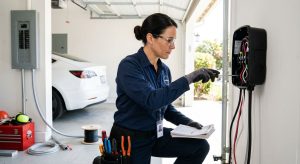
An electrical panel upgrade in Edison, NJ is one of the most impactful home improvement investments available to Middlesex County homeowners — and one of the most commonly deferred. Edison’s housing stock includes a large number of homes built in the 1950s through 1980s, many of which still have 100-amp panels that were adequate for the household demands of that era but are increasingly strained by today’s loads: central air conditioning, electric vehicles, home offices, and smart home technology. This guide explains what a panel upgrade involves in New Jersey specifically, how PSE&G coordination works, what permits are required in Edison, the rebate programs available to NJ homeowners, and what the work costs.
Why Edison Homeowners Are Upgrading Panels Now
Three converging trends are driving panel upgrade demand in Edison right now. First, the EV revolution: Middlesex County has one of the higher EV adoption rates in New Jersey, and homeowners who purchase electric vehicles quickly discover that a Level 2 home charger requires a dedicated 240-volt circuit that many older Edison homes cannot support without a panel upgrade. Second, the home electrification trend: as NJ incentives push homeowners toward heat pumps, induction ranges, and electric water heaters, the electrical load of the average home is increasing substantially. Third, insurance pressure: carriers that insure older Edison homes are increasingly scrutinizing electrical panels and requiring upgrades for properties with Zinsco, Federal Pacific, or other flagged panel brands.
From our service calls across Edison and Middlesex County, roughly 6 in 10 homeowners who call for a panel consultation have at least one of these three drivers behind the request. In many cases, all three apply simultaneously — the EV purchase that triggered the charger inquiry revealed the panel limitation, which in turn triggered an insurance review. The panel upgrade resolves all three in a single project.
100-Amp vs. 200-Amp Service: What the Difference Means
Service ampacity — the rated capacity of your panel — determines the maximum simultaneous electrical load your home can draw from the utility. A 100-amp service panel provides 24,000 watts of capacity (100 amps × 240 volts). A 200-amp panel provides 48,000 watts.
For a modern Edison home with central AC (drawing 15 to 30 amps), a heat pump (20 to 40 amps), an EV charger (30 to 40 amps), kitchen appliances, and the standard household electronics and lighting, the simultaneous demand on a 100-amp service is genuinely constrained. A 200-amp upgrade provides the headroom for all of these loads to run simultaneously without approaching the panel’s limits.
Some larger Edison properties — multi-zone HVAC, pools, extensive workshops, multiple EV chargers — may require 320-amp or 400-amp service. Your licensed electrician performs a load calculation to determine the appropriate service size for your specific property.
“In Edison you see a lot of split-bus panels from the 1970s — they have two main breakers instead of one. Technically legal at the time, but they are often at end of life now and have quirks that make them harder to work with safely. A modern 200-amp single-main replacement clears all of that up.”
— Dikran, Blue Moon Electrical
PSE&G Coordination: How the Utility Fits Into Your Panel Upgrade
In Edison, PSE&G (Public Service Electric and Gas) is the utility serving most residential customers. A panel upgrade that also requires a service entrance upgrade — new meter base, new service entrance cable, or a change in service ampacity — requires coordination with PSE&G before and after the installation.
The typical sequence for a panel upgrade with service upgrade in Edison:
- The licensed electrician pulls the required permits from the Township of Edison’s Building Department.
- The electrician installs the new panel and service entrance components, leaving the meter socket ready for the utility’s inspection.
- The homeowner (or contractor on the homeowner’s behalf) contacts PSE&G to request a meter pull and reconnection.
- PSE&G inspects the service entrance and reconnects the meter.
- The Township of Edison inspector performs the electrical inspection.
This coordination process adds a few days to the total project timeline compared to a panel replacement where the service entrance is not being changed. Your electrician handles most of this coordination — you should not need to navigate the PSE&G process on your own.
Edison NJ Permits for Panel Upgrades
All electrical panel upgrades in Edison require a permit from the Township of Edison’s Building Department, and the work must be inspected by a licensed NJ electrical inspector. New Jersey requires that electrical work be performed by a licensed Electrical Contractor (EC) holding a valid NJ State Electrical Contractor License. The inspector verifies compliance with the NEC as adopted by New Jersey and any state amendments.
Work performed without a permit in Edison is subject to fines and may need to be removed and redone before an after-the-fact permit is granted. More practically, unpermitted electrical work in an Edison home is a disclosure issue in real estate transactions and a potential insurance coverage problem. Blue Moon Electrical handles all permit applications and inspection coordination as part of every Edison panel upgrade.
New Jersey Rebates for Panel Upgrades
New Jersey homeowners have access to several incentive programs for electrical panel upgrades, particularly when the upgrade is connected to electrification goals:
- Federal IRA Rebate: Up to $4,000 for qualifying panel upgrades under the Home Electrification and Appliance Rebates (HEAR) program. Income requirements apply.
- NJ Clean Energy Home Efficiency Program: The New Jersey Board of Public Utilities offers incentives for home energy efficiency improvements that may include panel upgrades as part of electrification projects. Check njcleanenergy.com for current programs.
- PSE&G Energy Efficiency Incentives: PSE&G periodically offers incentives for customers who upgrade electrical infrastructure as part of heat pump or EV charging installations.
Blue Moon Electrical’s rebate assistance team manages documentation and submission for all applicable programs. We ensure that every qualifying project captures the maximum available rebate.
What Does a Panel Upgrade Cost in Edison NJ?
Panel upgrade costs in Edison vary based on the existing service configuration, panel location, and whether a service entrance upgrade is also needed. General ranges for Edison area projects:
- 100-amp to 200-amp panel replacement (same service entrance): $1,800 to $3,500
- 100-amp to 200-amp with service entrance upgrade: $2,500 to $5,000
- 200-amp panel replacement (existing 200-amp service): $1,500 to $2,800
- Panel relocation (moving panel to new location): Add $500 to $2,000 depending on complexity
After federal IRA rebates and applicable NJ program incentives, net costs are significantly lower for qualifying homeowners. Blue Moon Electrical provides detailed written estimates after assessing your specific property. Contact Blue Moon Electrical’s Edison NJ team at your local contact number to schedule an assessment.
Combining Your Panel Upgrade with an EV Charger in Edison
The majority of Edison homeowners who need a panel upgrade are also considering or planning an EV charger installation. Combining both in a single project is the most cost-effective approach — the electrician runs the EV charger circuit during panel installation, the permit covers both, and the inspection covers both in a single visit. The incremental labor cost of adding the EV circuit during a panel replacement is substantially less than scheduling it as a separate project.
For Edison homeowners, Blue Moon Electrical regularly packages panel upgrades and EV charger installations as a single coordinated project, with a single permit application and a single inspection. This approach typically saves $400 to $800 compared to the two projects scheduled separately.
Common Panel Problems Found in Edison Homes
From our panel assessment work in Edison and Middlesex County, these are the conditions we find most frequently in the pre-1985 housing stock:
- Federal Pacific Electric Stab-Lok panels — common in 1960s and 1970s Edison developments, consistently flagged by insurance carriers
- 100-amp services in homes that have been significantly expanded with additions — the original service was adequate for the original footprint but not for the expanded home
- Split-bus panels without a single main breaker — an older panel design that lacks the single disconnect point required by current code for new installations
- Panels with no available spaces for additional circuits — all slots are used, and adding any new circuits (EV charger, HVAC system, workshop circuits) is impossible without a panel upgrade
- Panels with improper breaker types — aftermarket or mismatched breakers installed by previous owners or unlicensed contractors