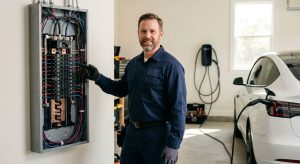
An electrical panel upgrade for a home theater and pool equipment is one of the most common reasons a Beverly Hills homeowner calls an electrician who isn’t dealing with an outage or a tripped breaker. The estate was built decades ago, the panel has been touched once or twice since, and now a home theater build or a new pool is asking the system to do more than it was ever sized for.
This is not a niche problem here. Much of Beverly Hills was built in the 1920s and 1930s, grand Mediterranean estates in the Flats, mid-century homes up in Trousdale, and those houses were wired for a different era of electrical demand, long before air conditioning was standard, let alone a home theater or a pool with its own equipment pad.
Why Beverly Hills Estates Run Out of Capacity
A 1920s or 1930s estate’s original service was sized for lighting, a radio, and maybe a window fan. Central air conditioning alone can use a meaningful share of an older panel’s total capacity. Add a pool, a home theater, and an EV charger in the motor court, each a real, ongoing draw, and it’s easy to see how a panel that felt generous in 1935 runs out of room by today’s standards, even without anyone doing anything unusual. It’s also worth taking seriously rather than deferring: NFPA research found electrical distribution and lighting equipment behind an estimated 30,740 home fires a year from 2016 to 2020, and U.S. Fire Administration data shows those fires concentrate in bedrooms and concealed wall or attic spaces, exactly where an older estate’s original wiring tends to run.
Trousdale’s mid-century homes carry a related but distinct issue: many were built with electrical systems suited to that era’s more modest appliance loads, and decades of incremental additions, a pool here, a remodel there, often left the panel patched rather than properly upgraded.
What a Home Theater Actually Draws
A home theater’s electrical demand is less about any single component and more about how many components run simultaneously, for hours, at a stretch. A projector or large display, an AV receiver, a subwoofer amplifier, and several channels of powered speakers each draw modestly on their own, but together on a single circuit they add up quickly, and a subwoofer amp under load can pull more than people expect. Most home theater installers recommend at least one dedicated 20-amp circuit for the equipment rack, sometimes two, separate from the room’s general lighting and outlet circuits, specifically so the system doesn’t share a line with anything else in the house.
Dedicated Circuits for Pool and Spa Equipment
Pool equipment has its own, separate set of requirements. A standard pool pump runs on a dedicated 240-volt circuit, and a U.S. Consumer Product Safety Commission safety alert has specifically flagged pool and spa electrical equipment, underwater lighting circuits in particular, as an electrocution risk when ground-fault protection isn’t in place. Current code requires GFCI protection on pool pump motors, heaters, and any outlet within 20 feet of the water, and older pools, the kind common on Beverly Hills estates that have had a pool since the 1960s or earlier, are the ones most likely to be missing it.
- Pool pump motor: dedicated 240V circuit, GFCI-protected
- Pool or spa heater: typically its own dedicated circuit
- Home theater equipment rack: one to two dedicated 20A circuits recommended
- EV charger in the motor court or garage: comparable draw to a large dryer
- Central AC and whole-house systems: often the single largest existing load on an older panel
| Amenity | Typical Circuit Need |
|---|---|
| Home theater equipment rack | 1-2 dedicated 20A circuits recommended |
| Pool pump and heater | Dedicated 240V circuit(s), GFCI-protected |
| EV charger in motor court/garage | Comparable draw to a large dryer, for hours |
| Central air conditioning | Often the largest existing load on an older panel |
| Architectural and landscape lighting | Smaller individually, adds up across zones |
Protecting Original Plaster and Millwork During the Work
Running new circuits through a 1920s Mediterranean estate or a Trousdale mid-century home isn’t the same job as wiring new construction. Finished plaster, original millwork, and period details all raise the stakes on how the work gets routed. A licensed electrician experienced with older Beverly Hills homes plans circuit paths that avoid unnecessary demolition, working through existing chases, attics, and crawl spaces where possible, and patching carefully where it isn’t.
This planning step is worth doing before any wiring starts, not as an afterthought once a wall has already been opened. Mapping the route from the panel to the theater room or pool equipment pad against the home’s actual construction, plaster-and-lath walls behave very differently from drywall when it comes to fishing new wire, means fewer surprises and less patchwork repair once the electrical work is finished and the finish trades move back in.
Panel Upgrade vs Subpanel for Additions
Not every addition requires touching the main service. If the existing panel has open capacity and breaker space, a dedicated subpanel for a home theater or a pool equipment pad can be the more contained option, one that doesn’t require a full utility disconnect and reconnect. A full electrical panel upgrade becomes the right call when the existing service is already at its limit, which is common enough on original 1920s and 1930s services that were never meant to carry today’s load. When that upgrade happens, current federal guidance for the 25C electrical panel tax credit sets 200 amps as the minimum capacity a qualifying panel must be able to serve, which is worth checking if the project is part of a larger electrification plan.
GFCI and Safety Requirements Near Pools and Theaters
Beyond the pool-specific GFCI requirements, a whole-panel inspection during this kind of project regularly turns up issues that predate the current project entirely: double-tapped breakers, missing bonding, or outlets that were never properly grounded. A full safety inspection alongside the theater or pool work is a reasonable way to make sure the rest of the panel is sound before adding more load to it.
“On a lot of Beverly Hills estates, the panel has been added to piecemeal for decades, a pool here, a remodel there, and nobody ever stepped back to look at the whole system. Before we add a theater or pool circuit, we check what the panel is already carrying.”
– Dikran, Blue Moon Electrical
What an Older Panel Inspection Typically Finds
On an estate that’s had work done by different contractors across different decades, the panel itself often tells a more complicated story than its amperage rating suggests. Double-tapped breakers, two wires landed under a single screw meant for one, show up often on panels that have had circuits added over the years without ever being formally expanded. It’s a widespread pattern, not a rare defect, and it creates unpredictable protection for both circuits sharing that breaker.
A missing bonding screw, the connection between the neutral bus and the panel cabinet, is a serious but easy-to-miss omission, and it’s one inspectors specifically look for on any panel that’s been replaced or modified rather than installed fresh. Reverse polarity outlets, where the hot and neutral wires were swapped during an earlier remodel, create a shock risk even when a device connected to them is switched off, and they’re a common enough finding that a whole-panel check during a theater or pool project is worth the extra time it takes. Thermal imaging during this kind of inspection can also catch a breaker running hotter than its neighbors, often the first visible sign of a loose connection or an overloaded circuit before it becomes a service call.
None of this is specific to home theaters or pools, but a project that’s already opening up the panel and adding load is the natural point to catch it, rather than treating the new circuits as a standalone addition to a system nobody has actually looked at closely in years.
2026 Code Changes Relevant to This Kind of Project
A few code updates are worth knowing about if the theater or pool project coincides with touching the service panel itself. The 2026 National Electrical Code requires an outdoor “Emergency Disconnect,” clearly marked, on any property where the service panel is being replaced or newly installed, so first responders can cut power from outside the building. This doesn’t apply to a simple downstream circuit addition, but it does apply if the project also involves a full panel swap, and it’s worth pricing in from the start rather than discovering it partway through.
EV charging circuits, relevant if the theater or pool project is happening alongside a motor court charger, are also affected by a newer high-frequency GFCI requirement for outdoor equipment taking effect in 2026. Inverter-based EV charging can create a kind of leakage current that trips a standard GFCI even when the circuit is working correctly, so confirming the charger’s GFCI protection is rated for that specific load matters more than it used to.
Arc flash marking requirements have also expanded under the 2026 code, removing a prior threshold that limited the requirement to larger equipment. This mostly affects commercial and business-triangle properties rather than single-family estates, but any Beverly Hills property with a commercial or tenant-facing component, a converted carriage house used as an office, for instance, should have that question raised during the same assessment. None of these changes should stall a project, but knowing about them before a quote is written avoids a surprise change order once the permit application is already in front of the city.
Permits Through Beverly Hills Building and Safety
Beverly Hills runs its own permitting through Beverly Hills Building and Safety, separate from the county process, and most panel upgrades, new circuits, and service changes require a permit through that office. Scheduling the work around inspections here is its own small art, and a licensed electrician familiar with the city’s process can avoid the back-and-forth that comes from filing it wrong the first time.
Planning the Upgrade Around a Remodel
If a home theater or pool project is part of a larger remodel, the electrical planning goes a lot smoother when it happens alongside the rest of the design rather than after the fact. Coordinating with contractors and designers early means circuit paths, panel location, and any EV charger installation in the motor court can all be planned together, rather than retrofitted around finished work. On the permitting side, state law under Assembly Bill 1236 and Assembly Bill 970 requires Beverly Hills, like every California jurisdiction, to offer an expedited permitting process for EV charging stations specifically.
Sequencing matters more than most homeowners expect. A theater room’s equipment rack and dedicated circuits are far easier to run before walls are finished and millwork is installed, and the same is true of any subpanel feeding a pool equipment pad before hardscape and landscaping close off access. Bringing the electrician in during design, rather than after the contractor has already started framing, is the difference between a clean installation and one that has to work around finished construction.
Cost Factors for Beverly Hills Panel Work
A dedicated subpanel for a home theater or pool equipment pad, added to a panel with available capacity, is the lower-cost path. A full service upgrade on an original 1920s or 1930s system costs more, in part because older service equipment and sometimes original wiring elsewhere in the house need evaluation as part of the same project, and in part because working around finished plaster, millwork, and period details takes more time than the equivalent job in newer construction. Properties in the Flats with mature landscaping and hardscape around the service entrance can also add cost if trenching or access requires extra care to avoid disturbing either one. Still, it’s the option that gives an estate genuine capacity for a theater, a pool, an EV charger, and whatever comes next, rather than solving each addition as a separate, disconnected project every time something new gets added to the property.
If your Beverly Hills estate is planning a home theater, a pool project, or both, Blue Moon Electrical’s Beverly Hills electricians can assess the existing panel and lay out whether a subpanel or a full upgrade fits the project before construction starts, so the electrical plan is settled before the rest of the remodel is underway.