Table of Contents
- The Growing Need for 200-Amp Panel Upgrades for EV Charging
- Electrical Panel Fundamentals: Why 200 Amps Is the Modern Standard
- Panel Upgrade Feasibility and Cost Analysis for EV Owners
- 200-Amp Panel Upgrade for EV Charger: Step‑by‑Step Process and Costs
- Tax Credits, Load Calculations, and Long‑Term Value
- Frequently Asked Questions About Panel Upgrades for EVs
- Start Your EV-Ready Panel Upgrade with Blue Moon Electrical
The Growing Need for 200-Amp Panel Upgrades for EV Charging
The 200-amp panel upgrade for EV charger cost depends on the home’s existing electrical infrastructure, local permit fees, and the project scope, so a firm price can only be given after an on-site inspection by a licensed & insured electrician. As electric vehicles become mainstream, the increased load on residential electrical systems has made the 200-amp panel the modern standard, capable of supporting high-draw appliances alongside EV charging without overloading.
According to Blue Moon Electrical’s panel upgrade guidance, flickering lights and circuit breakers that trip frequently are common indicators that an existing panel is overloaded and due for an upgrade. The industry has moved toward 200-amp service as the gold standard for modern homes, delivering the capacity to run air conditioning, major appliances, and EV chargers at the same time while maintaining safe, reliable power delivery.
Because Santa Barbara’s regulations require a building permit from the local Building and Safety Division, we ensure every installation is permitted and code-compliant. Before delving into these specifics, here’s a brief explanation about how 200 amps have come to be viewed as the bare minimum amperage needed in a modern house and future electricity needs.
Key Takeaways
- A residential electrical panel is the central distribution point that receives incoming power from the utility and routes it through individual circuits to every outlet, appliance, and fixture.
- Upgrading your home’s electrical panel to 200 amps creates the capacity needed for a dedicated Level 2 EV charger, but the feasibility hinges on a systematic load calculation.
- Determining whether your home’s electrical system can support a new EV charger starts with a proper residential electrical load calculation.
- What size electrical panel do I need for an EV charger?
Electrical Panel Fundamentals: Why 200 Amps Is the Modern Standard
A residential electrical panel is the central distribution point that receives incoming power from the utility and routes it through individual circuits to every outlet, appliance, and fixture. As homes incorporate more high-demand equipment—from induction cooktops and heat pumps to Level 2 EV chargers—the panel’s ampacity determines whether the system can support simultaneous loads safely. Blue Moon Electrical confirms that 200-amp service has become the industry gold standard for modern residences, replacing the 100-amp panels installed in homes built before the 1990s.
The original code was written to support a home that had two or three major appliances along with lights and outlets in all the rooms, but now a lot more is plugged into these circuits: central air conditioning, electric dryers, and vehicle charging at night. As part of the change under the 2026 National Electrical Code, load calculations have moved out of Article 220 and into Article 120, lowering the value of general lighting and receptacle load down from 3 VA to 2 VA per square foot. The load simultaneously being put onto a 100-amp panel exceeds its capability to carry all those circuits when they are used together.
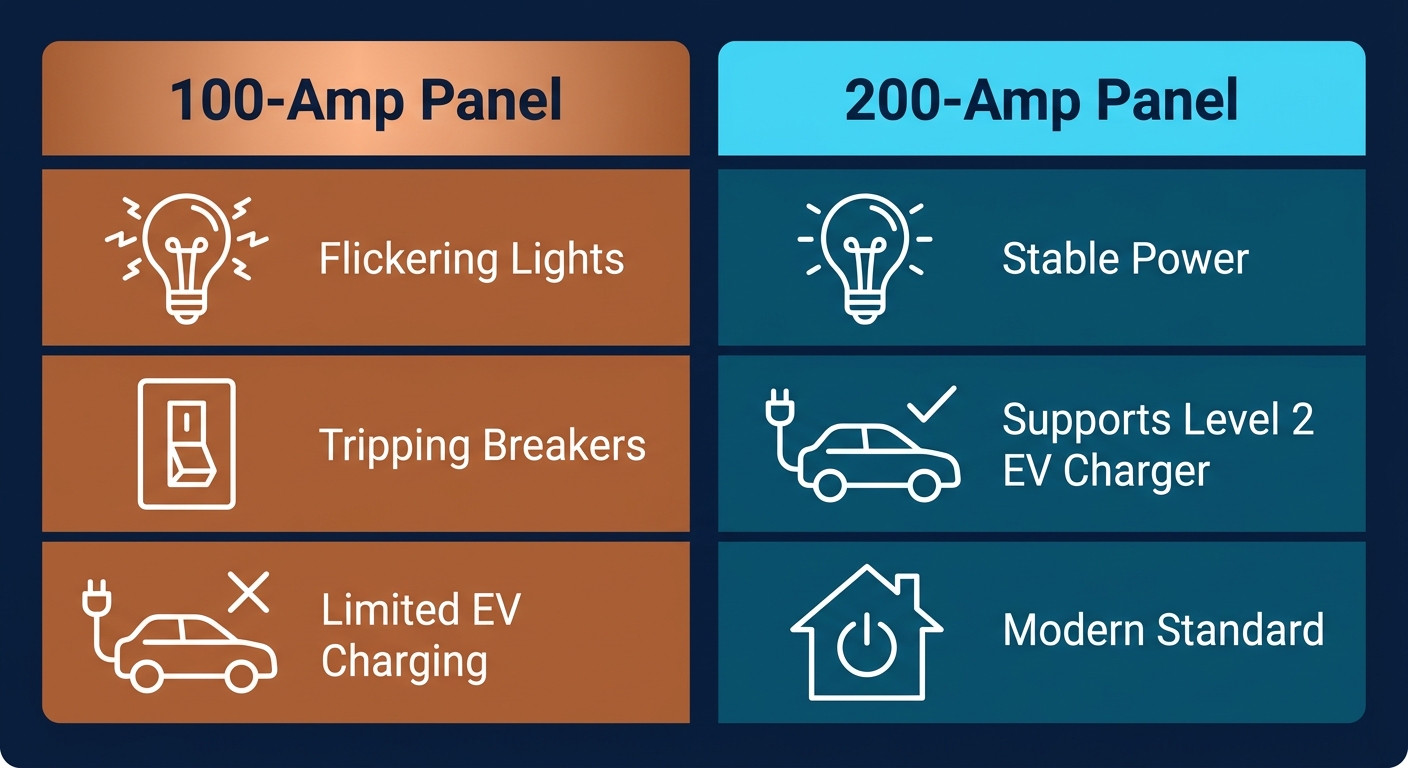
Here is a comparison of some significant attributes that set apart the features of 100-amp and 200-amp panel in household scenarios for EV charger installation.
| Feature | 100-Amp Panel | 200-Amp Panel |
|---|---|---|
| Typical capacity | 19,200–24,000 watts of usable power | 38,400–48,000 watts of usable power |
| EV charger support | May support one Level 1 charger but cannot accommodate a dedicated 50-amp Level 2 circuit without exceeding safe load limits | Easily supports one or more Level 2 EV chargers on dedicated circuits while leaving capacity for major appliances |
| Signs of overload | Flickering lights, frequently tripping breakers, reliance on power strips, warm or buzzing panel surfaces | Rare overload indications under normal residential loads; designed with headroom for future electrical additions |
| Code alignment | May not meet current NEC load calculation requirements for dwellings with EV charging, electric cooking, and electric heating | Aligns with 2026 NEC Article 120 standard method load calculations, typically yielding a recommended service size of 150 amps or greater |
The amount of room in a 200 amp circuit panel is sufficient to accommodate new electric vehicle chargers being installed, provided that other domestic appliances aren’t affected as a result.
Whether an upgrade can be made will depend upon a range of factors, such as the home’s current service size, what the existing wiring looks like and how much work is required to obtain permits for this kind of project.
Panel Upgrade Feasibility and Cost Analysis for EV Owners
Upgrading your home’s electrical panel to 200 amps creates the capacity needed for a dedicated Level 2 EV charger, but the feasibility hinges on a systematic load calculation.
Assessing Your Home’s Electrical Load
According to NEC 2026 Article 120, the total electric demand that your house places on the service is calculated using this method. The process starts by measuring the general illumination load and the receptacle loads at 2 volt-amperes (VA) for each square foot of living area; this figure has been decreased from the 3 VA/square-foot ratio required previously.
Next up come the VA requirements for each small-appliance circuit and laundry circuit (each equals 1,500 VA), as well as the nameplates on all fixed appliances in the home. In the case where there are four or more such appliances in a home, a 75% demand factor can be applied. Any cooking appliance that is rated at 12 kW or lower requires 8,000 VA, whereas a clothes dryer uses the nameplate rating or a 5,000 VA minimum, whichever is higher. The load from any heating/cooling systems will also be calculated according to the largest of the two individual loads, because these systems do not run simultaneously.
After summing these loads and applying the demand factors described in Article 120, a qualified electrician arrives at a total service demand in VA, then divides by 240 volts to find the required ampacity. Adding a Level 2 charger that draws 30 to 48 amps can push the calculated demand past 150 amps, signaling that a 200-amp panel upgrade is necessary. If flickering lights, frequently tripping breakers, or an over-reliance on power strips are already present, the panel is likely overloaded and professional evaluation becomes urgent.
Cost Factors for 200-Amp Panel Upgrades
- Permit and inspection fees: A building permit from the local building department in Santa Barbara is mandatory for any panel upgrade. The permit ensures code compliance with the California Electrical Code and any municipal requirements for grounding and bonding.
- Labor for the panel swap: This covers the removal of the old panel, mounting and wiring the new 200-amp service.
- Materials: The panel itself, main breaker, branch circuit breakers, and all wiring necessary to upgrade the service entrance.
- EV charger unit and installation: When a panel upgrade is bundled with a Level 2 charger installation, this category includes the charger itself, dedicated circuit wiring, and conduit runs.
| Cost Component | Panel Upgrade Only | Panel Upgrade + EV Charger Installation |
|---|---|---|
| Permit and inspection fees | Similar cost | Similar cost |
| Labor for panel upgrade | Included | Included; added labor for charger wiring |
| Materials (panel, breakers, wiring) | Included | Included; plus charger-specific wiring |
| EV charger unit and installation | N/A | Additional cost varies by model and placement |
We provide upfront written pricing after a thorough on-site assessment, so you know exactly what to expect before any work begins. Our licensed and insured electricians handle every permit and inspection, streamlining the process from start to finish.
Knowing the investment helps you plan the timeline and prepare for a seamless transition to faster, safer home charging — and Blue Moon Electrical stands behind every project with our Satisfaction Guaranteed on Every Service.
200-Amp Panel Upgrade for EV Charger: Step-by-Step Process and Costs
Once you have determined that a 200-amp upgrade is feasible for your EV charger, the next step is understanding the process and costs involved. Blue Moon Electrical handles every stage, from permit applications to final inspection, ensuring that your panel upgrade meets all code requirements and supports reliable EV charging.
Permitting and Code Compliance
We manage the entire permitting process for your 200-amp panel upgrade. Our licensed electrician will be pulling the proper permits from whichever city you live in, i.e. The Santa Barbara Building and Safety Division, the Los Angeles Department of Building and Safety, the building offices of Irving, TX or Edison, NJ. We have master electricians who know this stuff and follow the rules from day one. If a permit gets approved, we make sure all the required inspections get scheduled and arrange to have the city inspector look over things during key phases of the project. Because we stand behind our work with a satisfaction guarantee, we never cut corners. Everything, including every connection, bonding jumpers, and labels put inside each box must be done right if it’s going to pass inspection the first time around.
We will break up the whole cost of a main electrical box changeout including all fees and labour for you to have a better idea on what you’re going to be spending money on. By doing that, we take care of getting permits and code compliance ourselves, and we streamline the process and minimize delays related to paperwork and scheduling.
Installation Timeline and Coordination
When our electricians arrive on the scheduled day, we coordinate with the local utility company ahead of time to de-energize the service drop for 30 to 60 minutes while we remove the old panel and install the new 200 amp equipment. This physical work takes around 4 to 6 hrs for just replacing the existing panel. We’ll check each individual circuit when the power gets back up again. After the electrical tests are all done, we’ll book the final city inspection, which generally happens one to two working days later at most. We give you the approval once they pass their inspections, along with all paperwork that goes along with the installation.
This chart shows the standard timeline that would be followed in either scenario. The actual times could differ depending on site conditions, the utility’s timetable, and availability of the inspector.
| Milestone | Panel Upgrade Only | Panel Upgrade + EV Charger |
|---|---|---|
| Permit acquisition and approval | 1–3 weeks (city-dependent) | 1–3 weeks (city-dependent) |
| Power disconnect (utility coordination) | 30–60 minutes, scheduled in advance | 30–60 minutes, scheduled in advance |
| Panel replacement and installation | 4–6 hours | 5–7 hours (includes dedicated EV charger circuit) |
| Final inspection and sign-off | Scheduled within 1–2 days; visit 30–60 minutes | Scheduled within 1–2 days; visit 30–60 minutes |
Including the EV charger circuit with your main panel upgrade adds only a modest amount of on-site labor, making a combined project the most efficient approach for homeowners who plan to charge an electric vehicle. By having our electricians handle both the main panel and the EV charging system, they can run the new circuit while the panel is already open, avoiding duplicate permit fees and return trips.
Tax Credits, Load Calculations, and Long-Term Value
Determining whether your home’s electrical system can support a new EV charger starts with a proper residential electrical load calculation. Under the 2026 National Electrical Code (NEC), the methodology was moved from Article 220 into a new Article 120, consolidating the process, according to industry technical guidance from Sparky Toolbox. One notable change that can work in a homeowner’s favor is the reduction of the general lighting load from 3 VA per square foot to 2 VA per square foot. Because this calculation directly affects the total estimated demand, a lower computed load can sometimes demonstrate that an existing panel has enough capacity to handle an EV charger without an upgrade.
In addition, various incentives that have been set in place on both local and national levels would cover up for some expenses linked to the new system.
| Incentive | Eligibility | Estimated Value |
|---|---|---|
| Federal EVSE Tax Credit | Residential installations in eligible census tracts | Varies – verify with official source |
| State-Level Rebates | Varies by state and utility program | Varies – verify with official source |
| Local Utility Incentives | Customers of participating utilities | Varies – verify with official source |
| Energy Efficiency Financing | Based on lender and program criteria | Varies – verify with official source |
Eligibility standards and financial support can change quickly, therefore make sure that you contact them first on the IRS website or through your state’s energy office or utility provider prior to planning any budget.
Upgrading your old electrical panel also adds value to your home, by putting you on the right path for supporting multiple new additions down the road like electric vehicle chargers, heat pumps, induction cooktops or even a backyard ADU. Many buyers now consider electrical readiness a practical asset, and a documented load calculation paired with a permitted upgrade can make a property stand out during resale. All these savings and other technical reasons people have require their own list of questions, and this article provides answers to them.
Frequently Asked Questions About Panel Upgrades for EVs
What size electrical panel do I need for an EV charger?
A 200-amp service is suggested if you plan on plugging in your electric vehicle as well as running the A/C along with other large consumption appliances.
How do I know if my current panel is overloaded?
If flickering lights occur, there are frequent breaker trips, or there is heavy reliance on power strips, those are common signs that an electrical panel is overloaded and may need upgrading to reduce fire risk.
Is a building permit required for a panel upgrade?
In order for work to be up to code and pass required inspections, a building permit is required before upgrading electrical panels in the majority of jurisdictions.
Does Blue Moon Electrical handle permits and inspections?
Our licensed, bonded, and insured master electricians pull required permits and coordinate inspections to ensure code-compliant installations.
How do I get a quote for the work?
We provide an upfront written quote after an on-site assessment.
Getting started is straightforward: contact us to schedule an on-site assessment and receive a transparent, written quote for the cost of a 200-amp panel upgrade for an EV charger in Santa Barbara. Our licensed and insured in every city we serve teams across California, Texas, Washington, and New Jersey handle permits, code compliance, and professional installation so your EV charger operates safely from day one. Electrical work is hazardous — never attempt DIY — and all upgrades must follow local code and permit requirements. Call (855) 904-2265 to book your assessment.
FAQ
How long does it take an electrician to complete a 200-amp service upgrade?
A 200-amp service upgrade typically takes 4 to 6 hours of on-site work to replace the existing panel. The electrician coordinates a 30- to 60-minute utility power disconnect, installs the new equipment, and verifies each circuit. A final city inspection is scheduled within one to two days afterward.
Can a 100-amp electrical panel safely support a level 2 ev charger?
No, a 100-amp panel cannot safely support a Level 2 EV charger. A Level 2 charger draws 30 to 48 amps, pushing total demand beyond the panel’s safe limits and risking overload. Signs of an overloaded panel include flickering lights and frequently tripping breakers. A professional load calculation will confirm if an upgrade is needed.
What is the tax credit for electrical panel upgrades in 2026?
The federal tax credit for EV charger installations in 2026 covers 30% of qualified costs, including electrical panel upgrades and conduits, up to a maximum of $1,000 per charging port. Claiming the credit requires that the property be placed in service in an eligible tax year, per IRS guidelines.
Do I Need to Upgrade my 100-amp Panel to 200 Amps for a Tesla Wall Connector?
Yes, a Tesla Wall Connector typically requires a 200-amp panel. A 100-amp panel cannot safely accommodate the 30- to 48-amp draw of a Level 2 charger alongside other household loads. A residential load calculation per the 2026 NEC, considering lighting, appliances, and the charger, will determine if an upgrade is necessary.
How Much Extra does a Panel Upgrade Add to Ev Charger Installation Costs?
A panel upgrade adds $1,500 to $3,000 to EV charger installation, based on the amperage and site specifics. This covers the new panel, breakers, labor, and permits. Bundling the upgrade with charger installation is the most efficient approach, adding only a modest amount of on-site labor and avoiding duplicate permit fees.
Start Your EV-Ready Panel Upgrade
Understanding the cost of a 200-amp panel upgrade for an EV charger is just the first step in making your home EV-ready. Our licensed and insured electricians specialize in code-compliant installations that keep your family safe. From load calculations to permit coordination, we handle every detail with transparent, upfront pricing. Serving homeowners in California, Texas, Washington, and New Jersey, our team brings over 20 years of experience to every project. Schedule your on-site assessment today to receive a written quote tailored to your home’s specific needs. Call (855) 904-2265 or fill out our online form to get started.
Start Your EV-Ready Panel Upgrade