Table of Contents
- Track Lighting Installation Costs: What Homeowners and Businesses Should Know
- What Impacts the Total Cost of Installing Track Lighting?
- Professional Labor Costs and Installation Timelines for Track Lighting
- How Existing Wiring, Circuits, and Your Electrical Panel Affect Track Lighting Projects
- Code Requirements, Permits, and Compliance for Track Lighting Installation
- Is Track Lighting Easy to Install? DIY Risks vs. Professional Installation
- Get a Written Quote for Your Track Lighting Project
Track Lighting Installation Costs: What Homeowners and Businesses Should Know
Homeowners and business owners frequently ask how much it costs to install track lighting as there aren’t flat-rate prices for installation. Blue Moon Electrical gives a written quote based off of a site visit to get all of the correct pricing and information. The main factors affecting the pricing are the number of lights you’d like, accessibility to the ceilings and condition of the existing wiring. An on-site assessment will be needed to look at each factor before a quote is given for your space.
There are several property-specific factors that will impact the final installation cost, so an accurate quote can only be given after an on-site visit and written estimate, rather than an online estimate.
Key Takeaways
- Installation costs for track lighting will be determined based on different property specificities, which makes giving out flat rate prices difficult.
- Our licensed electricians will tailor their labor scope according to the needs of each job, which is why we provide upfront written pricing only after an in-person inspection.
- After you check your wiring and existing circuits, the next task will be to make sure your track lighting plan meets code and permit requirements.
- When homeowners see the codes, permits, and other things that are required for track lighting, the next question is if their project is simple enough for them to take on themselves.
- If you’re trying to figure out how much it costs to install track lighting, the truth is that it all depends on a visit to your home.
What Impacts the Total Cost of Installing Track Lighting?
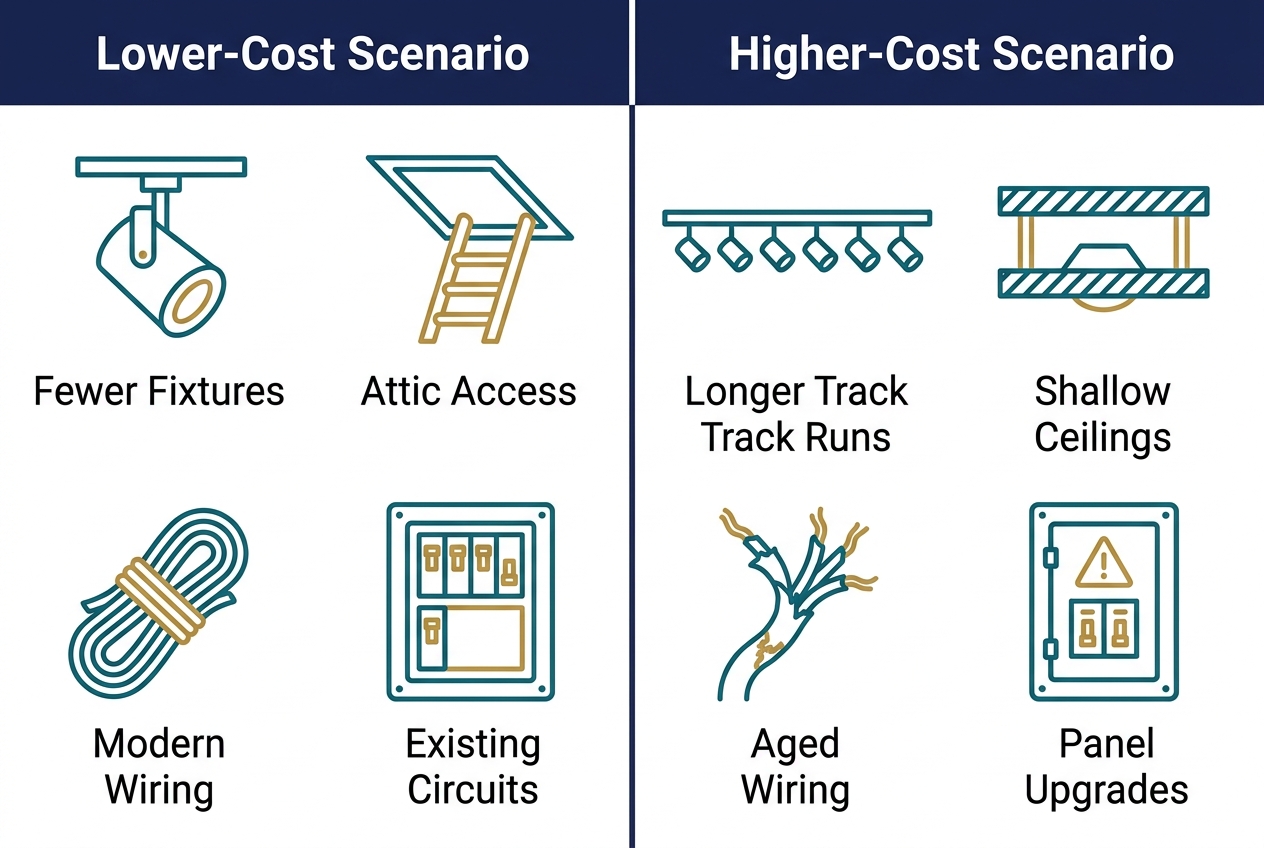
Installation costs for track lighting will be determined based on different property specificities, which makes giving out flat rate prices difficult. The final price for your project is dependent on how many fixtures you have, the length of track you’ll need, and how easy it is to get to the ceiling space. Older wiring that’s often found in homes from the 1920’s and 1930’s often requires upgrades to safely support modern LED loads, while limited panel capacity may necessitate upgrades to accommodate new circuits. Also, complying with your local building codes such as California’s Title 24 energy codes can affect the type of light fixtures you use and the complexity of installation.
It can be difficult to give precise calculations without seeing a home firsthand. For example, houses with shallow ceilings may require slim LED wafer lighting, which carries different installation requirements than standard fixtures. A property with an accessible attic can have easier wiring runs and lower man hours. Similarly, existing electrical infrastructure—whether modern wiring or outdated knob-and-tube—directly impacts the scope of work and associated costs.
| Cost Factor | Lower-Cost Scenario | Higher-Cost Scenario |
|---|---|---|
| Fixtures and Track Length | Fewer fixtures and shorter track runs | Many fixtures and long track runs |
| Ceiling Accessibility | Attic access and standard-height ceilings | Shallow cavities and no attic access |
| Existing Electrical Conditions | Modern wiring and adequate panel capacity | 1920s–1930s original wiring and limited panel capacity |
| Wiring Requirements | Existing circuits support new fixtures | New circuits or panel upgrades required |
| Code Compliance | Fixtures already meet applicable standards | Title 24 requirements for JA8-certified, IC-rated, or airtight fixtures |
Each property has different circumstances due to how they are built and wired. Therefore, the only way to give an accurate written quote is for our licensed electricians to come out to the site. They check if the ceilings are accessible, what kind of wires are in place, whether the panel is big enough, and whether you are code-compliant. This lets us tailor a price for your home upfront. Not only does this help prevent surprise costs, but also gives you an accurate picture of what you will be paying.
Professional Labor Costs and Installation Timelines for Track Lighting
Our licensed electricians will tailor their labor scope according to the needs of each job, which is why we provide upfront written pricing only after an in-person inspection. Fixture quantity, ceiling access and existing electrical condition can vary greatly from one home to another, so any labor numbers we give you are just planning ranges, and not a flat rate. Like-for-like track light replacements using existing wiring in LA are permit-exempt, usually the fastest and easiest jobs our crews take on. upfront written pricing only after an on-site assessment
Typical Installation Scenarios and Time Expectations
| Installation Scenario | Typical Work Involved | Time Considerations |
|---|---|---|
| Straightforward Replacement | Swap an existing track fixture on the same wiring without new wiring or hardware | 1–2 hours, generally permit-exempt in Los Angeles |
| New Track on Existing Circuit | Mount and wire new track from an existing circuit, including fixture placement and aiming | 2–4 hours, contingent on ceiling access and fixture count |
| New Circuit or Panel Work | Install a dedicated circuit or upgrade the electrical panel to support new track lighting | 4–8 hours plus permit approval timelines (roughly two weeks) and two-stage inspections |
What else can cause delays outside of the labor? Permits at LADBS can take two weeks for approval, and inspections require a 24-48 hour notice to be scheduled. Ceiling access issues, like shallow cavities or lack of attic space, can create complications for wiring runs and older homes may need their panel upgraded in order to safely power all those modern LEDs. There’s no such thing as a standard track lighting installation schedule.
Permitting realities shape every professional installation. Any jobs requiring new circuits or panel work need to be done by a licensed C-10 contractor and will require processing through the LADBS, with permit fees ranging between $150 – $2,500. Upgrades may also be necessary for your existing system, especially in homes that were built prior to the 1940s, which can affect our labor hours and project length. We take care of all permits and inspections so you don’t have to.
How Existing Wiring, Circuits, and Your Electrical Panel Affect Track Lighting Projects
The state of the wiring, circuits, and electrical panel that currently exists in your home will play a huge role in determining what is possible for a track lighting project, and how much it will cost you. Prior to starting any work, our licensed electricians will check to see if your existing system can handle the extra load, or if any upgrades need to be done to code in order to be safe.
Calculating Load for Track Lighting
According to the National Electrical Code (NEC), track lighting load is determined by the physical length of the track, not the wattage of the fixtures installed. The NEC calls for 150 VA per two feet of track (or fraction thereof), to provide a conservative safety margin for adding more fixtures in the future. An 8 foot track uses 600 VA, while a 12 foot track would be 900 VA. These values are compared to your circuits’ safe continuous limits: 1,440 VA on a 15-amp circuit and 1,920 VA on a 20-amp circuit (80% of breaker rating).
Since transformers are used in most lights today they have an inductive load and electricians use Volt-Amperes (VA) and not Watts for this calculation. Any load above these continuous limits will need a separate circuit, or if that is not possible, you can split the track into multiple branch circuits to stay under these limits.
Existing Wiring vs. New Circuit Requirements
| Project Condition | Electrical Work Required | Budget Implication |
|---|---|---|
| Overhead wiring already exists | Assess existing circuit capacity | Lowest cost scenario |
| Track load fits circuit headroom | Verify VA against 80% continuous limit | Minimal added electrical cost |
| Load exceeds continuous limits | Dedicated circuit or splitting across branches | Added circuit work raises cost |
| Older home with limited panel capacity | Possible wiring updates or panel evaluation | Highest cost tier |
For projects that fit in the circuit’s headroom, we typically don’t need to add any more electrical work, which keeps costs low. In the event that the load goes over continuous and we have old wire that doesn’t have enough capacity, we’ll need to make some upgrades.
Older Homes and Panel Capacity
Homes from the 1920s-1930s tend to be more difficult as the old wiring and small panel capacities are a concern. If this is the case, we will assess whether the old electrical wiring in your home is capable of taking on the load of all your lighting or if you need rewiring/panel upgrades prior to your new installation.
Code Requirements, Permits, and Compliance for Track Lighting Installation
After you check your wiring and existing circuits, the next task will be to make sure your track lighting plan meets code and permit requirements. These rules help prevent fires, provide for safe electrical continuity, and keep luminaires secured under load.
Code Requirements for Track Lighting
Residential track lighting has to follow NEC-based rules that focus on safety and stability. The lighting track must connect permanently to a branch circuit that is equal to or less than the track’s rating, and the fittings have to be track specific for polarizing and grounding purposes. Track lighting may not be installed in wet, damp or corrosive locations, and tracks can’t be concealed in walls or run through partitions.
Track height matters too – it needs to be at least five feet above the finished floor unless it is protected from physical damage or operates at low voltage (under 30 volts rms). The supports should be no more than four feet apart, and any track section four feet or less in length will need at least two support points to hold the weight of the luminaires that will be hung on it.
Permits and Inspections in Los Angeles
In Los Angeles, electrical permits processed through LADBS typically cost between $150 and $2,500, with approval timelines averaging about two weeks. Whole-house rewiring permits generally fall between $250 and $600 or more, depending on project scope. Like-for-like fixture replacements that don’t alter wiring are usually permit-exempt, but adding new circuits, upgrading panels, or rewiring requires a permit and must be handled by a licensed C-10 contractor.
There are two key inspections in the permitting process: a rough-in inspection prior to drywall covering the wire, and a final inspection once all devices are energized and operational. Homeowners may act as owner-builders for their primary residence, but they remain responsible for code compliance and passing both inspections. Inspections require 24-48 hours notice, and permits must be posted on site once approved.
Why Permits and Professional Installation Matter
Skipping permits can cost you fines, stop work orders and issues when it comes time to sell your house. At Blue Moon Electrical, our licensed and insured team pulls required permits and coordinates inspections for all projects that need a permit to ensure your track lighting installation is up to code right out of the gate.
Is Track Lighting Easy to Install? DIY Risks vs. Professional Installation
When homeowners see the codes, permits, and other things that are required for track lighting, the next question is if their project is simple enough for them to take on themselves.
| Consideration | DIY Approach | Licensed Professional Installation |
|---|---|---|
| Safety | DIY wiring risks electrocution, fire hazards, and improper grounding if fittings aren’t securely fastened or polarization is broken. | Our licensed electricians follow code-mandated grounding and bonding protocols, ensuring safe, reliable connections every time. |
| Code Compliance | DIY installers often overlook minimum 5-foot mounting height, support spacing at four feet or less, and prohibited locations like wet or concealed spaces. | We adhere to NEC and local code requirements, including proper mounting heights, support spacing, and location restrictions, eliminating compliance risks. |
| Permits and Inspections | Many DIY projects proceed without permits, risking fines, failed inspections, or insurance denials if discovered. | We pull all required permits and coordinate inspections end to end, ensuring your installation meets jurisdictional standards without delays. |
| Load and Panel Knowledge | An 8-foot track draws 600 VA and a 12-foot track 900 VA against continuous-load limits of 1,440 VA on 15-amp and 1,920 VA on 20-amp circuits; exceeding these requires dedicated circuits or splitting across branches, which most DIYers cannot assess accurately. | Our electricians evaluate your panel capacity and load distribution, recommending dedicated circuits or balanced branch assignments to prevent overloads and ensure safe, long-term operation. |
| Pricing Clarity | DIY pricing is open-ended—tools, parts, and potential correction of failed inspections can drive costs far beyond initial estimates. | We provide transparent, upfront written quotes after on-site assessments, so you know the full project cost before work begins. |
We handle all permits and inspections for you, providing code-compliant, professionally installed track lighting with no hidden gotchas. We take care of everything, so you can enjoy your new lighting with confidence.
Frequently Asked Questions
What Factors Impact the Total Cost of Installing Track Lighting?
Track lighting installation costs depend on fixture quantity, track length, ceiling accessibility, and existing wiring condition. Older homes with 1920s–1930s wiring or limited panel capacity often require upgrades to handle modern loads safely. Local code compliance, such as California Title 24 requirements for specific fixtures, also affects pricing.
How Much does Labor Typically Cost for Professional Track Lighting Installation?
Blue Moon Electrical provides upfront written pricing only after an on-site assessment, so labor costs vary by project scope. Like-for-like replacements using existing wiring are usually the fastest and least expensive, while new circuits or panel work require more time and cost.
Is it cheaper to install track lighting where overhead wiring already exists?
Yes, installing track lighting where overhead wiring already exists is generally cheaper because it avoids the need for new wiring or panel upgrades. Projects using existing circuits typically require less labor and permit work.
Do I need to budget for new electrical circuits when installing track lighting?
You may need to budget for new electrical circuits if the existing circuit cannot safely support the track lighting load. The National Electrical Code requires calculating track lighting load based on track length, and exceeding continuous limits may require dedicated circuits or splitting the track across branches.
How long does a professional electrician typically take to install a track lighting system?
Installation time varies by project complexity. Straightforward replacements on existing wiring take 1–2 hours, while new track on existing circuits takes 2–4 hours. Jobs requiring new circuits or panel work can take 4–8 hours plus permit approval timelines and inspections.
Get a Written Quote for Your Track Lighting Project
If you’re trying to figure out how much it costs to install track lighting, the truth is that it all depends on a visit to your home. Flat rate pricing isn’t applicable to custom lighting installations as far as the fixture quantities, ceiling access and existing wiring conditions change from home to home. Our licensed electricians will assess your space to see what JA8 certified or IC rated fixtures are needed per California’s Title 24, check panel capacity and review any old wiring, especially if your home was built between the 1920s and 1930s. Then we can provide you with a written quote.
Once the assessment is complete, we pull the appropriate permits and provide you a written quote that reflects what your job will cost. All of our work adheres to local electrical code, and we highly recommend against attempting any electrical work yourself because of how dangerous it can be. Call for an on-site assessment to receive a transparent quote specific to your home.
Call (855) 904-2265 to get started.
Get Your Written Track Lighting Quote
You’ve seen why track lighting installation costs vary so much from property to property, from fixture counts and ceiling accessibility to aging wiring and panel capacity. Because these factors interact, an on-site assessment is the only reliable way to know what your project will involve. Our team provides an upfront written quote after evaluating your specific conditions, so there are no surprises along the way. Our licensed and insured electricians also pull required permits and coordinate inspections as part of code-compliant work. In California, that includes guidance on Title 24 fixture requirements such as JA8-certified and IC-rated options. Scheduling an assessment is simple, and our team responds quickly to inquiries during standard business hours. Contact us at (855) 904-2265 or through our online form to book your on-site assessment today.