Table of Contents
- Elevate Your Outdoor Space with Deck Lighting
- Understanding Deck Lighting Options
- Evaluating Key Deck Lighting Types and Features
- Planning Your Deck Lighting Installation
- Advanced Considerations for Integrated Deck Lighting Systems
- Frequently Asked Questions About Deck Lighting
- Your Deck Lighting Project with Blue Moon Electrical
Elevate Your Outdoor Space with Deck Lighting
Deck lighting transforms an ordinary backyard into a welcoming evening retreat, extending your outdoor living space well past sunset. It adds warmth and elegance while making stairs and railings safer for family and guests. When thoughtfully designed, every fixture works together to create a cohesive, inviting look that complements your home’s architecture. Whether you’re hosting evening gatherings or simply relaxing after a long day, the right lighting makes every moment on your deck feel special.
When installed by a licensed and insured electrician, your deck lighting system meets all local building codes and safety standards. We pull required permits and coordinate with local inspectors to ensure every installation is fully compliant. At Blue Moon Electrical, we bring over 20 years of experience to every project, ensuring precise layout, proper wiring, and durable fixtures that last for years. Beyond creating a warm and inviting atmosphere, a professionally designed deck lighting system increases your property’s curb appeal and adds a layer of security by eliminating shadowed areas around stairs and railings. We stand behind our work with a satisfaction guarantee, not an empty promise. Our electricians handle the technical details—from transformer sizing to corrosion-resistant connections—so you can enjoy a beautifully lit deck without worry.
Let’s explore the various deck lighting solutions available to bring your vision to life. To learn more about safe and efficient options, refer to our low voltage deck lighting guide.
Understanding Deck Lighting Options
Building on the concept of elevating your outdoor living area, the first step is to understand the available options for outdoor illumination on and around your deck. The right lighting design blends safety, ambiance, and functionality, and choosing the appropriate fixture type is essential. We categorize outdoor lighting for decks into three groups: accent, task, and safety.
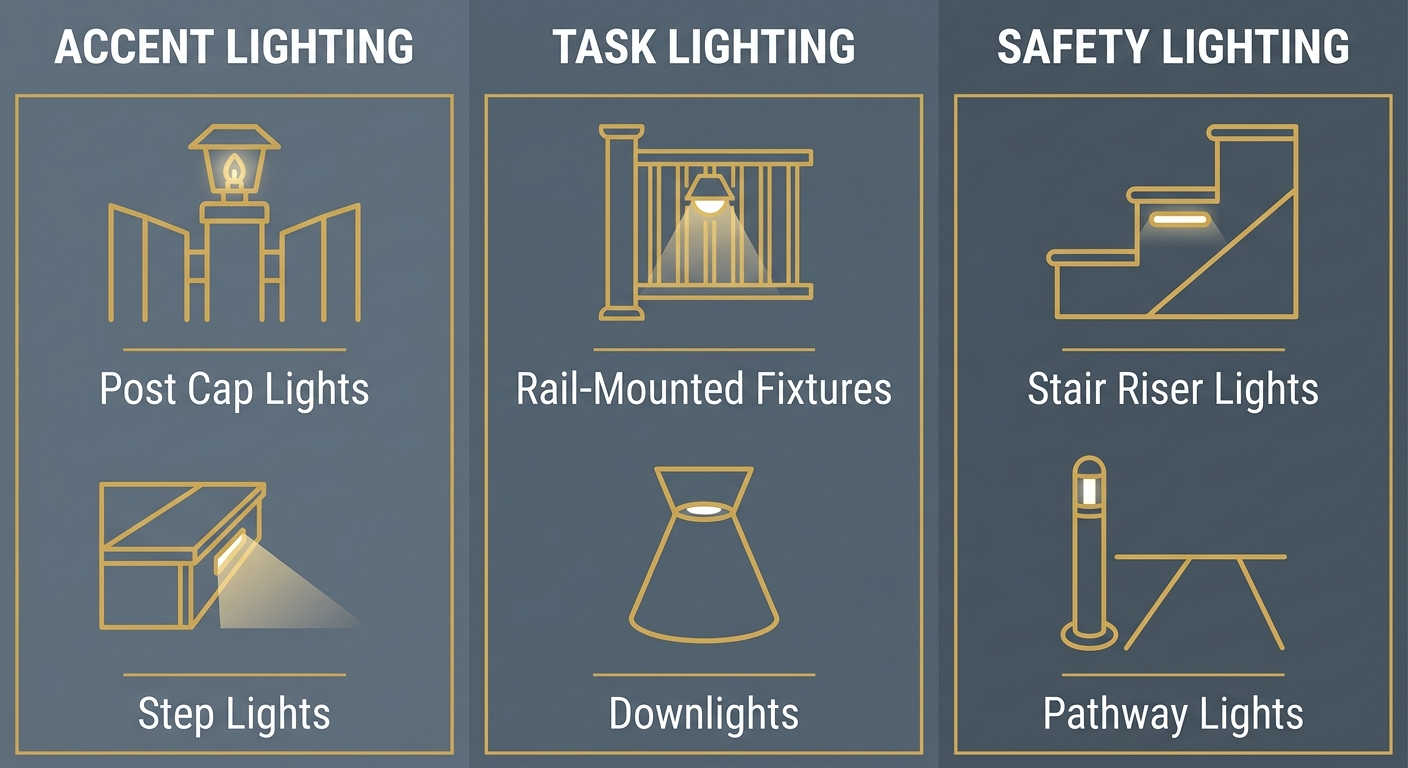
Accent lighting uses subtle fixtures such as post cap lights and recessed step lights to create a warm, inviting atmosphere without overwhelming the space. Task lighting adds functionality by placing focused beams on work areas like outdoor kitchens or dining tables with rail-mounted fixtures and directional downlights. Safety lighting is the most essential, and it includes stair riser lights and pathway markers that clearly define steps and walkways, reducing the risk of trips and falls after dark. A well-designed outdoor lighting plan combines all three categories, and our team helps you choose fixtures that complement your deck’s design.
For homes with composite decking, specialized composite deck lights are engineered to blend with the material without compromising its longevity. These fixtures often use sealed housings and hidden fasteners that accommodate the natural expansion and contraction of composite boards. According to an authoritative industry review, composite deck lights can deliver consistent performance and maintain their appearance. To explore detailed comparisons and user experiences, we recommend reading the full composite deck lights review available online. After reviewing the options, our licensed electricians can advise on placement and handle the entire installation to ensure a flawless finish.
Stair lighting is essential for preventing accidents. Building safety guidelines require at least 40 to 100 lumens per riser to clearly define each step edge, and riser-mounted LED fixtures are the preferred choice because they eliminate overhead shadowing. Our electricians ensure every fixture is installed to code, with weatherproof connections and concealed wiring to avoid electrical hazards. We also provide upfront written pricing that covers the full scope of work, so there are no hidden charges. This commitment to safety and transparency is why homeowners trust us for their outdoor illumination needs.
With a clear understanding of accent, task, and safety lighting, you can now evaluate the specific types and features that will bring your vision to life. From choosing the right fixture finish to planning smart controls, the next section explores the details that turn a basic lighting plan into a personalized outdoor retreat.
Evaluating Key Deck Lighting Types and Features
Having explored the broad categories of deck lighting, we now turn to evaluating the specific fixture types and their features in detail.
Post-Cap and Riser Lights for Composite Decks
Post-cap lights fit onto the tops of deck posts while riser lights are mounted on the vertical face of stair risers. For composite deck boards, manufacturers offer mounting brackets and screws that secure without damaging the material. These fixtures typically carry an IP65 weather-resistance rating, meaning they are dust-tight and protected against water jets, which is important for year-round exposure. The LED modules inside deliver lifespans of 25,000 to 50,000 hours, reducing the need for bulb replacements.
Stair and Rail Lighting for Safety
Falls on outdoor stairs are a leading home injury risk, so proper illumination is non-negotiable. The Deck Stair Lighting Safety guide stresses that stair tread lights should be placed on every individual step, casting at least 1 foot-candle of illumination directly onto the tread to eliminate shadows. A beam angle of around 30° focuses the light downward, minimizing glare that could obscure the step edge. We design our installations to enhance deck stair lighting safety with proper beam angles. Rail lights, typically spaced every 4 to 6 feet along the railing, further reduce trip hazards and prevent accidental collisions with the rail.
Integrated Deck Lighting Systems
Integrated LED systems embed light strips or spotlights directly into deck boards during construction, providing a seamless appearance with no exposed wiring on the surface. Upfront costs for integrated fixtures are typically about $15 to $30 per fixture. Integrated LEDs generally last 25,000 to 50,000 hours and require no bulb changes, so long-term maintenance needs are minimal.
The following table compares the primary fixture types for decks, highlighting their ideal applications, key features, cost ranges, and durability considerations.
| Fixture Type | Best For | Key Features | Typical Cost Range (per fixture) | Durability & Maintenance |
|---|---|---|---|---|
| Post-Cap Lights | Post tops | IP65, 25-50k hr LED | $10–$50 | Moderate; clean lenses |
| Riser Lights | Stair risers | IP65, downward light | $10–$50 | Weather-resistant; annual cleaning |
| Stair Tread Lights | Step edges | 30° beam, 1 fc | $10–$50 | Sealed; 25-50k hr LED |
| Rail Lights | Rail safety | 4–6 ft spacing, IP65 | $10–$50 | Aluminum housing; low maintenance |
| Integrated LED Systems | New decks | No exposed wiring | $15–$30 | High durability; no bulb changes |
LED Deck Lighting Costs and Value
Beyond the fixture itself, total cost includes transformers, wiring, and labor. A typical low-voltage transformer runs $50 to $150, and wiring averages $0.50 to $1.50 per foot. Professional installation labor for a standard deck usually falls between $200 and $500, though complex layouts or large fixture counts can increase the total. DIY material packages commonly range from $400 to $1,200 for a complete system, while hiring a licensed electrician or contractor may bring the overall project to $1,500 to $4,000. At Blue Moon Electrical, we provide transparent, upfront written pricing after assessing your deck’s specific requirements, and we ensure all work meets local codes and permit standards. Once you have evaluated the key lighting types and their costs, the next step is planning the actual installation to ensure code compliance and optimal placement.
Planning Your Deck Lighting Installation
Now that you have compared the types and features of deck lighting options, the next step is to translate that knowledge into a concrete installation plan. We will guide you through creating a layout, selecting fixtures that work with your deck material, understanding electrical codes and permits, and the value of professional installation.
Creating a Deck Lighting Layout
Begin by measuring the deck footprint and marking high-priority zones: all stair treads and risers, seating clusters, and perimeter edges. Deck stair lighting safety guidelines emphasize that insufficient lighting on outdoor stairs is a leading cause of unintentional falls, so riser-mounted lights that define step edges are essential. Space fixtures 6 to 8 feet apart for even illumination and avoid hot spots. For existing decks, surface-mount retrofits are often straightforward; for new construction, recessed fixtures can be integrated beneath joists to achieve a seamless look. A clear, measured layout ensures every zone is properly lit and visually balanced.
Choosing Fixtures for Your Deck Material
Fixture compatibility depends on the decking material. Wood and composite posts accept post-cap lights when the post tops are accessible, while surface-mount fixtures work on any deck surface but require careful sealing to prevent moisture intrusion. Recessed lights are only suitable for decks with adequate cavity space—typically new construction with deep substructures—and must never cut into the structural core of composite boards. Wiring concealment also varies: wood decks allow routing under joists with staples or clips, composite decks need chase conduits or under-deck trays, and PVC decking may require pre-drilled channels. Never staple wire directly into PVC. Matching fixture type and concealment method to your deck material yields a clean, code-compliant installation.
Electrical Code and Permitting Considerations
Outdoor lighting must comply with the National Electrical Code. Low-voltage systems (12V or less) generally do not require a permit, but they still need GFCI protection on the transformer side. Line-voltage systems (120V) require a permit, inspection, and direct-burial cable buried at least 18 inches deep—24 inches under a driveway. Proper grounding and weatherproof connections are essential to avoid shock hazards. We coordinate permitting and inspections so that every installation meets local requirements, protecting your investment and future home sales. A licensed electrician ensures that all wiring, fixtures, and documentation satisfy code, giving you confidence in the safety of your outdoor space.
Why Professional Installation Adds Value
While DIY deck lighting might seem manageable, improper connections can create shock hazards, and unpermitted work may complicate future home sales. In contrast, our team brings over 20 years of experience and 12,000 completed projects to every job. For homeowners in Calabasas, our team provides expert electrical services in Calabasas with upfront pricing and a satisfaction guarantee. We handle all code requirements, from GFCI protection to burial depth, and coordinate inspections. Throughout the installation, we test every circuit and fixture, verifying illumination levels to meet safety standards. The result is a safe, warranty-protected installation with clean wiring concealment that preserves your deck’s appearance. Professional installation adds long-term value, protects your warranty, and ensures your outdoor space is ready for evening gatherings.
Once your basic plan is in place, you may wish to explore advanced integrated systems like smart controls and multi-zone programming that build on this code-compliant foundation.
Advanced Considerations for Integrated Deck Lighting Systems
Once you have finalized the layout and fixture placement for your outdoor project, several advanced technical factors demand attention to transform a basic setup into a fully integrated lighting system that delivers long-term safety and performance.
One crucial decision involves choosing between low-voltage and line-voltage configurations. Low-voltage systems (12V or 24V) offer improved safety and energy efficiency, yet they still require careful design to prevent voltage drop over long cable runs. Line-voltage (120V) installations must be protected by GFCI outlets and installed inside conduit, making professional installation essential to meet code requirements. Integrating either system with your home’s electrical panel, smart controls such as dimmers, timers, or voice assistants, and ensuring compliance with local codes calls for a licensed electrician. For homeowners in the Coachella Valley, our team provides professional electrical services in Palm Desert that ensure safe, code-compliant integration of your deck’s lighting system.
Transformer sizing and wiring gauge are equally important. Industry best-practice guidelines recommend selecting a transformer with 25–30% more capacity than the total wattage of all connected fixtures — for example, a 150-watt transformer can handle up to 120 watts of lighting. Using the correct wire gauge, typically 10/2 or 12/2, minimizes voltage loss and maintains consistent brightness across every run. While these specifications may seem straightforward, a licensed electrician will verify that the entire circuit, from the transformer to the last fixture, meets manufacturer and code requirements.
Material compatibility is another advanced consideration. According to a comprehensive review of composite deck lighting, composite decking retains more heat than natural wood, so selecting LED fixtures with minimal heat output is critical. Some composite manufacturers also impose specific cutout and mounting guidelines — failing to follow them can void the decking warranty. A licensed electrician familiar with local codes and material specifications can verify that the installation meets both safety standards and the deck manufacturer’s conditions.
These technical factors often prompt questions about safety, compatibility, and compliance, which we address in the FAQ section that follows.
Frequently Asked Questions About Deck Lighting
You might still have a few questions about outdoor deck lights – let’s address them with straightforward answers.
Q: What is the difference between low voltage and line voltage systems for decks? Low voltage systems use a transformer to reduce line voltage to 12V, improving safety and energy efficiency while delivering bright, code-compliant illumination.
Q: Can lights be installed on a composite deck? Yes, but composite decking requires compatible fixtures to prevent heat damage and warranty issues. We confirm all lights are safe and appropriate during installation.
Q: Why should I hire a professional for outdoor lighting installation? As a bonded and licensed electrical contractor, we ensure code compliance, proper grounding, and weather-resistant stair lighting to protect your warranties and safety.
If you’re ready to begin your outdoor lighting project, the next section explains how we can assist.
Your Deck Lighting Project with Blue Moon Electrical
The FAQs above address the most common deck lighting questions — now it’s time to bring your vision to life. Our electricians are licensed and insured in every city we serve, and we provide transparent, upfront written pricing after an on-site assessment. With 24/7 availability, we’re ready for emergency or same-day service whenever you need us. Our experience extends to specialized work such as historical restoration in San Francisco, reflecting our attention to detail and code-compliant standards. Contact your local team today for a free consultation.
Request Your Deck Lighting Estimate
You’ve explored the best deck lighting options for 2026 and understand how proper illumination enhances safety, ambiance, and property value. Now, it is time to turn that knowledge into a beautifully lit outdoor space with a trusted professional. Our licensed and insured electricians, backed by over 20 years of experience, provide expert design and installation tailored to your deck’s unique needs. We deliver upfront written pricing after an on-site assessment, ensuring complete transparency with no surprises. All work meets local codes and comes with our satisfaction guarantee for your peace of mind. With 24/7 availability and rapid response, we are ready to bring your deck lighting vision to life whenever you are. Visit our California service page to schedule your personalized consultation today.
Request Your Deck Lighting Estimate