EV charger installation in San Clemente works a little differently than it does in most of Orange County, because your electricity comes from San Diego Gas and Electric instead of Southern California Edison. That one detail affects your rate plan, the incentives you can use, and the way you should think about charging costs. It is also something many online guides written for the rest of the county get wrong.
This guide covers what San Clemente homeowners should know before adding a Level 2 charger: how SDG&E pricing works, what happened to the federal charger credit, whether your panel can handle the load, and what HOA rules can and cannot stop. If you would rather talk it through in person, our San Clemente electricians can assess your home and give you a written plan.
Key Takeaways
- San Clemente homes are served by SDG&E, so SCE panel-upgrade programs do not apply.
- The federal 30C charger credit ended for equipment placed in service after June 30, 2026.
- SDG&E’s EV-TOU-5 plan prices electricity highest from 4 p.m. to 9 p.m. every day.
- SDG&E’s 2025 table showed summer super off-peak near 12 cents, on-peak near 71 cents.
- A Level 2 charger on a 240-volt circuit is the standard choice for home charging.
- Older 100-amp San Clemente panels often need load management, a subpanel, or an upgrade.
- California Civil Code 4745 limits HOAs from prohibiting or unreasonably restricting EV charger installation.
- Coastal garages benefit from outdoor-rated, sealed equipment that resists moisture and salt exposure.
San Clemente Is SDG&E Territory, and That Changes the Math
Most of Orange County buys power from Southern California Edison. San Clemente is different. San Diego Gas and Electric serves San Diego County and a portion of southern Orange County, and San Clemente sits inside that area. You can see it on your bill, and it matters for EV owners in three ways.
- Different rate plans. SDG&E has its own EV time-of-use plans with its own peak hours and prices.
- Different incentives. Programs offered by Southern California Edison, including its panel-upgrade support for EV charging, are for Edison customers. They do not apply to an SDG&E home in San Clemente.
- Different utility coordination. If your project needs a service upgrade, your electrician works with SDG&E on the meter and service connection.
We bring this up first because we regularly talk with San Clemente homeowners who read about an Edison program and assumed it covered them. Starting with the right utility saves time and prevents disappointment later.
What Changed in 2026: The Federal Charger Credit Ended
For several years, homeowners in eligible areas could claim a federal tax credit on home charging equipment. That window has closed. The IRS instructions for Form 8911 explain that the section 30C credit’s termination date was moved from December 31, 2032, to June 30, 2026, and that you cannot claim it for property placed in service after June 30, 2026.
So if you are installing a charger this fall or later, plan your budget without that credit. The good news is that the biggest ongoing savings for most SDG&E customers never came from a one-time credit anyway. It comes from charging at the right time of day.
Picking the Right SDG&E Rate Plan Before You Plug In
Your charger is only half of the savings picture. The rate plan decides what every mile actually costs. SDG&E’s EV and home electrification pricing plans include EV-TOU-5, which SDG&E describes as best for customers who can charge overnight. It has three pricing periods, including the lowest overnight pricing, with peak pricing from 4 p.m. to 9 p.m.
The gap between those periods is large. In SDG&E’s February 2025 EV-TOU-5 total rates table, the summer super off-peak rate was roughly 12 cents per kilowatt-hour while the summer on-peak rate was roughly 71 cents. Rates are updated regularly, so check the current table, but the pattern is what matters: charging during the evening peak can cost several times more than charging overnight.
A few practical points for San Clemente drivers:
- Choose a charger with scheduling, or use your car’s own charging timer, so it waits for off-peak hours automatically.
- Look at your whole household’s usage, not just the car. An EV rate applies to the whole home on EV-TOU-5, so heavy evening use elsewhere affects the result.
- SDG&E’s pricing page notes a monthly Base Services Charge that took effect in October 2025, which is not included in the per-kilowatt-hour prices shown.
- SDG&E also offers an Electric Vehicle Climate Credit to eligible EV drivers in San Diego and southern Orange counties. Eligibility and amounts can change, so confirm the current details with SDG&E.
Once your charging schedule is set, a Level 2 charger simply refills the battery while you sleep, at the cheapest time of the day.
Does Your San Clemente Panel Have Room for a Level 2 Charger?
San Clemente has a wide range of housing. Homes near the Pier Bowl and the older neighborhoods off El Camino Real can date back decades, while communities such as Talega and Forster Ranch were built much more recently. That range shows up inside the electrical panel.
The U.S. Department of Energy’s guide to home charging describes Level 2 equipment as running on 240-volt service, the same kind of circuit used by a dryer or range. The difference is duration. A charger can run at a high, steady load for hours, often at the same time the rest of the house is using power.
“An EV charger pulls a steady load for hours at a time, which is very different from a toaster or a hair dryer. That is why we always do the load calculation first. It tells us whether the panel can carry that charger safely every single night.”
Victor, Blue Moon Electrical
What the load calculation tells us
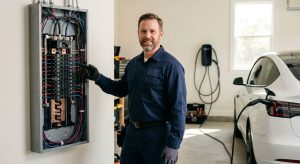
A load calculation adds up your existing appliances, heating and cooling, and planned additions, then compares the total with your service rating. It answers the question that matters: can this panel carry a charger safely, every night, without overloading?
In practice, newer San Clemente homes with 200-amp service and open breaker spaces often need only a dedicated circuit. Older homes on 100-amp or 125-amp service are more likely to need one of the other paths shown below.
| What the load calculation shows | Typical path | Why it fits |
|---|---|---|
| Panel has spare capacity and open breaker spaces | Add a dedicated 240-volt circuit for the charger | Simplest and fastest path |
| Capacity is close, but no major loads are planned | Charger with load management or a load-sharing device | Avoids a service upgrade in many homes |
| Main panel is full, but the service has room | Install a subpanel to feed the charger | Solves space limits, not capacity limits |
| Service is maxed out or equipment is failing | Upgrade the service and panel with SDG&E coordination | Best if more electric loads are coming |
The table shows why we never quote a charger install from the car model alone. Two identical chargers can have very different installation scopes depending on what the panel can support.
Load management and subpanels
If your capacity is close, a load management device can limit the charger’s draw when the rest of the house is busy, which avoids a service upgrade in many homes. If your panel simply has no open spaces, a subpanel installation adds room for new circuits. Neither of these adds capacity to the service itself, so they only work when the load calculation allows it.
When a service upgrade makes sense
If the service is maxed out, or you plan to add a heat pump, an induction range, or battery storage later, upgrading once is usually smarter than working around the limit. Our electrical panel upgrade service covers the coordination with SDG&E, the permit, and the inspection. Rebates can sometimes help when a panel upgrade is part of a larger electrification project, but programs change often and eligibility varies, so we check what is available at the time of your project rather than promising a result.
The San Clemente Installation Process, Step by Step
Most home charger projects follow the same sequence. Knowing it helps you plan around permits and inspection.
1. On-site assessment
We look at the panel, the path from the panel to the parking spot, and where the charger will mount. We also ask about your car, your driving habits, and any future plans that could add load.
2. Permit through the city
A new 240-volt charger circuit requires an electrical permit from the City of San Clemente. California law requires cities to provide a streamlined permitting process for EV charging stations, which helps keep typical residential projects moving.
3. Installation
Installation includes the breaker, the correctly sized wire and conduit, the charger mounting, and any load management equipment. For a garage close to the panel, this is often a one-day job.
4. Inspection
A city inspector checks the finished work. We make sure everything is labeled and accessible so the inspection goes smoothly.
5. Rate plan and scheduling
After the charger is live, switch to the SDG&E rate that fits your household and set the charging schedule. This last step is where the long-term savings actually begin.
If you want one team to handle all of this, our EV charger installation service covers the assessment, permit, installation, and inspection from start to finish.
HOAs, Condos, and California’s Right to Charge
San Clemente has many homeowners associations, from planned communities to condo buildings near the coast. A common worry is that the HOA will simply say no. California law gives owners strong protection here. Under California Civil Code section 4745, provisions in a common interest development’s governing documents that prohibit or unreasonably restrict installing an EV charging station in an owner’s designated parking space are void and unenforceable.
That does not mean anything goes. An association can still set reasonable standards, require an application, and ask for things like insurance or a licensed contractor, especially when the installation touches common areas. The practical approach is to:
- Read your HOA’s architectural or modification rules before you schedule the work.
- Submit a complete application with the charger location, wiring route, and contractor license information.
- Clarify who pays for any metering or wiring that runs through common areas.
- Keep copies of approvals and the city permit for your records.
In condos, the wiring route is often the hardest part, since the charger may be far from your unit’s panel. Planning that route early is what keeps a condo project affordable.
Coastal Garages: Equipment Choices That Last
San Clemente’s ocean air is great for living and hard on metal. Chargers mounted outdoors, in carports, or in open garages close to the water deal with moisture and salt that can shorten the life of cheaper hardware.
A few choices help equipment last:
- Pick a charger rated for outdoor use if it will be exposed to the weather at all.
- Use weather-resistant enclosures, fittings, and covers for any outdoor wiring.
- Mount the charger where it is sheltered from direct spray and standing water.
- Ask for sealed connections at every point where wiring enters an outdoor box.
These details add very little to the cost of the job, and they are much cheaper than replacing corroded equipment a few years later.
Tesla Wall Connector or a Universal Level 2 Charger?
If you drive a Tesla, a Tesla Wall Connector is a natural fit, and our Tesla charger installation service handles those specifically. If you have another brand, or expect to own a different car later, a universal Level 2 charger may be the more flexible choice.
Whatever you choose, look for these features:
- Scheduling, so charging waits for SDG&E’s cheapest hours.
- An adjustable amperage setting, so the charger can be matched to your circuit.
- Safety certification from a recognized testing laboratory.
- A cable long enough to reach the charge port without stretching across the garage.
A hardwired installation is often the cleanest option for a Level 2 charger. It also avoids plug and receptacle wear from repeated high loads over time.
Common Mistakes San Clemente Homeowners Can Avoid
Most charger problems we are called to fix trace back to a few avoidable decisions made during the first installation. Knowing them ahead of time saves money and frustration.
- Skipping the load calculation. A charger that works fine in winter can start tripping breakers in summer when air conditioning, a pool pump, and the car all run at once.
- Installing without a permit. Unpermitted work can cause trouble with insurance claims, HOA approvals, and home sales, and it means nobody independently checked the wiring.
- Charging on the wrong rate plan. Leaving the car to charge as soon as you pull in at 5 p.m. puts the whole session inside SDG&E’s most expensive window.
- Buying the charger before the site visit. The right amperage setting depends on your circuit, so it is better to confirm the electrical path first and choose the equipment second.
- Ignoring future loads. A second EV, a heat pump, or battery storage can change the answer, so share those plans during the assessment.
None of these take long to get right up front. They simply need to be part of the conversation before the first wire is pulled.
Start Your San Clemente EV Charger Project
Getting EV charging right in San Clemente comes down to three things: a panel that can carry the load, a permitted and inspected installation, and an SDG&E rate plan that matches when you actually charge. Get those right and home charging becomes the easiest, cheapest part of owning an electric car.
Our electricians can assess your panel, explain your options in plain language, and give you a written price before any work starts. Learn more about our electrical services in San Clemente and schedule a visit from our local team.