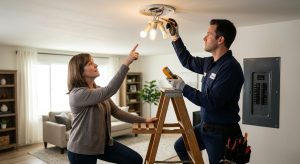
Federal Pacific and Zinsco panel replacement comes up constantly in Torrance for one simple reason: the city’s median home was built around 1963, which lands squarely in the years these two panel brands were most commonly installed. If you own or are buying a home from that era in Torrance, there is a real chance one of these panels is sitting in your garage or hallway right now, and knowing what to look for can save you from an unpleasant surprise during a home sale or an insurance renewal.
This is not a scare tactic used to sell panel upgrades. It is a documented, decades-old issue that home inspectors, insurance carriers, and licensed electricians across the country treat consistently the same way. Understanding why matters more than just taking someone’s word for it, especially if you are weighing whether to act on it now or wait until a sale or renewal forces the issue.
The good news is that once you understand what you are looking at and why it matters, the path forward is straightforward: identify the panel, get a professional evaluation, and plan the replacement on a timeline that works for you rather than one dictated by a lender, an inspector, or an insurance non-renewal notice.
How to Identify a Federal Pacific or Zinsco Panel
You do not need to be an electrician to do a basic visual check. Open the panel door and look at the branding on the inside cover or on the breakers themselves.
- Federal Pacific Electric (FPE): Look for “Federal Pacific Electric,” “FPE,” or the name “Stab-Lok” printed on the panel or breakers.
- Zinsco: Look for “Zinsco” or “GTE Sylvania” branding, commonly found in Torrance homes built through the 1970s.
- Age indicator: If your Torrance home was built between the 1950s and 1980s and still has its original panel, there is meaningful odds it is one of these two brands, since they were among the most widely installed panels of that era nationwide.
If you find either name, the next step is a professional inspection, not a DIY breaker test. Do not open breakers or attempt to test them yourself; simply note what you found and call a licensed electrician.
Why These Panels Are Treated Differently
The issue with both brands centers on the circuit breakers, not just the panel enclosure. A breaker’s job is to trip, cutting power, when it detects an overload or a short circuit. The U.S. Consumer Product Safety Commission investigated Federal Pacific Stab-Lok breakers in the early 1980s after reports of unusually high failure rates. According to testing referenced in that investigation, a meaningful share of the breakers failed to trip even when overloaded well beyond their rated capacity, which is the opposite of what a breaker is supposed to do in a fault condition.
It is worth being precise here: the CPSC closed its investigation in 1983 without issuing a formal recall, citing budget constraints and stating the available data did not conclusively establish a hazard to the standard required for a recall action. That is a different outcome than a Federal Pacific panel “recall,” a term some sources use inaccurately. What did happen is that Underwriters Laboratories later withdrew its listing for the affected Stab-Lok breakers, and the home inspection and insurance industries have treated these panels as a documented liability ever since, independent of whether a formal recall was ever issued.
Zinsco panels have a related but distinct failure mode. Their breakers were known to fuse directly to the bus bar over time, which means the breaker can appear to be switched off while the circuit remains energized, or it can fail to trip at all during an overload because the mechanism has physically bonded to the panel.
Federal Pacific vs. Zinsco: What to Look For
A licensed electrician can confirm which type, if any, is installed in your Torrance home.
The Insurance Angle
This is often the reason homeowners act on a Federal Pacific or Zinsco panel when they might otherwise put it off. Many homeowners insurance carriers now decline to write new policies, or decline to renew existing ones, for homes with a documented FPE or Zinsco panel, treating it as an unacceptable underwriting risk similar to knob-and-tube wiring. If you are buying a home in Torrance with one of these panels, or if your current insurer flags it at renewal, replacement is often not optional if you want to keep coverage in place.
As our electrician Dikran puts it, “We see this most often during real estate transactions. The buyer’s inspector flags an FPE panel, the insurance company won’t write the policy without replacement, and suddenly it’s a closing deadline instead of a planned project.”
“A Federal Pacific panel isn’t necessarily an emergency the moment you find one, but it’s not something to leave alone either. Get it evaluated by a licensed electrician so you know exactly what you’re dealing with and can plan the replacement on your own timeline, not the insurance company’s.”
— Dikran, Blue Moon Electrical
Torrance’s Housing Stock and Related Risks
Torrance’s building boom in the late 1950s and 1960s means an FPE or Zinsco panel is rarely the only aging system in these homes. Aluminum branch wiring, common in construction from the mid-1960s to mid-1970s, and knob-and-tube wiring in the small number of pre-1950 properties, both carry their own documented fire-risk profile and are frequently found alongside an outdated panel during a full electrical inspection.
An experienced electrician performing a panel replacement in an older Torrance home will typically also check for these related issues while the panel is open, rather than treating the replacement as an isolated task. Double-tapped breakers and mismatched wire gauge to breaker amperage are two of the most common findings once a dead front comes off an older panel, and both are meaningfully easier and cheaper to correct during a planned panel replacement than to discover later during an unrelated repair call.
Beyond Insurance: The Actual Safety Case
It is easy to treat this as purely a paperwork problem since the insurance angle gets so much attention, but the underlying safety case stands on its own. A breaker that fails to trip during an overload means the one safeguard designed to stop an overheating circuit before it ignites simply does not activate. Combined with decades of thermal cycling, corrosion, and in some cases prior amateur modifications, that is a meaningfully different risk profile than a modern panel with breakers that meet current Underwriters Laboratories standards.
Home electrical fires remain one of the more common categories of residential fire nationally according to the National Fire Protection Association, and aging electrical distribution equipment that cannot accommodate today’s loads is a recurring contributing factor. A panel that cannot reliably interrupt a fault during an overload compounds that risk rather than reducing it, which is the core reason licensed electricians treat FPE and Zinsco replacement as a genuine safety recommendation, not just a box to check for underwriting purposes.
What an Electrician Checks Beyond the Panel Label
A thorough evaluation goes beyond simply confirming the brand name on the cover. Experienced electricians commonly use a thermal imaging camera during the inspection, since it can reveal a breaker or connection running hotter than its neighbors even when nothing looks visibly wrong from the outside. They will also check for missing or improperly sized bonding screws, doubled-up neutral wires sharing a single terminal on the bus bar, and mismatched wire gauge relative to breaker amperage, since all three are common findings in panels of this era regardless of brand.
It is also worth noting that AFCI, or arc fault circuit interrupter, protection was not required by code until 2002. That means any home with an original 1960s or 1970s panel, Federal Pacific, Zinsco, or otherwise, almost certainly predates AFCI protection entirely, which adds another layer of risk reduction that a full panel replacement typically brings along with it, since new panels are installed to current code requirements for AFCI where applicable.
What Replacement Involves
A Federal Pacific or Zinsco panel replacement in Torrance follows the same permitted process as any other panel upgrade: a licensed electrician evaluates the existing panel and wiring, pulls a permit through the City of Torrance Building and Safety Division, coordinates a temporary shutoff with the utility, removes the old panel and breakers entirely, installs a new code-compliant panel sized to your home’s actual load, and schedules the required inspection.
It is worth being clear that replacing only the breakers on an FPE panel while keeping the original panel enclosure is not considered an adequate fix by most electricians or inspectors. The concern is with the underlying panel design as much as the individual breakers, so a full panel replacement, not a partial breaker swap, is the standard recommendation.
Cost to Expect
A straightforward Federal Pacific or Zinsco panel replacement in Torrance typically falls in a similar range to a standard panel upgrade, generally between $1,500 and $4,500 depending on the target amperage and whether any additional issues, like ungrounded circuits or aluminum wiring mitigation, are found and addressed during the same visit. Homes where the replacement is being done specifically to satisfy an insurance requirement sometimes need documentation, like photos of the completed work and a copy of the permit, to submit back to the carrier.
If You Are Buying or Selling in Torrance
For sellers, replacing a known FPE or Zinsco panel before listing avoids a last-minute scramble during escrow, when a buyer’s inspector flags it and the timeline suddenly gets tight. For buyers, a pre-offer or inspection-period electrical evaluation confirms exactly what you are dealing with before you are locked into a purchase price that did not account for a several-thousand-dollar panel replacement.
Some buyers negotiate a closing credit to cover the replacement rather than requiring the seller to complete it before closing, which can move faster if the insurance carrier only requires proof the work is scheduled rather than already finished by the closing date. Either approach can work, but it needs to be decided early in the transaction rather than discovered during the final week of escrow, when there is little room to negotiate and even less time to schedule a licensed electrician before the deadline.
Getting an Evaluation
If you suspect your Torrance home has a Federal Pacific or Zinsco panel, the most useful next step is a licensed electrician’s on-site evaluation, not a guess based on the home’s age alone. Bring any documentation you have, like a prior home inspection report or insurance correspondence, since that often points directly to the concern that needs addressing, and it helps the electrician give you a faster, more accurate quote on the first visit rather than a second appointment just to confirm what a previous inspector already found.
Blue Moon Electrical’s licensed electricians serve Torrance homeowners with straightforward panel evaluations and upfront, written pricing, so you know exactly what you are working with and what it will cost to resolve.
Related Electrical Work to Consider
If your panel replacement uncovers aluminum wiring or knob-and-tube wiring elsewhere in the home, addressing aluminum wiring replacement or a broader whole home rewiring at the same time is often more efficient than treating them as separate projects later. It is also a reasonable time to schedule a full electrical safety inspection to document the overall condition of your home’s system, which is useful both for your own records and for insurance purposes.
Whether you just found an FPE or Zinsco label behind your panel door or you are navigating an insurance deadline, Blue Moon Electrical’s team can evaluate your home’s specific situation and give you a clear, written plan for your Torrance, CA panel replacement.