Table of Contents
- Flickering Lights in House Troubleshooting: What Every Homeowner Should Know
- Why Lights Flicker: Basic Causes and Electrical Behavior
- Loose Neutral Wires: A Silent Threat to Home Electrical Safety
- Appliance-Driven Flickering: Overloaded Circuits and Inrush Current
- LED Flickering and Dimmer Switch Compatibility Issues
- When to Call a Licensed Electrician for Flickering Lights
- Securing Your Home's Electrical Safety
Flickering Lights in House Troubleshooting: What Every Homeowner Should Know
When it comes to troubleshooting flickering lights in the house, it is important to recognize when a problem calls for professional attention. Flickering lights are an early warning of underlying issues, from loose connections to overloaded circuits, signs that should not be dismissed. The National Fire Protection Association identifies flickering or dimming lights as a key indicator that warrants a call to a qualified electrician, and its safety data shows that electrical failures contribute to thousands of home fires each year. At Blue Moon Electrical, our licensed & insured team provides 24/7 emergency electrical service to address flickering light concerns, and we stand behind every project with a satisfaction guarantee on every service. Whether a fixture is flickering or multiple rooms are affected, our electricians respond to assess and resolve the issue. Understanding the common reasons behind these symptoms is the foundation of effective troubleshooting—helping you decide when an observation is enough and when expert help is needed.
Why Lights Flicker: Basic Causes and Electrical Behavior
Sometimes, the root cause is the neutral wire, which is a critical part of the return path in a residential split-phase 120/240 volt service. Flickering Lights Authority states high resistance neutral faults cause the neutral point to shift, resulting in voltage unbalance, and lights that dim and brighten randomly.
Electrical Behavior Behind Flickering
The neutral conductor in a power circuit is intended to balance voltage between the two hot legs. When corrosion, thermal cycling, or improper terminations introduce resistance, that balance is disrupted. If there is a resistance as small as 1 ohm on a neutral line with a 10-ampere current imbalance, there can be a 10 volt drop, pulling voltage on one of the hot legs outside the standard tolerance of 114-126 volts. Lights can dim and brighten randomly, and other lights can be too bright.
Neutral Wire Problems by Location
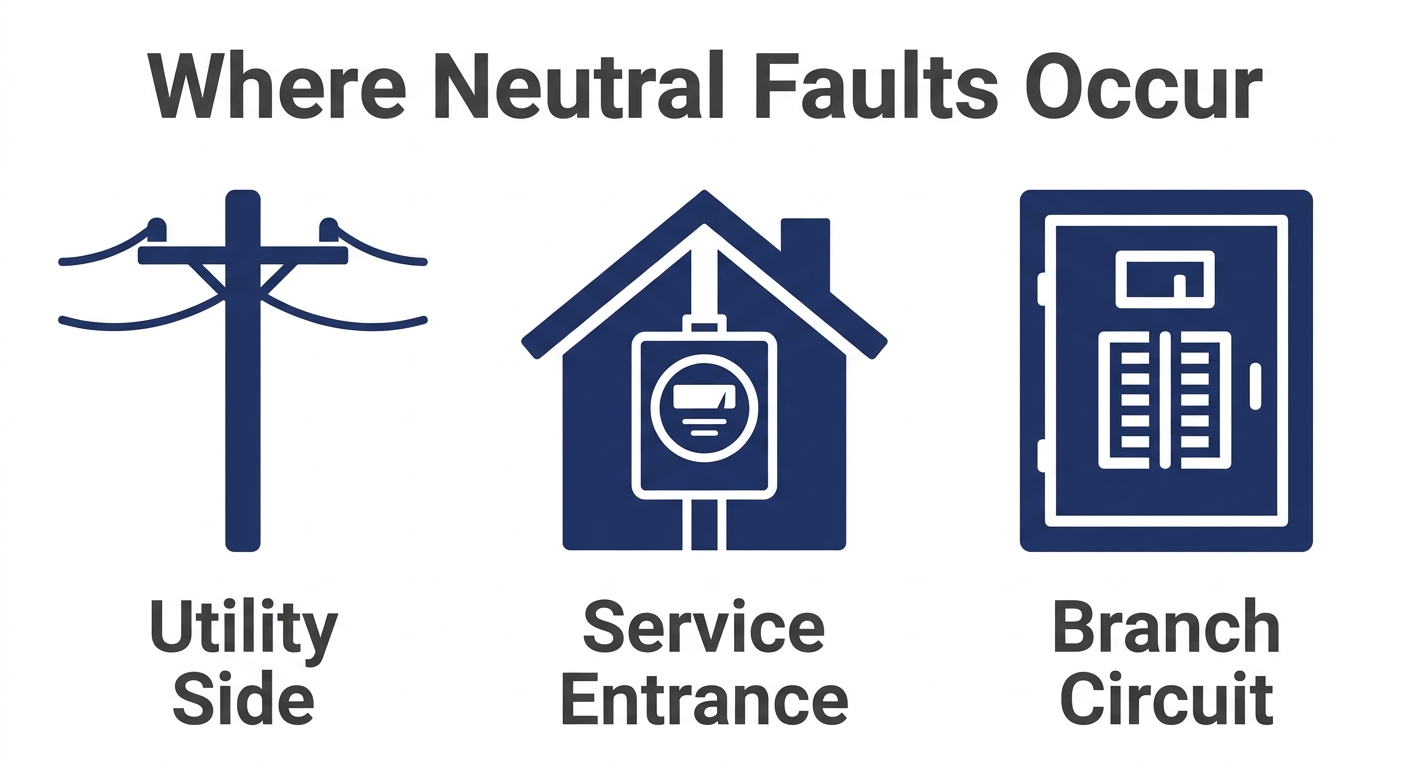
Flickering Lights Authority divided the causes of the faults into four categories: utility-side issues at the transformer, service entrance faults where the utility connection meets the home, main panel neutral bar problems inside the breaker enclosure, and localized branch circuit faults in the wiring that feeds specific outlets and fixtures. Each location creates different flickering patterns and introduces fire and appliance-damage risks.
Aluminum Conductor Considerations
Aluminum neutral conductors, which are still widely used in older installations, are especially vulnerable. Creep and galvanic corrosion at terminations can, over time, cause high-resistance connections. The Consumer Product Safety Commission (CPSC) identified aluminum wiring in 15- and 20-amp branch circuits as an unsafe fire hazard as early as 1974. Periodic inspection of aluminum neutral connections remains a necessary safety practice.
The Role of Professional Voltage Testing
Confirming a neutral connection fault requires measuring line-to-neutral voltage under load, a diagnostic step that a licensed electrician performs with specialized meters. While other factors can also cause flickering, neutral wire issues are uniquely hazardous because they can generate widespread voltage swings that damage electronics. At Blue Moon Electrical, our electricians use precise voltage measurements to isolate these faults safely, ensuring every repair aligns with National Electrical Code requirements for grounding and bonding.
One of the most prevalent and hazardous of these faults is a loose neutral connection.
Loose Neutral Wires: A Silent Threat to Home Electrical Safety
It’s important to cover lesser known flicker triggers, like loose neutral wires. These can deteriorate over time and cause serious issues, like major voltage swings, fire hazards and damage to electronic equipment. These issues require a professional to examine the system.
A home’s 120/240 volt split-phase system uses the neutral wire to return current to the source. A loose connection on the neutral wire causes what is known as a high-resistance neutral fault. According to that source, these faults can allow dangerous voltage swings throughout the circuit, making some lights appear brighter and others appear dimmer. For example, a loose service neutral connection can cause one side of the circuit to be at more than 120 volts, and the other side to be less than 120 volts, creating a fire hazard and damage to electronics.
Neutral faults can occur at several points: utility-side transformer or service drop, service entrance at the weatherhead or meter base, main panel neutral bar, or individual branch circuits. These kinds of faults are often misdiagnosed, because the symptoms are often like simple switch and bulb failures. Load-dependent flickering can help to pinpoint the approximate location of the fault. Professional diagnostic testing is needed to safely isolate the fault.
In all, there are several reasons to contact a licensed electrician to do an inspection, because hidden loose connections in the service entrance or panel can easily be overlooked, and pose a threat to the electrical users.
Homes with aluminum wiring (mid-20th century) also presents additional problems. Terminals loosen due to expansion and contraction of the aluminum wiring. Galvanic corrosion also occurs at joints and creates a resistive oxide layer. The CPSC (Consumer Product Safety Commission) published warnings in 1974 and any flickering in these homes warrants a call to an electrician.
Our licensed electricians diagnose and repair loose neutral issues with precision. We provide thorough diagnostic assessments, clear written quotes, and satisfaction guaranteed on every service. While a loose neutral is a serious culprit behind flickering lights, other factors—such as appliance-related power draws—can also contribute. Identifying the root cause quickly protects your home and loved ones.
Appliance-Driven Flickering: Overloaded Circuits and Inrush Current
While loose neutral connections point to wiring issues inside the walls, another common cause of flickering is external—large appliances pulling more current than the circuit can comfortably deliver. When a refrigerator, air conditioner, or space heater starts up, its motor draws a brief but massive spike of electricity called inrush current.
For a quarter-second or so, the appliance may demand three to five times its normal running amperage. That surge creates a voltage drop on the shared circuit, making lights dim momentarily. Troubleshooting flickering lights often begins with checking which appliances are running at the same time—the more high-wattage devices a circuit serves, the more pronounced the effect. Although a split-second flicker is usually harmless, repeated or severe dimming signals an overload that needs attention.
Recognizing overloaded electrical circuit symptoms can help pinpoint the cause. Besides lights that dim when a motor kicks on, you may notice warm wall outlets, a buzzing sound from the breaker panel, or recurrent tripping of breakers. According to fire-safety guidance from the National Fire Protection Association (NFPA), flickering or dimming lights are a warning sign that a qualified electrician should inspect the circuit without delay.
As a temporary measure, move heavy appliances to different circuits while awaiting professional assessment. Moving a space heater to a living-room outlet on a separate breaker can stop the flicker and reduce strain. However, these adjustments are only a stopgap. They do not address underlying problems such as undersized wiring or a failing breaker.
Modern safety codes rely on Arc-Fault Circuit Interrupters (AFCIs) to sense dangerous arcing and shut off power before a fire can start. The NFPA notes that AFCIs detect abnormal arcing conditions, adding a critical layer of protection that traditional breakers lack. If your home’s panel is not yet equipped with AFCIs, upgrading may be a sensible step.
If flickering persists after you have balanced appliance loads, the issue may stem from dimmer switches or LED bulb compatibility—topics we explore next. In the meantime, if you see frequent or prolonged dimming, contact a licensed electrician. We can inspect your system and recommend code-compliant repairs. Our emergency service is available for urgent concerns.
LED Flickering and Dimmer Switch Compatibility Issues
Persistent flickering in LED fixtures has a different root cause and requires further examination. According to the NFPA, faint or intermittent flickering or dimming of lights can signal an electrical issue and should prompt a call to a qualified electrician, not a do-it-yourself (DIY) effort.
The most common culprit behind LED flickering is incompatibility between the bulb and the dimmer switch controlling it. Traditional dimmer switches were designed for incandescent bulbs, which draw a much higher electrical load. LED bulbs operate on significantly lower wattages and rely on electronic drivers that regulate current. When an older dimmer attempts to modulate power for an LED, the mismatch disrupts the driver’s electronics, producing visible flicker, buzzing, or a limited dimming range. Even dimmers rated for compatible dimmer switch operation may not work with every LED bulb — pairing matters just as much as the switch itself.
Prior to diagnosing a more serious fault with the wiring, please try the following verification steps:
- Check the dimmer’s labeling for “LED compatible,” “CL rated,” or similar markings. These designations indicate the switch was engineered for the low-wattage characteristics of LED technology.
- Verify that the LED bulb’s packaging states it is dimmable. Non-dimmable LED bulbs will flicker or fail prematurely when installed on any dimmer circuit.
- Test one known-compatible dimmable LED bulb in the fixture that is flickering. If the flickering stops, the original bulb and dimmer were simply mismatched.
Some newer ‘trailing-edge dimmers’ are specifically designed for electronic loads and, as such, offer smoother performance with LED fixtures.
If these checks do not resolve the flickering, the issue may extend beyond the dimmer itself — loose connections, voltage fluctuations, or overloaded circuits can produce similar symptoms. The NFPA identifies flickering lights alongside warm or discolored outlets and tingling sensations from appliances as red flags that require professional evaluation. Our licensed electricians on our team regularly diagnose these conditions and can determine whether a simple dimmer replacement is sufficient or if more comprehensive electrical troubleshooting is needed. When in doubt, a professional assessment provides peace of mind and ensures your home’s electrical system operates safely.
When to Call a Licensed Electrician for Flickering Lights
Although some flickering lights are caused by incompatible LED dimmer switches, other flickering indicates a deeper electrical fault that demands professional evaluation. Our licensed, bonded, and insured electricians guide homeowners in deciding when to call an electrician, separating nuisance flicker from serious safety hazards.
The NFPA indicated some warning signs to call an electrician, including light flicker that persists or gets worse, lights that flicker when a heat-producing appliance is turned on, outlets that are warm or discolored, or a tingling sensation when touching an appliance. Because home electrical fires account for an estimated 13% of all home structure fires annually, the NFPA recommends plugging only one heat-producing appliance into a receptacle at a time. Our team can inspect for overloaded circuits, loose connections, or faulty wiring whenever these warning signs appear.
Flickering lights can also be the result of a high resistance neutral fault. According to that source, in a split phase 120/240 volt residential service, a compromised neutral conductor causes dangerous voltage swings: one leg may rise above 120 volts while the other drops, causing some lights to brighten and others to dim simultaneously. Because the fault often changes under load, measuring static voltage won’t catch it; our licensed electricians test line-to-neutral voltage with appliances running to isolate the problem to the service entrance, main panel, or a branch circuit. Addressing the source ensures repairs are effective and prevent further damage to sensitive electronics.
Aluminum wiring presents its own risk. In homes constructed between the 1960s and mid-1970s, aluminum neutral conductors are vulnerable to creep—gradual deformation under pressure—and galvanic corrosion at connections. That source points out that these conditions create high-resistance junctions that generate heat and voltage fluctuations, and the Consumer Product Safety Commission identified aluminum branch-circuit wiring as a significant fire hazard in 1974. If your home contains aluminum wiring and flickering appears, our team can evaluate the circuits and recommend safe remediation, such as copper pigtailing or full aluminum wiring replacement, to eliminate the danger.
In the meantime, it is essential that you contact a licensed electrician to address these concerns as part of your due diligence in ensuring the electrical safety of your home, which will be discussed next.
Securing Your Home’s Electrical Safety
Flickering or dimming lights are a clear warning sign that demands a professional diagnosis, not a quick DIY fix. When troubleshooting flickering lights in your house, call a licensed electrician immediately.
The National Fire Protection Association stresses simple habits that will protect your home. Plug only one heat-producing appliance into each receptacle to prevent overloading, and never rely on extension cords for major appliances; plug them directly into wall outlets. Install tamper-resistant outlets to protect children from shocks. Also, Arc-Fault Circuit Interrupters (AFCIs) should be used and tested monthly.
We are licensed and insured in every city we serve across California, Texas, Washington, and New Jersey. We employ master electricians to deliver code-compliant, permitted work on every project, backed by a satisfaction guarantee.
Schedule your electrical safety inspection today: call (855) 904-2265 or request your upfront written quote. Remember, electrical work is hazardous: always trust a licensed professional to handle local codes and permits. (855) 904-2265
Get an Upfront Electrical Quote
Now that you’ve explored the common causes of flickering lights—from neutral wire faults to inrush current and LED dimmer incompatibility—you can take the next step to safeguard your home. The National Fire Protection Association advises that persistent or worsening flickering warrants a call to a licensed electrician. Our insured and licensed team is available 24/7 to diagnose and resolve electrical issues safely. We provide transparent, upfront written pricing and back every service with a guarantee. Whether you need a neutral wire inspection, a panel upgrade, or a full electrical safety assessment, our electricians are ready to help. Reach out by phone or through our website to schedule your on-site evaluation. Protect your family and property by turning your flickering light concern into lasting peace of mind.
Get an Upfront Electrical Quote