Table of Contents
- Modern Electrical Capacity for Growing Businesses
- Why Commercial Circuit Upgrades for Businesses Demand Attention Now
- Can a Circuit Breaker Be Upgraded in a Commercial Setting?
- Commercial Circuit Breaker Panel Types and Capacity Benchmarks
- Permitting, Code Compliance, and Inspection Requirements
- Choosing a Licensed Partner for Your Commercial Upgrade
- Plan Your Commercial Circuit Upgrade with Confidence
Modern Electrical Capacity for Growing Businesses
Commercial circuit upgrades for businesses are becoming essential as facilities grow, adding three-phase loads, EV charging stations, and new high-power equipment that residential systems cannot support. Modern commercial facilities require electrical service entrances rated from 400 to over 4,000 amperes, far exceeding residential capacities, and rely on panelboards and switchboards as the power distribution hubs that keep operations safe and code-compliant.
Our licensed and insured electricians assess each facility’s current load and future needs before recommending targeted upgrades that meet NEC and OSHA standards. Whether expanding capacity for EV infrastructure or integrating advanced machinery, we ensure your electrical system scales with your business without compromising safety or compliance.
Unplanned downtime is expensive and needs urgent attention because overloaded panels risk causing costly interruptions and safety violations.
Key Takeaways
- With company growth, the electrical systems that once ran a small office or store now strain under modern demands.
- It can be in a commercial building if the replacement panelboard is listed for the existing enclosure by catalog number or matches its dimensions, or if field labeling is performed per NFPA 70 Section 408.9.
- In other words, we work with robust distribution equipment sized to handle heavy loads and complex configurations.
- Permits are a required part of commercial circuit upgrades for businesses in California, ensuring every upgrade meets state and local safety standards before energizing new circuits.
- When planning commercial circuit upgrades for businesses, choosing the right licensed partner directly impacts safety, compliance, and long-term reliability.
Why Commercial Circuit Upgrades for Businesses Demand Attention Now
With company growth, the electrical systems that once ran a small office or store now strain under modern demands. Circuitry upscaling isn’t only about installing more capacity into commercial circuits, but also about protecting business activities, ensuring compliance, and preventing issues before they happen.
Commercial electrical service entrances typically range from 400 to over 4,000 amperes with three-phase configurations, far exceeding residential systems. Upgrades are often triggered by expanding EV charging networks that require 150–400 additional amperes, aging equipment nearing obsolescence after 25–30 years, or the need to meet updated code requirements like NFPA 70-2023 and OSHA 29 CFR 1910.303. These projects demand specialized planning because they involve AHJ-approved permits, utility coordination, and sometimes stamped engineering drawings—processes that can extend timelines significantly.
In Los Angeles, permitting alone typically takes four to eight weeks, which is why businesses should initiate assessments now rather than waiting for capacity issues to stall operations. Engaging a licensed electrical contractor before demolition or build-out begins allows us to evaluate existing panel capacity and power requirements, preventing costly code violations and rework. With transparent, upfront written pricing based on on-site assessments, we help property managers and tenants align upgrades with tenant improvement allowances and budget constraints from the outset.
Delays in planning commercial circuit upgrades for businesses can compound risks: unexpected downtime, compliance penalties, or costly retrofits that disrupt operations. Starting the process early ensures a smoother transition and protects the investment in your commercial space. Commercial upgrades aren’t optional when growth, safety, and regulatory compliance intersect—professional assessment is the logical next step.
Can a Circuit Breaker Be Upgraded in a Commercial Setting?
It can be in a commercial building if the replacement panelboard is listed for the existing enclosure by catalog number or matches its dimensions, or if field labeling is performed per NFPA 70 Section 408.9. The purpose here is to ensure that our circuit breakers comply with the rules set forth in the National Electrical Code as well as retain their original short-circuit ratings.
When the fault current exceeds 10,000 amperes, field labeling will be required if the replacement panelboard is not pre-listed for the enclosure. For systems at or below this threshold, any legacy listing marks from the original equipment must be removed to prevent confusion. Replacement panelboards retain the short-circuit current ratings of the original equipment when properly listed, preserving system safety and performance without requiring a full enclosure replacement.
They’re more likely to feature higher voltage loads that include things like 400-4,000+ amp service entrances – much beyond what’s required in a typical residence. Typical reasons why a business would need these changes could be because of out-of-date wiring, code updates, or just adding new high-draw appliances – including electric vehicle charger stations – which can require their own capacity increases up to around 150-400 amps. Most commonly, this project will have to work closely with utilities, AHJ-permitting agencies, and stamped engineering drawings (stamped by professional engineers). Commercial buildings frequently have 208/120V &/or 480/277V three phase systems, requiring specific electrical equipment to be used along with good attention paid towards load balance per NEC Article 250 Grounding and Bonding Rules.
Permits and inspections go through the following steps: loading evaluation, obtaining a utility review, pulling the appropriate permits and inspecting all of the work done for compliance with NFPA 70-2023 and OSHA 29 CFR 1910.303 before bringing any upgraded equipment back online. If we’re working on projects based out of Los Angeles or elsewhere throughout California, there will likely be at least one additional level of city-specific jurisdictions that need to approve our work prior to being able to re-energize the systems.
Whether a commercial breaker upgrade is feasible depends on matching the right distribution equipment to your building’s capacity and operational needs.
Commercial Circuit Breaker Panel Types and Capacity Benchmarks
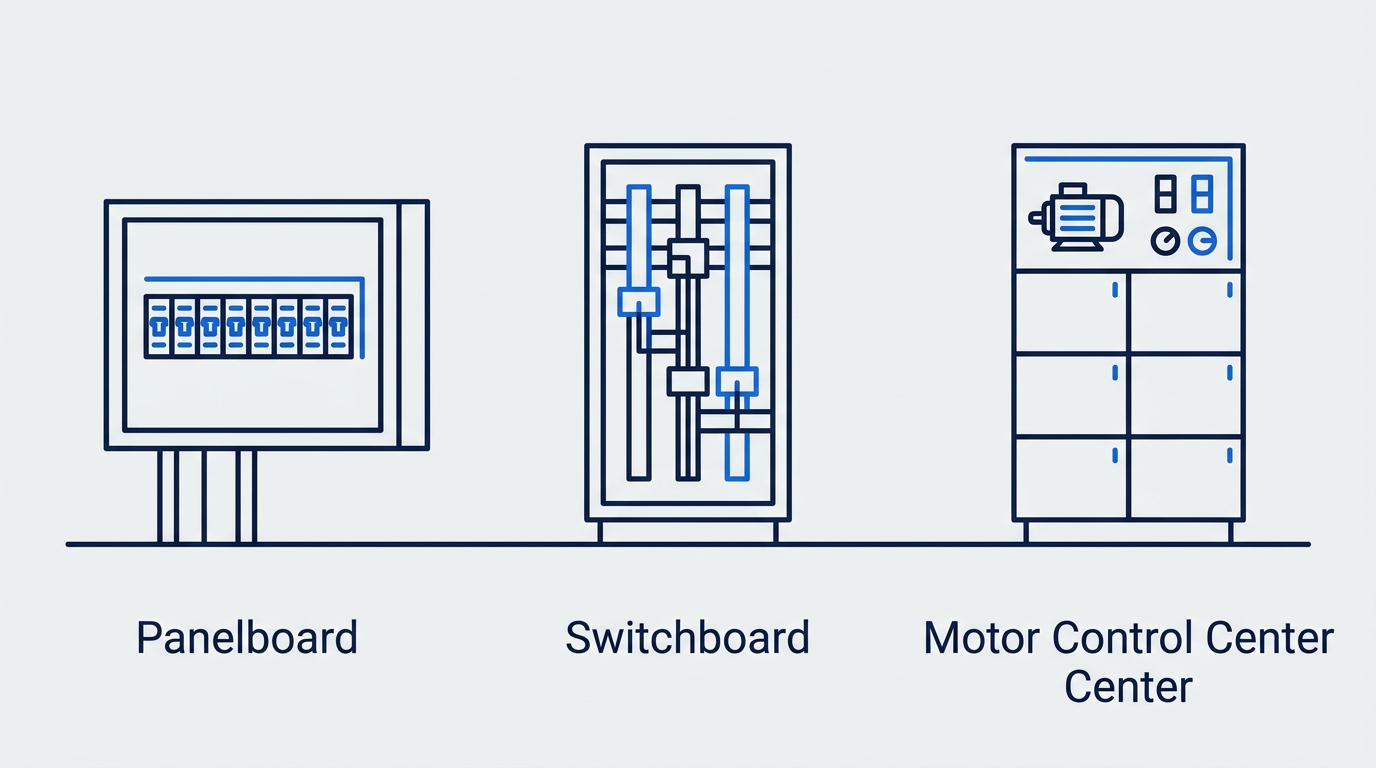
In other words, we work with robust distribution equipment sized to handle heavy loads and complex configurations. For commercial purposes, we have three types of equipment: panelboards, switchboards and motor control centers. Each is made specifically for its service capacity and application.
| Equipment Type | Typical Amperage Range | Voltage Configuration | Best Suited For |
|---|---|---|---|
| Panelboard | Up to 1,200 amperes | 208/120V three-phase, 480/277V three-phase | Branch and feeder circuits in offices, retail spaces, and small industrial facilities |
| Switchboard | 400 to 4,000+ amperes | 208/120V three-phase, 480/277V three-phase, 480V delta | Main service entrance equipment for mid-size to large commercial buildings |
| Motor Control Center | 200 to 1,200 amperes | 480V three-phase | Heavy machinery, HVAC systems, and manufacturing lines |
Selecting the right class hinges on load calculations and intended use. Panelboards serve branch and feeder circuits efficiently in offices, retail, and small industrial settings, while switchboards handle main service entrance functions for mid-size to large buildings. Motor control centers are purpose-built for managing high-horsepower motors in manufacturing and HVAC applications.
The commercial service entrance ratings range from 400 amperes to over 4,000 amperes and have three-phase voltage ratings including 208/120 volts, 480/277 volts and 480 volts Delta. The service is used on high horsepower machines, bio-tech equipment, and electric vehicle charging stations. Therefore selecting proper electrical equipment is part of this process which will determine how the installation gets permitted and inspected. Panelboard replacement retains the same short-circuit current rating as originally rated if listed by catalog number or dimensions. If the fault current exceeds 10,000 amps, then the field label must be included if they were not pre-listed according to NFPA 70 section 408.9
After the appropriate equipment class is chosen, the project must progress through permitting and inspection to ensure compliance with local codes and safety standards.
Permitting, Code Compliance, and Inspection Requirements
Permits are a required part of commercial circuit upgrades for businesses in California, ensuring every upgrade meets state and local safety standards before energizing new circuits. Licensed commercial electrical contractors in Carlsbad must pull permits through the local building division, and the City of Carlsbad’s Building Division typically processes applications within two to eight weeks. Compliance spans Title 24 of the California Electrical Code and local municipal amendments, with fire alarm system installations requiring separate fire marshal approval in addition to the standard electrical permit.
Calif., Title 8, Sec. 2725. Service Entrance Equipment, requires there to be a disconnecting means that is marked, readily accessible, and is capable of simultaneously interrupting all ungrounded circuit conductors. Surge and lightning arresters shall be connected to the supply side of any switches in the circuit. The equipment must be suitable for the prevailing environmental conditions. An exception applies for fire pump circuits with proper overcurrent protection, which may remain connected on the source side. Control transformer circuits with proper overcurrent protection may also remain connected on the source side. These requirements ensure that service equipment can safely isolate power during emergencies or maintenance.
Before tearing down starts, bring in a Licensed electrical contractor to verify that the load on the circuit matches what can be handled at your location under the rules set forth within your area. This early planning helps avoid costly rework. It also ensures that seismic retrofitting mandates for panels and transformers are addressed, particularly in jurisdictions across California where such upgrades are required.
A typical inspection sequence follows a predictable structure: permit application and plan review, rough-in inspection once wiring is installed but before walls are closed, and a final inspection to confirm code compliance after all work is complete. Navigating permits, codes, and inspections safely depends on working with a properly licensed partner who understands both state regulations and local nuances.
Choosing a Licensed Partner for Your Commercial Upgrade
When planning commercial circuit upgrades for businesses, choosing the right licensed partner directly impacts safety, compliance, and long-term reliability. Our technicians ensure every project meets local codes through meticulous permit coordination and rigorous inspections with city building divisions like those in San Jose and Carlsbad.
Verify licensing and insurance
We hold current licensure, insurance and bond for all municipalities that we service which protects your business from potential liability claims and ensures your commercial wiring jobs will be code compliant. Checking this information ahead of time can prevent any headaches down the road and keep you out of hot water with local codes. Our 20+ years of experience along with a team of Master Electricians ensure that each job has very experienced commercial electricians working on it.
Confirm permit management and inspections
A competent contractor files for all needed permits up front, then obtains a final sign-off when finished. Our team coordinates with local building departments—such as the City of San Jose and Carlsbad Building Division—to secure approvals before work begins, eliminating delays and ensuring your upgrade passes every inspection. We manage every step so you can focus on running your business without interruption.
Assess capacity expertise for high-demand needs
Commercial establishments may need 200-amp services or greater due to electric vehicle chargers, lighting installations, or other equipment. Our staff will check out the existing structure and provide a solution to fit your requirements without overloading any component and making sure you have enough power for whatever might come next. Whether the goal is upgrading panels or redoing wiring, our crew makes certain the electrical framework does exactly what you want it to do.
Demand transparent pricing practices
We provide upfront written pricing only after an on-site assessment, so you know the full cost before work starts. This transparency protects against hidden fees and allows accurate budgeting for your commercial circuit upgrades for businesses. With no surprises, you can plan with confidence and avoid budget overruns.
Having that information makes you ready to evaluate bids confidently and select a partner who prioritizes safety, compliance, and your company’s uninterrupted operation.
Plan Your Commercial Circuit Upgrade with Confidence
When a business needs to upgrade its electrical system and has a licensed C-10 contractor like our team, it doesn’t have to navigate through the maze of permits, inspections and Title 24 requirements on its own. Our local team members take care of everything related to permitting and codes so that a company’s project will comply with all requirements right from the start.
Permit timelines typically range from two to eight weeks, so we encourage getting an on-site appointment well before you need the work started to align with your desired start date. You’ll receive a clear, written quote after our evaluation—no surprises, just transparent pricing you can budget for with confidence. We understand costs must fit into any project’s overall budget!
Ready to move forward? Contact Blue Moon Electrical today at (855) 904-2265 to schedule your evaluation and obtain a written estimate on your business’ commercial circuit upgrades for businesses near you. We ensure that all work meets local code and permit requirements, and we strongly advise against attempting any DIY electrical tasks as it can be extremely dangerous.
Plan Your Upgrade with Experts
You’ve seen how commercial circuit upgrades for businesses involve more than swapping out a panel — from 400 to 4,000+ amp service entrances and NFPA 70 requirements to Title 24 permitting and seismic considerations. With permit timelines often running two to eight weeks, early planning protects both your schedule and your budget. The right licensed partner handles permits, inspections, and code compliance end to end, so your operations face minimal downtime. Blue Moon Electrical brings over 20 years of licensed commercial electrical experience across California, and every project starts with an on-site assessment and upfront written pricing. Call (855) 904-2265 to schedule your assessment and get a firm quote before any work begins. As with all electrical work, upgrades must comply with local codes and permit requirements — trust a licensed commercial electrician to scope it correctly.
Plan Your Upgrade with Experts