An electrical panel upgrade for a large estate is rarely about one appliance. In Malibu, it’s almost always about several systems arriving at once: a pool that needs its own dedicated circuit, a guest house that used to sit empty and now has its own kitchen and laundry, and an EV charger in a garage that was wired decades before anyone planned for one. Any single addition might fit on the existing service. All three together, on a property that was built for a smaller electrical footprint, usually don’t.
Malibu’s estates present this problem in a specific way. Properties here often combine a main house with one or more detached structures, a guest house, a pool house, a garage suite, spread across a large lot, sometimes along the coast and sometimes up in the canyons. Each structure adds its own load to the property’s total demand, even when only the main house’s panel was ever upgraded.
Why Malibu Estates Outgrow Their Original Panel
A property’s electrical service was sized for the home as it existed when the panel went in, not for the home as it exists after a pool, a guest house, and an EV charger get added over the years. This is common enough that Blue Moon Electrical’s own Malibu team fields it regularly: a 100-amp panel that was perfectly adequate for the original 1970s or 1980s house has nothing left to give once a pool pump, a guest house sub-panel, and a Level 2 charger are all drawing at the same time.
The fix isn’t always a bigger main panel. Sometimes it’s a properly sized subpanel for a detached structure. Sometimes it’s a full service upgrade because the main panel itself has no room left, physically or electrically. The right answer depends on a load calculation, not a guess.
How Pools, Guest Houses, and EV Chargers Add Up
A standard pool pump typically runs on a dedicated 240-volt circuit, and per a U.S. Consumer Product Safety Commission safety alert, all electrical equipment around a pool, including pump motors, heaters, and any outlet within 20 feet of the water, needs ground-fault circuit-interrupter protection. The same alert notes that older pools, the kind common on estates that have had a pool for decades, are the ones most likely to be missing that protection. That’s not optional, and it’s not free capacity the pool can borrow from elsewhere in the house.
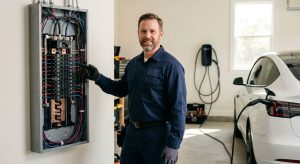
A guest house with its own kitchen, laundry, and HVAC is functionally a second home electrically, even though it’s on the same property. Depending on size, it may need its own subpanel entirely, fed from the main service but with its own dedicated breaker space. And a Level 2 EV charger draws roughly what a large electric dryer or central AC unit draws, continuously, for hours at a time, which is a meaningful chunk of a 100-amp service’s total capacity on its own.
- Pool pump and equipment pad: dedicated 240V circuit, GFCI-protected throughout
- Pool or spa heater: a second dedicated circuit in most configurations
- Guest house kitchen, laundry, HVAC: often warrants its own subpanel
- Level 2 EV charger: comparable draw to a large dryer, running for hours
- Landscape and exterior lighting across a large lot: smaller individually, but adds up over multiple zones
Load Calculations: The Step Before Any Upgrade
A load calculation adds up everything the property draws, or will draw once every planned addition is in place, and compares that total against what the existing service can safely deliver. This is the step that turns “we think we need a bigger panel” into an actual number, and it’s also the step that sometimes reveals a full service upgrade isn’t necessary at all, that a well-placed subpanel solves the problem for less money and less disruption.
Skipping this step is how homeowners end up with a system that trips breakers under real-world load instead of one that quietly handles it. It’s also the step that determines whether a straightforward 200-amp service is enough, or whether a larger estate genuinely needs 400-amp service.
200-Amp vs 400-Amp Service for Larger Properties
A 200-amp panel is the modern standard and handles most single-family homes comfortably, even with an EV charger and central AC added in. It’s also, per federal guidance for the 25C electrical panel tax credit, the minimum capacity a qualifying panel upgrade must be able to serve. But a Malibu estate with a pool, a guest house, and a canyon lot with a well pump or septic system can push past what 200 amps comfortably supports, especially once a backup generator for wildfire-season outages enters the picture. In those cases, 400-amp service, sometimes configured as dual 200-amp meter sockets, is the more realistic target.
| Property Feature | Typical Panel Impact |
|---|---|
| Main house only, no major additions | 200A service is usually sufficient |
| Add a pool and pool equipment pad | Dedicated 240V circuit, GFCI-protected |
| Add a guest house or pool house | Often needs its own subpanel |
| Add a Level 2 EV charger | Comparable draw to a large dryer, for hours |
| Add a whole-home backup generator | Often the tipping point toward 400A service |
Coastal and Canyon Conditions That Complicate the Job
Malibu’s 21 miles of coastline and its canyon terrain add real conditions that a standard panel upgrade in a flatter, drier city doesn’t have to account for. Beachfront panels and connections corrode faster in salt air, which matters for the service equipment itself, not just the aesthetics. Canyon properties on long service runs from the road need wiring sized to handle the distance without excessive voltage drop. And in both cases, public safety power shutoffs during high fire-risk weather, a measure the state’s utilities have used since 2018 under California Public Utilities Commission authorization and that the City of Malibu has specifically flagged as more frequent in recent fire seasons, make backup power planning a real part of the panel-sizing conversation, not an afterthought.
Subpanels for Guest Houses and Detached Structures
A detached guest house, pool house, or garage suite is a strong candidate for its own subpanel rather than running every individual circuit back to the main panel. A subpanel gives the detached structure its own breaker space, simplifies future changes to that structure without touching the main panel, and can be sized specifically for what that building needs rather than borrowing capacity in a piecemeal way from the main service. On a property with several outbuildings, staggering subpanels this way also makes it easier to isolate one structure’s circuit for repair or maintenance without cutting power to the rest of the estate.
Permits and Utility Coordination in Malibu
Panel and service work is permitted through the City of Malibu and, for unincorporated areas nearby, Los Angeles County. Because a service upgrade touches the utility connection itself, Southern California Edison coordination is part of the timeline, and that coordination, not the electrical work itself, is often the longest part of the schedule. Planning the permit and utility steps early avoids a project that sits half-finished waiting on a utility appointment, especially on a canyon property where access itself can add scheduling delays a flatter lot wouldn’t face.
“We size Malibu estate services for the property, not just the house. A pool, a guest house, and a generator all pull from the same panel, and the only way to get it right is a real load calculation before anyone picks a panel size.”
– Victor, Blue Moon Electrical
What to Expect During the Upgrade
A full electrical panel upgrade involves a new meter base, new service entrance conductors, and the new panel itself, plus permitting and a scheduled utility disconnect and reconnect. For a property adding a detached guest house circuit, subpanel installation is scoped and priced separately and can often proceed on a faster timeline since it doesn’t require the same utility coordination as a full service change. Adding an EV charger alongside either project is usually more efficient than doing it as a separate job later, since the load calculation and permit can account for it from the start. Permitting for the charger itself is faster than it used to be statewide: state law under Assembly Bill 1236 and Assembly Bill 970 requires every California jurisdiction to offer an expedited process for EV charging station permits, and demand for that step keeps climbing, with the California Energy Commission reporting electric vehicles now account for 16.6% of new car sales statewide.
What the Electrician Checks in the Existing Panel
Before quoting an upgrade, a thorough electrician doesn’t just measure the amperage on the label, they open the panel and look at what’s actually inside. Double-tapped breakers, two wires landed under a single screw meant for one, show up often on estates that have had circuits added piecemeal over the years by different contractors at different times. A missing bonding screw, the connection between the neutral bus and the panel cabinet, is a serious but easy-to-miss omission that breaks the fault-current path the whole system depends on for safety. Thermal imaging during this kind of inspection can also reveal a breaker running hotter than the ones around it, often a sign of a loose connection or an overloaded circuit well before it becomes an emergency call.
On a property with a mix of original wiring and additions from different decades, this inspection step matters more than it does on a newer build. A panel that was upgraded once in the 1990s and then had a pool circuit added in the 2000s and a guest house subpanel tapped in more recently can accumulate small inconsistencies that a full load calculation and physical inspection catch together, rather than either one alone.
Backup Power and PSPS: Sizing for a Generator Too
A whole-house standby generator changes the math on a panel upgrade, and it’s worth factoring in even if the immediate reason for the project is a pool or a guest house. Before anyone talks about generator size, the panel needs a look: many Malibu properties, especially older hillside and canyon homes, were built with 100-amp service that leaves little headroom for a generator on top of existing loads like HVAC, a pool, or an EV charger. Sizing a generator starts with the same load calculation used for the rest of the property, adding up what the home actually draws and deciding whether to back up everything or just the essential circuits, a choice that changes both the generator size and whether a dedicated subpanel makes sense.
Skipping that step is how homeowners end up with a generator that trips breakers under real load instead of one that quietly does its job during a shutoff. For a property already planning a panel upgrade for a pool or guest house, it’s a natural point to ask whether generator readiness should be part of the same project rather than a separate one down the road.
Cost Factors for Malibu Estate Electrical Work
Cost scales with scope more than with any single feature, but Malibu’s terrain adds its own variables on top of the standard equipment list. A property with a long service run from the road to the panel, common on canyon lots, needs wiring sized to avoid excessive voltage drop over that distance, which adds to material cost. Beachfront properties often need corrosion-resistant, marine-grade materials for any exposed equipment, since salt air degrades standard hardware faster than an inland property would ever see. A subpanel for a guest house, sized appropriately, costs less than a full service upgrade and can often solve the problem on its own. A full 200-amp to 400-amp service upgrade costs more, in part because of the heavier service entrance cable and the utility coordination involved, but it’s the option that gives a large estate genuine headroom for a pool, a guest house, an EV charger, and a future generator all at once, rather than solving one problem at a time as each addition strains the system further, and rather than paying for a second mobilization every time the property adds something new.
If your Malibu property has added a pool, a guest house, or an EV charger since the panel was last touched, or you’re planning all three, Blue Moon Electrical’s Malibu electricians can run the load calculation and lay out whether a subpanel or a full service upgrade is the right fit before any equipment gets ordered, and before a contractor is already on site expecting power that isn’t there yet.