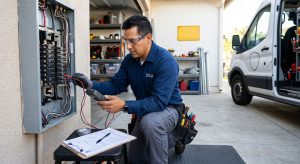
A Palm Desert seasonal home electrical checklist is not something most homeowners think about until they come back from a summer away and find the pool pump breaker tripped, the AC struggling to catch up after weeks off, or an outdoor outlet that will not reset. Palm Desert’s mix of full-time residents and part-time snowbird owners means a huge share of the city’s homes sit empty for weeks or months at a time, and an electrical system that is fine under daily use behaves very differently after sitting idle through a 115-degree summer.
This checklist walks through what to do before you leave, what desert heat and an empty pool system do to a home’s wiring over a season, and what to check before you flip everything back on. Blue Moon Electrical’s Palm Desert electrician team handles exactly this kind of seasonal home evaluation year-round.
Why Palm Desert Homes Need a Different Electrical Approach
Palm Desert and the wider Coachella Valley run on a seasonal rhythm that most cities simply do not have. Palm Desert describes itself as a community with roughly 50,000 full-time residents and more than 30,000 seasonal residents who arrive for the cooler months and leave well before peak summer heat. Nearby Indian Wells shows just how common part-time ownership is in this part of the valley: city housing element data reported that 83.1 percent of vacant housing units were classified as seasonal, recreational, or occasional use, with an overall vacancy rate above 50 percent.
That pattern matters for electrical planning because a system built and maintained for constant daily use is being asked to do something different in a seasonal home: sit dormant for months, then get switched back on all at once under some of the most extreme heat in the country. Summers across the Coachella Valley regularly bring temperatures of 100 degrees and beyond from June through October, and that heat does not pause just because the house is empty.
Before You Leave: An Electrical Shutdown Checklist
A few steps before closing up a seasonal Palm Desert home go a long way toward avoiding a bad surprise on your return.
- Have a licensed electrician test every GFCI outlet, indoors and out, before you leave, since a GFCI that will not trip or reset properly is a device that has already started to fail
- Confirm pool and spa equipment circuits are in good condition rather than assuming last season’s setup is still fine
- Check the panel for warm breakers, corrosion, or loose connections before the home sits unattended for weeks
- Consider a whole-home surge protector if you do not already have one, since desert power fluctuations from grid strain during peak cooling season can spike through unprotected circuits while no one is home to notice
- Leave HVAC and pool equipment on their designed settings rather than shutting everything off cold, since some systems are meant to cycle periodically even during an absence
- Document the panel and major equipment with photos so any change is easy to spot when you return
Pool and Spa Circuits: What to Check Before an Extended Absence
Pool and spa electrical requirements in California are governed by NEC Article 680, and the rules exist specifically because water and electricity are such a dangerous combination. Every circuit supplying a pool pump, heater, underwater light, or nearby receptacle requires GFCI protection, and at least one 125-volt, 15- or 20-amp receptacle must sit between 6 and 20 feet of the pool edge for maintenance equipment, also GFCI protected.
A pool pump GFCI that trips repeatedly while you are away is not something to just leave alone until you get back. Left unresolved, a nuisance-tripping breaker can mean a pump sits off for weeks, which in desert heat can lead to algae growth, equipment strain, and a much bigger cleanup and repair job than a quick electrical fix would have been.
“A pool GFCI that keeps tripping isn’t being overly cautious. It’s usually picking up moisture or a failing pump seal, and that’s exactly the kind of thing you want caught before a home sits empty for the summer, not after.”
– Marco, Blue Moon Electrical
GFCI Protection and the 2026 Code Update Worth Knowing
GFCI protection is the single biggest reason electrocution deaths have dropped so dramatically over the past several decades. Industry data compiled by Schneider Electric shows electrocutions fell from an average of 1,101 per year between 1971 and 1980 to an average of 249 per year between 2011 and 2023, a reduction widely credited to the expanded adoption of GFCI protection through successive National Electrical Code editions. That is exactly the kind of protection a Palm Desert pool, spa, and outdoor circuit setup depends on.
There is a 2026 code wrinkle specific to outdoor HVAC equipment that is worth knowing if you are scheduling any electrical work on a Palm Desert home. Outdoor HVAC equipment has historically been incompatible with standard GFCI devices because of nuisance tripping caused by variable-speed motors, so an exception has delayed enforcement of GFCI protection for listed HVAC equipment. That exception ends September 1, 2026, meaning outdoor HVAC circuits in Palm Desert homes will need high-frequency-compatible GFCI protection going forward, an important detail for anyone planning HVAC or panel work this year.
Whole-Home Surge Protection for Desert Power Fluctuations
Summer in the Coachella Valley pushes the regional power grid hard, with nearly every home and resort property running air conditioning at full capacity for months at a time. That kind of sustained grid strain increases the odds of voltage fluctuations and brief surges, which are far more likely to damage sensitive electronics, smart home equipment, and HVAC control boards in a home that is unattended and unable to be unplugged or reset quickly.
A whole-home surge protector installed at the panel is a relatively small investment that protects everything downstream at once, rather than relying on individual plug-in surge strips scattered around the house, most of which offer far less protection than homeowners assume.
What Desert Heat Does to a Panel Over a Summer
Extreme, sustained heat is hard on electrical components in ways that are easy to underestimate. Heat accelerates the breakdown of wire insulation, causes metal components inside a panel to expand and contract more aggressively, and adds mechanical stress at every connection point. A panel that already has a loose connection or an aging breaker is far more likely to show a problem after a summer of triple-digit attic and enclosure temperatures than one that runs in a mild climate year-round.
This is one reason electricians who work Palm Desert regularly recommend inspecting a seasonal home’s panel and major circuits before the owner leaves for the season, not months later when the AC finally needs to run hard again in October.
Heat also affects the pool equipment pad, the outdoor disconnect, and any exterior junction boxes exposed to direct sun for months at a time. Plastic conduit and outdoor-rated covers can become brittle over years of intense UV and heat exposure, and a cover that no longer seals tightly lets in dust, insects, and moisture from the occasional summer monsoon, all of which chip away at a circuit’s reliability over time.
| Palm Desert Seasonal Home Electrical Checklist | |
| Before You Leave | Before You Return |
| Test every GFCI outlet, indoors and out | Check for corrosion or moisture on the panel |
| Inspect pool and spa equipment circuits | Test GFCIs before relying on them |
| Confirm whole-home surge protection is in place | Bring HVAC and pool systems back on gradually |
| Photograph the panel and major equipment | Watch closely for tripping breakers or odd smells |
HOA and Golf Community Electrical Considerations
A large share of Palm Desert’s seasonal housing sits inside HOA-governed communities and golf club developments, which adds a layer most homeowners in non-HOA neighborhoods never have to think about. Exterior lighting changes, EV charger placement, and even golf cart charging setups often need HOA approval before work begins, and some communities have specific rules about what equipment can be visible from the street or fairway.
Working with an electrician who is familiar with local HOA processes in Palm Desert communities can save real time, since submitting the wrong equipment spec or skipping a required approval step is a common way these projects get delayed. It also helps to have documentation ready, such as equipment spec sheets and placement diagrams, before the HOA architectural review committee meets, since incomplete submissions are one of the most common reasons approvals stall for weeks.
Golf Cart and EV Charging Setup for Desert Communities
Golf cart charging is a genuinely common request in Palm Desert in a way it simply is not in most cities, given how many communities are built around golf cart-accessible streets and paths. A dedicated circuit for golf cart charging is a smaller job than a full Level 2 EV charger installation, but it still needs to be sized and installed correctly, especially in a garage that will also need to support a real EV charger down the line.
Homeowners adding both a golf cart charging station and a Level 2 EV charger to the same garage should have an electrician evaluate total panel capacity for both circuits together, rather than adding them one at a time without a combined load calculation.
This matters even more in a seasonal home, where the panel may already be carrying pool equipment, whole-home surge protection, and HVAC load without much spare capacity to begin with. Adding two new dedicated circuits to a panel that has not been evaluated in years is one of the more common ways homeowners discover, mid-project, that a panel upgrade is needed before the charging equipment they actually wanted can go in.
What to Check Before You Flip the Power Back On
Before switching everything back on after weeks or months away, a quick walkthrough helps catch problems before they become full-blown emergencies.
- Look for signs of rodent or insect activity near the panel, meter, or outdoor equipment, which is more common in a home that has sat quiet
- Check for any visible corrosion, moisture staining, or discoloration on the panel exterior
- Test GFCI outlets before relying on them for pool equipment, kitchen appliances, or outdoor tools
- Bring HVAC and pool systems back online gradually rather than starting every high-draw appliance at once
- Watch the first few days closely for tripping breakers, unusual smells, or warm switch plates
Signs Your Panel or Wiring Took Damage While You Were Away
Some warning signs are worth calling an electrician about right away rather than waiting to see if they resolve on their own: a breaker that will not reset, a burning smell near the panel or an outlet, visible scorch marks, a GFCI that trips instantly every time, or pool equipment that will not power on at all. None of these are things to troubleshoot yourself in a home that has been sitting empty, since you have no recent history of how the system was behaving before you left.
It is also worth checking in with neighbors or a property manager if you have one, since a power blip, a monsoon storm, or a utility maintenance event during your absence can sometimes explain an issue that would otherwise look mysterious. Knowing what happened while you were gone helps an electrician diagnose the actual cause rather than guessing at it.
Why a Pre-Season Electrical Inspection Is Worth Scheduling
The most reliable way to avoid an electrical surprise in a Palm Desert seasonal home is a scheduled electrical safety inspection before you leave and, ideally, another before your next stay begins. A licensed electrician can check the panel, test GFCI protection throughout the home, evaluate pool and spa circuits, and flag anything heat or time have started to wear down, long before it turns into an emergency call during the one week a year you are actually there to notice.
Whether your home is a full-time golf community residence or a true seasonal retreat, building an electrical checkup into your seasonal routine is one of the simplest ways to protect the property and avoid coming home to a problem instead of a vacation. It also tends to be one of the more affordable forms of protection available for a second home, especially compared with the cost and disruption of repairing water damage, pool equipment failure, or a full panel replacement discovered only after something has already gone wrong.
A seasonal home in Palm Desert is still a full electrical system that needs attention on a schedule that fits how the property is actually used, not the standard once-a-decade checkup that works fine for a full-time residence elsewhere.