Why Whole-House Surge Protectors Matter for Edison Homes
A whole-house surge protector in Edison, NJ is worth understanding before the next thunderstorm rolls through Middlesex County, not after it takes out a furnace control board or a smart thermostat. Central New Jersey sees hard summer thunderstorms and nor’easters most years, and both are common triggers for the kind of voltage spike that a plug-in power strip was never designed to stop.
A whole-house surge protector, also called a Type 2 surge protective device (SPD), installs at or near your main electrical panel and is built to intercept a voltage spike before it reaches any circuit in the house, rather than protecting only whatever happens to be plugged into a single strip.
What a Power Strip Actually Protects, and What It Misses
Plug-in surge strips have a real, limited job. They protect the handful of devices plugged directly into them. They do nothing for hardwired equipment such as central air conditioning, a furnace, an electric range, a well pump, or an EV charger, and they let a surge into the rest of the panel before the strip even reacts in some failure modes.
| Protection Type | Covers | Misses |
|---|---|---|
| Plug-in power strip | Only the devices plugged directly into it | HVAC, range, well pump, EV charger, and the panel itself |
| Whole-house SPD (installed at the panel) |
Every circuit in the home at once, including hardwired equipment | Localized surges that enter downstream of the panel, such as through a cable or phone line |
New Jersey’s Electrical Code Now Requires Surge Protection
This is not just a nice-to-have anymore. New Jersey adopted the 2020 National Electrical Code in September 2022, and Article 230.67 of that code requires a Type 1 or Type 2 surge protective device on all services supplying dwelling units, including whenever existing service equipment is replaced. That means any Edison home getting a panel replaced or a new service installed today needs an SPD as part of that work to pass inspection, not as an optional add-on.
For homes with an older panel that predates this requirement, adding a whole-house SPD closes that gap without waiting for a full panel replacement to trigger it.
How Often Storms Cause Real Damage in Central Jersey
Surge damage claims are common enough that the insurance industry tracks them separately from other storm losses. The Insurance Information Institute reported close to 61,000 homeowners insurance claims involving lightning damage nationwide in a single recent year, with an average settlement over $21,000 per claim. That figure covers direct strikes as well as the induced surges that travel through service lines from a strike or a utility-side event well away from the home itself, which is exactly the kind of event PSE&G customers see during a hard summer thunderstorm or an ice storm.
“A surge doesn’t have to hit your house directly to cause damage. A transformer blowing down the block or a strike a mile away can still push a voltage spike down the same service line every house on that circuit shares. The panel is where you stop it for the whole house at once, instead of hoping every device you own happens to be plugged into a strip.”
— David, Blue Moon Electrical
What a Whole-House Surge Protector Installation Involves
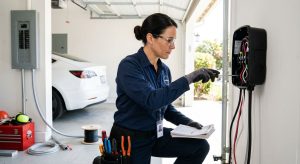
A licensed electrician installs the SPD at or immediately adjacent to your main service panel, typically on a dedicated two-pole breaker, so it can intercept a spike before it reaches any branch circuit. The work itself is usually straightforward for a licensed electrician and does not require opening walls, though it does require briefly shutting off power to the panel.
- A Type 2 SPD sized appropriately for your service, in line with NEC 230.67
- A dedicated breaker at the panel for the device
- A permit from the Township of Edison’s Building Department
- Inspection by a New Jersey licensed electrical inspector once the work is complete
Because it installs at the panel, a whole-house SPD also pairs naturally with other panel-related work. Homeowners already scheduling a panel upgrade in Edison often add surge protection to the same visit, since the panel is already open and the permit process is already underway.
Does Homeowners Insurance Cover Surge Damage in Edison?
Most standard homeowners policies cover surge damage that traces back to a covered peril such as a lightning strike, but coverage for surges from other causes, such as utility switching or a downed line, varies by policy and carrier. Documentation matters for any claim: keep the invoice for the SPD installation, note the date and approximate time of the storm or outage, and photograph any visibly damaged equipment before it is replaced. An SPD does not just reduce the odds of damage. It also gives an adjuster clear evidence that the home had a documented layer of protection in place.
Getting Whole-House Surge Protection Installed in Edison
If your Edison home has an older panel, has never had a documented surge protector installed, or you simply want the code-required protection in place before the next storm season, a licensed electrician can typically complete the installation, permit, and inspection in a single visit. Blue Moon Electrical’s Edison team handles the load assessment, the SPD sizing, the permit filing with the Township, and the coordination with the NJ electrical inspector as part of the job.
For homes already dealing with storm-related outages or panel damage, it is also worth reviewing our emergency electrician service in Edison, since a whole-house SPD is most valuable installed before the next event, not after.
How a Surge Actually Reaches Your Panel
Most homeowners picture a direct lightning strike when they think about surge damage, but that is actually the least common path. A voltage spike more often reaches an Edison home through one of a few routes.
- A nearby strike inducing voltage on the line. Lightning does not need to hit your house or even your street. A strike within roughly a mile can induce a damaging voltage spike on the same overhead or underground service lines that feed your home.
- Utility-side switching events. PSE&G restoring power after an outage, switching between circuits, or clearing a fault elsewhere on the grid can send a brief but damaging spike down the line well after the storm itself has passed.
- A transformer failure on your block. A blown transformer near your home is one of the more common causes of a serious, damaging surge, since it can send a much larger spike than a typical lightning-induced event.
- Large appliances cycling on and off inside your own home. Central air conditioning compressors, well pumps, and other high-draw equipment create smaller internal surges every time they cycle, which is a slower, cumulative source of wear on electronics rather than a single dramatic event.
A whole-house SPD at the panel addresses the first three sources directly, since all of them enter the home through the service conductors. That is also why it is a fundamentally different layer of protection than a plug-in strip, which can only react to whatever reaches the specific outlet it is plugged into.
What We See After Central Jersey Storms
Storm-related service calls in Edison follow a recognizable pattern each season. Homes without any surge protection at the panel tend to lose more than one piece of equipment in the same event, since a spike traveling through the service conductors reaches every branch circuit at once rather than a single outlet. Furnace and central air control boards, garage door openers, and networking equipment such as routers and modems are among the more common casualties, since all three sit on circuits that stay energized around the clock and are rarely protected by anything beyond a basic strip, if that.
Homes with a whole-house SPD already in place generally report far less of this pattern, since the device is doing its job upstream of every circuit before a spike ever reaches the equipment plugged in downstream.
Choosing the Right Surge Protective Device
Not every SPD is sized the same way, and getting this right matters more than picking the cheapest listed unit online. A licensed electrician sizes the device to your service (commonly 200-amp for an Edison single-family home), confirms whether a Type 1 or Type 2 device is the better fit for your specific service configuration, and checks the surge current rating, since a higher-rated device generally has more capacity to absorb a large event without needing replacement afterward.
It is also worth asking whether the device includes a visible status indicator, since some SPDs can absorb a surge and continue operating in a degraded state without any obvious sign, which means an indicator light is the only practical way to know it needs replacement after a major event.
Surge Protection as Part of a Broader Electrical Safety Plan
A whole-house SPD is one layer in a broader approach to protecting an Edison home’s electrical system, alongside a panel in good working condition, properly functioning GFCI and AFCI protection, and smoke and CO detectors that are within their rated service life. Homeowners updating any one of these are often well positioned to add the others in the same visit, since much of the labor and the permit process overlaps.
What Happens to Equipment During a Surge, in Plain Terms
Many homeowners assume a surge either destroys a device outright or does nothing at all, but the more common outcome sits in between. A voltage spike that is too small to visibly fry a circuit board can still degrade sensitive components over repeated smaller events, shortening the working life of electronics without an obvious single moment of failure. This is one reason homeowners sometimes replace the same type of equipment, a router, a garage door opener, a thermostat, more than once over a period of years without ever connecting the pattern to unprotected wiring. A whole-house SPD is designed to absorb these smaller, repeated events as well as a single larger one, which is part of why its benefit often shows up as fewer repeat failures over time rather than a single dramatic save.
Whole-House Surge Protection and Home Electronics Investment
The average Edison home now runs meaningfully more sensitive electronics than it did even a decade ago. Smart thermostats, video doorbells, home networking equipment, smart appliances, and increasingly an EV charger all sit on circuits that are energized continuously and rarely protected by anything beyond a basic plug-in strip, if that. Each of these represents a real replacement cost if damaged, and several tend to fail in the same event since they typically share circuits fed from the same panel. Viewed against the combined replacement cost of even a modest set of connected devices, a whole-house SPD is a comparatively small, one-time investment that protects all of them at once rather than requiring a strip at every outlet in the house.
Working With a Licensed Edison Electrician
Surge protective devices are inexpensive to buy but matter to install correctly, since sizing, breaker placement, and grounding all affect how well the device actually performs during a real event. New Jersey requires electrical work to be performed by a licensed Electrical Contractor holding a valid state license, and the permit and inspection process exists specifically to verify that installations like this meet code. When comparing quotes, ask whether the SPD is rated for your specific service size, whether the installation includes a dedicated breaker rather than sharing a slot with another circuit, and whether the permit and inspection are included in the price rather than billed as an add-on afterward.
Seasonal Timing for Edison Homeowners
Late spring through early fall is when Central Jersey sees the bulk of its thunderstorm activity, and winter brings its own risk from nor’easters and ice storms that can stress the grid in different ways, often through prolonged outages followed by a surge when power is restored. Scheduling a whole-house SPD installation before either season starts, rather than after the first bad storm of the year has already caused damage, is the more practical order of operations, and it also avoids the scheduling backlog that tends to follow a major regional storm event when demand for electrician visits spikes all at once.
Homeowners who wait until after a bad storm often find themselves competing for appointment slots with an entire neighborhood dealing with the same outage or damage at once, which can turn a routine, planned installation into an unplanned, weeks-long wait during exactly the period when protection matters most.