Backup generator PSPS Thousand Oaks conversations tend to start the same way every year: the wind picks up, Southern California Edison issues a Public Safety Power Shutoff watch, and homeowners realize they don’t actually know whether their electrical panel can accept a generator at all. August sits right in the middle of peak fire weather season here, which makes this exactly the wrong time to find out the answer is no.
We hear the same story from homeowners across the Conejo Valley almost every wind event: a generator sitting in the garage, purchased after last year’s outage, that nobody ever got around to connecting properly. It usually isn’t neglect. It’s that the generator purchase feels like the finish line, when in reality it’s only half the project. The other half, making sure the panel can accept that generator safely, is the part that actually determines whether the household has power during the next multi-day shutoff.
Why Thousand Oaks Sits Squarely in PSPS Territory
Southern California Edison shuts off power proactively in areas it designates as High Fire Risk Areas, or HFRAs, when weather conditions, strong winds, low humidity, and dry vegetation, create meaningful risk that its equipment could spark a wildfire. Thousand Oaks and the surrounding Conejo Valley fall within SCE’s service territory and include HFRA-designated circuits, particularly in the hillside communities closer to open space (SCE Public Safety Power Shutoff Program).
SCE has continued expanding the scope of areas considered for PSPS, adding tens of thousands of newly covered customers in recent years as more circuits get classified into high fire risk zones, alongside another large group of customers who sit on the borders of these zones and may be affected depending on the severity of a given weather event (SCE PSPS Program Updates). Practically, that means more Thousand Oaks households are in scope for a shutoff today than were a few years ago, even if their specific street hasn’t been affected yet.
It’s also worth understanding that PSPS designation isn’t fixed. SCE reassesses HFRA boundaries as it completes grid-hardening projects, undergrounds lines, or installs covered conductor in a given area, which can shift a neighborhood’s risk classification over time in either direction. A property that wasn’t affected last year isn’t guaranteed to stay that way, and one that saw repeated shutoffs a few years ago may see fewer once nearby infrastructure upgrades are finished. This is part of why a generator-readiness plan is worth having in place regardless of your street’s current PSPS history.
This expansion isn’t SCE being overly cautious for its own sake. The utility has pointed to specific cases where equipment damage during high-wind events would likely have caused an ignition had the power not already been shut off, which is the core rationale behind the program even as it inconveniences homeowners in the moment (SCE Public Safety Power Shutoff Program). For Thousand Oaks specifically, hillside neighborhoods near open space and canyon terrain tend to see the earliest and most frequent PSPS activity, since wind speeds there are typically higher than in the flatter parts of the valley.
What a PSPS Event Actually Means for Your Home
A PSPS isn’t a brief outage. Per California Public Utilities Commission guidance, residents should be prepared to endure outages lasting several days, since SCE won’t restore power until dangerous fire-weather conditions pass and crews have physically inspected the de-energized lines for damage (CPUC Public Safety Power Shutoff FAQs). That timeline is very different from a typical storm-related outage, and it’s the reason backup power planning for PSPS looks different from backup power planning for an ordinary blackout.
For most Thousand Oaks households, the real question during a multi-day PSPS event isn’t whether they’d like backup power, it’s whether their home is actually wired to accept a generator safely once one is delivered or pulled out of the garage. This is where a surprising number of homeowners discover a gap.
Why Most Panels Aren’t Generator-Ready Out of the Box
Connecting a portable generator directly to your home’s wiring without the right equipment is dangerous, both for anyone inside the house and for utility line workers outside it. Backfeeding a generator into a standard outlet or breaker can send power back out onto de-energized utility lines during exactly the kind of event a PSPS is meant to prevent, putting repair crews at serious risk.
The National Electrical Code addresses this directly. Article 702 governs optional standby systems and requires that the connection prevent paralleling the utility and generator sources, meaning the two can never be live on the same circuit at once (NEC Article 702 Generator Interlock Requirements). In practice, that means your panel needs either a listed transfer switch or a code-compliant interlock kit before a generator can be connected safely, and most homes simply don’t have either installed by default.
This is licensed electrician work, not a weekend DIY project. In California, anyone performing this kind of panel modification is required to hold a C-10 license through the Contractors State License Board, and the work typically requires a permit from the City of Thousand Oaks before it’s considered code-compliant (California C-10 Electrical Contractor License Requirements). Skipping the permit step might save a little time upfront, but it can create real problems later, particularly at resale, when an unpermitted panel modification shows up during a home inspection.
Interlock Kit vs. Transfer Switch: What’s Actually Different
Homeowners researching backup power in Thousand Oaks usually run into two main options:
- Generator interlock kit: A mechanical plate mounted on the panel cover that physically prevents the main utility breaker and the generator breaker from both being on at the same time. It’s a more affordable, panel-specific solution, and it requires you to manually manage which circuits draw power.
- Transfer switch (manual or automatic): A separate piece of equipment that isolates a chosen set of circuits from the main panel, either switched manually or automatically when an outage is detected. It typically costs more but offers more predictable operation and, in the automatic version, doesn’t require anyone to be home to switch it over.
Both are legitimate, code-compliant paths as long as they’re properly sized and installed. Which one makes sense depends on your panel’s layout, your budget, and whether you want the system to run automatically or you’re comfortable manually managing which circuits get power during an outage.
Getting Your Panel Evaluated Before the Next PSPS Watch
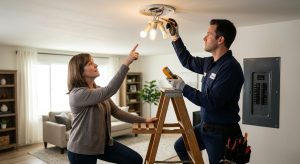
The most useful thing a Thousand Oaks homeowner can do ahead of wind season is have an electrician evaluate the existing panel specifically for generator readiness, rather than waiting until a PSPS watch is already posted. This evaluation typically covers whether the panel has room for an interlock kit or dedicated transfer switch circuit, what the home’s realistic essential-circuit load looks like, and whether any panel upgrade work is needed first if the existing equipment is undersized or outdated.
Homes with a well pump, medical equipment that depends on power, or a finished basement or ADU with its own subpanel benefit from this evaluation the most, since these are exactly the loads that turn a multi-day PSPS from an inconvenience into a real problem. A home with an ADU adds an extra wrinkle worth mentioning: if the ADU has its own subpanel, it needs to be part of the same generator-readiness conversation, since a solution designed only around the main house panel can leave a rented or occupied ADU without any backup power plan at all during an extended outage.
“A generator sitting in the garage doesn’t help anyone during a PSPS if the panel was never set up to accept it safely. That conversation needs to happen before wind season starts, not after the power’s already off.”
â Sako, Blue Moon Electrical
HOA and Neighborhood Considerations in Thousand Oaks
Several Thousand Oaks communities, including neighborhoods like North Ranch and Dos Vientos, have HOA guidelines that affect where a standby generator can be installed and how noise is managed. If you’re considering a permanently installed standby unit rather than a portable generator with an interlock kit, it’s worth checking your association’s rules on equipment placement and noise ordinances before purchasing, the same way an EV charger install requires HOA coordination in many California communities. A portable generator connected through an interlock kit generally avoids most of these restrictions since nothing is permanently installed outdoors.
City of Thousand Oaks building permits are a separate consideration from HOA approval, and both may apply depending on what equipment you’re installing. A standby generator typically requires sign-off on noise levels, setback distance from property lines, and fuel storage if propane or natural gas is involved, on top of the standard electrical permit for the interlock or transfer switch itself. Coordinating both approvals at the same time, rather than sequentially, tends to move faster.
Building a Realistic Load Plan
Once the panel itself is ready, the next step is deciding what actually needs power during an extended outage. Most homes can’t run everything simultaneously off a portable generator, so prioritizing the refrigerator, key lighting circuits, a sump or well pump if applicable, and any medical equipment makes more sense than trying to power the whole house. An electrician can walk through your panel’s circuit labeling as part of the same visit that installs an interlock kit or transfer switch, which solves two problems at once: confirming the panel is generator-ready and making sure your breaker labels actually reflect what each circuit really powers, since mislabeled panels are a common issue in homes that have had any electrical work done over the years.
Generator sizing follows directly from this load plan. A generator that’s undersized for the circuits you’ve prioritized will trip its own breaker repeatedly during use, while one that’s oversized costs more upfront and burns more fuel than necessary over a multi-day event. Walking through expected wattage for each priority circuit, refrigerator, a few lighting circuits, a well or sump pump motor’s startup surge, before buying or connecting a generator avoids both of these outcomes and is a quick calculation for an electrician to run through with you.
This is also a good time to confirm your home has working smoke detector installation coverage and that GFCI protection is functioning on relevant circuits, since a PSPS often coincides with the exact hot, dry conditions where fire risk and electrical safety checks matter most anyway.
What to Do Before the Next Wind Event
Waiting until an SCE PSPS watch is issued leaves very little time to schedule an electrician, source equipment, and get an interlock kit or transfer switch installed correctly. The homeowners who get through a multi-day shutoff with the least disruption are consistently the ones who had this evaluation done during a calm week in late spring or early summer, well before the first red flag warning of the season.
If you already own a portable generator and haven’t had your panel evaluated for a proper connection method, that’s the single highest-value call to make before wind season peaks. It’s a far smaller project than most homeowners expect, and it closes the one gap that actually determines whether backup power works when you need it. Most interlock kit installations, once the panel has been assessed and any necessary upgrade work identified, can be completed in a single visit, well within the window most homeowners have between now and the next red flag warning.
Blue Moon Electrical evaluates panels and installs interlock kits and transfer switches for homeowners throughout Thousand Oaks, ahead of and during PSPS season. If you’re not sure whether your panel can safely accept a generator, we can check it and walk you through the options before the next SCE PSPS watch is issued.