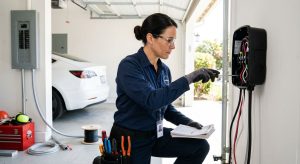
EV charger installation in Orange, CA usually starts with a simple question that turns out to have a slightly more complicated answer: can my existing panel handle it? A Level 2 home charger adds a meaningful, continuous load to a circuit, and in a city where a lot of the housing stock predates modern electrical demand, the panel question comes up almost as often as the charger question itself.
Here’s what actually goes into installing one, what it costs, and where California and Southern California Edison rebates realistically fit into the budget.
Level 1 vs. Level 2: why almost everyone ends up at Level 2
Level 1 charging uses a standard 120-volt outlet — the same kind everything else in your house plugs into — and adds roughly 3 to 5 miles of range per hour. That’s workable if you drive very little day to day, but most EV owners find it too slow to keep up with normal use. Level 2 charging runs on a dedicated 240-volt circuit, similar to an electric dryer or range, and adds roughly 20 to 40 miles of range per hour depending on the charger and the vehicle. For anyone driving a typical daily commute, Level 2 is what makes home charging actually convenient rather than something you’re managing around.
The practical test is simple: if your commute and errands add up to more daily driving than an overnight Level 1 charge can replace, Level 2 stops being a nice-to-have and becomes the thing that makes owning an EV workable without relying on public charging. Most new EV owners in Orange land on Level 2 within the first few months even if they started out planning to get by on a regular outlet.
Does your panel have room for it?
This is the question that determines everything else about the project. A Level 2 charger typically draws 30 to 50 amps on a dedicated circuit, which is a substantial chunk of a 100-amp panel’s total capacity once you account for what’s already running — central air, an electric range, a water heater. A licensed electrician runs a load calculation to check whether your existing service has enough headroom for the new circuit without exceeding safe capacity.
Two outcomes are common when the numbers come back. If there’s headroom, the charger circuit gets added directly to the existing panel and the job is comparatively simple. If there isn’t, a panel upgrade becomes part of the project — not because the charger itself demands 200-amp service, but because the combined load of everything else in the home plus the new circuit pushes past what the current panel can safely deliver. This is more common in Orange than a lot of homeowners expect, given how much of the city’s housing stock predates the era of central air, electric ranges, and EVs all sharing the same 100-amp service.
Neither outcome is a bad one — a panel upgrade tied to an EV charger is exactly the kind of project that qualifies for the rebate covered below, so finding out you need one isn’t purely a cost increase. It’s worth getting a licensed electrician in Orange, CA to run the actual numbers rather than guessing based on your panel’s age alone.
“Half the EV charger calls I get in Orange turn into a panel conversation once we actually run the numbers. It’s not a sales tactic — it’s just what the math shows on a lot of these older 100-amp services.”
— Razmik, Blue Moon Electrical
What EV charger installation costs in Orange
The charger unit itself typically runs a few hundred dollars for a mid-range Level 2 model. Installation labor — running the dedicated circuit from the panel to the charger location, mounting the unit, and permitting the work — is where the real cost variation shows up, and it depends heavily on the distance between your panel and where you want the charger mounted, plus whether the panel has room without an upgrade.
| EV Charger Installation in Orange, CA: Scope and Cost Tiers | ||||||
|
SCE rebates: what’s actually available
Southern California Edison’s Charge Ready Home program offers eligible customers rebates of up to $4,200 toward a panel upgrade needed to support a Level 2 EV charger circuit, funded through California’s Low Carbon Fuel Standard program. The Center for Sustainable Energy administers the program on SCE’s behalf and has issued thousands of these rebates to date, working with a network of participating electrical contractors.
It’s worth understanding what the rebate actually covers, since it’s a common point of confusion. The Charge Ready Home program is structured around the panel upgrade specifically — the piece of the project that becomes necessary because of the charger, not the charger unit itself. That’s consistent with how utility rebates for panel work generally function: several other California utilities offer their own versions of a combined charger-and-panel rebate, each with its own cap and eligibility rules, so it’s worth checking whether your specific utility territory has a program beyond SCE’s if you’re near a service boundary.
Program terms, funding availability, and eligibility criteria change over time, and the federal tax credit that used to apply to home EV charger installations expired at the end of June 2026, so don’t build a budget around a specific incentive figure without confirming current terms first. Treat the rebate as a genuine offset worth pursuing, not a guaranteed discount — your electrician should be able to tell you whether your project qualifies before you commit to a number.
Choosing a charger: what actually matters
Most homeowners overthink the charger itself and underthink the installation. The mainstream Level 2 chargers on the market today — hardwired or plug-in, WiFi-connected or not — all deliver comparable real-world charging speed for a given amperage. The meaningful differences are cord length (make sure it reaches your parking spot without stretching), whether it needs to be outdoor-rated, and whether it’s on your utility’s approved equipment list if you’re pursuing a rebate. A more expensive charger with smart scheduling features is a nice-to-have, not a requirement — the electrical work behind the wall matters more than the box on it.
Plug-in units are worth a mention specifically: they let you unplug the charger and take it with you if you move, and they don’t require an electrician to swap if the unit ever fails. Hardwired units tend to be slightly more weather-resistant for outdoor mounting since there’s no plug connection exposed to the elements. Neither is objectively better — it comes down to whether you’re likely to relocate and how exposed the mounting spot actually is.
Older wiring and the EV circuit
If your home is old enough to have aluminum branch wiring or any remaining knob-and-tube circuits, the EV charger conversation sometimes surfaces that issue even when it wasn’t the reason for the call. A new 240-volt circuit for the charger is run fresh regardless, so it doesn’t inherit any problems from older wiring elsewhere in the house — but an electrician doing a proper assessment should flag it if they see it, since it’s relevant to your home’s electrical health even if it’s not part of this specific project.
This is genuinely common in Orange, where a meaningful portion of the housing stock predates modern wiring standards. It’s not a reason to delay the EV charger project — the two are separate scopes of work — but it’s worth knowing about so it doesn’t come as a surprise if it’s mentioned during the assessment.
Permits: don’t skip this step
EV charger circuits require an electrical permit in Orange like any other new circuit, and skipping it isn’t a shortcut worth taking — an unpermitted 240-volt circuit is exactly the kind of thing that surfaces at resale when a buyer’s inspector reviews the panel. It also matters for rebate eligibility: at least one regional rebate program explicitly requires proof of installation by a licensed electrician or a final, signed-off electrical permit before releasing funds. A reputable installer pulls this as part of the job.
Charger placement and where the circuit runs
Most Orange homes have their panel on an exterior wall or in a garage, which usually keeps the run to a garage-mounted charger relatively short. Homes where the panel is on the opposite side of the house from the driveway or garage — common in some of Orange’s older layouts — see costs climb because of the added conduit and wire run. If you’re deciding where to park and charge, mentioning that upfront lets your electrician route the most direct path rather than working around a decision made after the quote.
It’s worth walking the actual path with whoever quotes the job rather than describing it over the phone. A run that has to cross an attic, go around a finished interior wall, or clear a slab foundation costs meaningfully more than one that runs a straight line along an exterior wall, and seeing it in person is the only reliable way to price it accurately.
Older homes and outdoor-rated equipment
For homes without an attached garage, or where the charger needs to be mounted outdoors, the equipment itself needs to be rated for outdoor exposure — sealed enclosures, corrosion-resistant hardware, and proper drip loops so water doesn’t track down into the connection point. This matters everywhere in Orange but especially for older homes where the electrical panel and any exterior conduit have already seen decades of sun and weather exposure before the new circuit gets added.
A charger mounted on an exterior wall also needs to sit at a reasonable height and clearance from the ground per code, and if it’s anywhere visible from the street on a home within the Old Towne Orange Historic District, it’s worth checking whether the mounting location or equipment enclosure needs to go through the city’s historic preservation review before installation — a quick question to your electrician can confirm whether that applies to your specific property.
How long the install actually takes
A straightforward EV charger installation where the panel already has capacity is typically a half-day job — running the new circuit, mounting the charger, and testing it. Add a panel upgrade to the scope and the timeline stretches to a full day, plus whatever time the utility needs to coordinate if the service size is changing. Either way, most homeowners can plan around a single day of scheduled work rather than a multi-day disruption.
What to ask before you book the install
Whichever EV charger installer in Orange, CA you’re considering, a short list of questions upfront saves a lot of frustration later:
- Does the quote include the permit and the final inspection, or is that separate?
- Is a load calculation included, or is the quote based on a visual assessment of the panel only?
- What happens to the price if the assessment reveals a panel upgrade is actually needed?
- Is the charger you’re installing on any current utility rebate’s approved equipment list?
- How long is the warranty on the installation labor, separate from the charger manufacturer’s warranty?
Getting clear answers to these before work starts avoids the most common source of frustration with EV charger projects — a quote that assumed the panel had capacity, followed by a change order once it turns out it didn’t. Asking the load-calculation question specifically, before anything else, is the single best way to avoid that surprise.
EV charger installation in Orange, CA is usually a straightforward project once the panel question is settled one way or the other. If you’re planning one and want to know where your home lands before committing to anything, Blue Moon Electrical’s EV charger and panel electricians in Orange, CA can run the load calculation and walk you through rebate eligibility as part of the same visit, rather than as separate conversations spread across multiple appointments and multiple quotes.