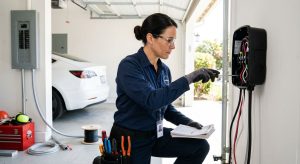
EV charger installation Torrance homeowners are booking often runs into the same obstacle before a single wire gets pulled: the home’s existing electrical panel. A lot of Torrance’s housing stock, built through the 1950s, 60s, and 70s, was wired around a 100 amp panel designed for a very different set of household appliances than what a modern family runs today, and a Level 2 EV charger is a meaningful, continuous new load to add on top of that.
This is not a reason to assume you cannot add a charger. It is a reason to have the panel checked first, since the answer determines whether your installation is a straightforward one-day job or one that needs a panel upgrade or a subpanel worked in alongside it.
Why Older Torrance Panels Are the Bottleneck
A 100 amp panel was a completely reasonable choice for a 1960s Torrance home running gas heat, a gas water heater, and a handful of standard appliances. Modern households have added central air conditioning, an electric range or oven in many cases, a home office with multiple devices, and now often an EV charger, all drawing from the same 100 amps that panel was built around.
A Level 2 home EV charger typically requires a dedicated 40 to 50 amp circuit, which is a substantial chunk of a 100 amp panel’s total capacity, especially once you account for everything else the panel is already carrying on any given day. Whether that fits safely alongside everything else in your home depends on a proper load calculation, not a guess, since simply having an open breaker slot does not automatically mean the panel has the amperage available to support it.
What a Load Calculation Actually Checks
A licensed electrician performs a load calculation by adding up your home’s existing electrical demand, lighting, HVAC, major appliances, and general receptacle circuits, and comparing that total against your panel’s rated capacity, following the same basic method used for any circuit addition, not something invented specifically for EV chargers. This tells you how much headroom actually exists for a new EV charger circuit, rather than relying on the number of open breaker slots, which does not reflect available amperage.
If the calculation shows enough headroom, your EV charger can often be added directly to the existing panel, and the installation is a relatively contained project. If it does not, there are still a few paths forward, and none of them require abandoning the idea of adding a charger.
Your Options When the Panel Is Already Full
The most common solution is a full panel upgrade, typically from 100 amps to 200 amps, which gives the home substantial headroom not just for the EV charger but for future additions like a heat pump HVAC system or a home battery. This is the more involved option, but it solves the capacity question for the long term rather than just the immediate charger installation.
A second option, worth discussing if your panel is otherwise in good condition and just tight on space or capacity for this one circuit, is a dedicated subpanel sized specifically for the EV charger, sometimes paired with a load management device that automatically reduces charging current during periods of peak household demand rather than requiring a full service upgrade.
A third, less common option in older homes is addressing what is actually consuming capacity elsewhere in the panel first, such as replacing an older double-tapped breaker configuration or updating undersized circuits, which sometimes frees up enough headroom without a full panel replacement. This only applies in specific situations and is something your electrician will identify during the load calculation, not something to assume applies to your home.
Questions worth asking before your EV charger quote
- What is my panel’s current rated amperage?
- Has a full load calculation been performed, not just a slot count?
- Does the charger circuit need a panel upgrade or would a subpanel work?
- Is my current wiring copper or aluminum branch circuits?
- Does this project trigger any additional NEC 2026 code requirements?
The NEC 2026 Update Electricians Are Watching for EV Circuits
Beyond capacity, there is a code detail worth knowing about. The 2026 National Electrical Code update specifies that EV charging receptacles must be specifically listed and rated for EV charging use (EVSE-rated), rather than a general-purpose receptacle repurposed for the job. Product listings and local code adoption timelines are both still catching up to this requirement in places, so a licensed electrician who installs EV chargers regularly should be able to confirm what applies to your specific project before it is specified.
This is also connected to the broader GFCI protection conversation happening in outdoor and inverter-based circuits generally, since EV charging equipment uses similar high-frequency inverter technology to modern HVAC systems. A properly rated, code-compliant installation accounts for both the receptacle listing requirement and the correct GFCI protection type from the start.
| Panel situation | Likely path |
|---|---|
| 200 amp panel, open capacity | Direct circuit addition, single-day job |
| 100 amp panel, full or tight | Panel upgrade to 200 amps recommended |
| Panel adequate, garage subpanel needed | Dedicated EV subpanel installation |
“An open breaker slot doesn’t mean you have room. I’ve seen panels with plenty of empty slots that are already maxed out on amperage. The load calculation is the part that actually answers whether a charger fits, and it’s worth doing before you order equipment, not after.”
– Dikran, Blue Moon Electrical
What EV Charger Installation Typically Costs in Torrance
The cost of an EV charger installation depends almost entirely on what your panel needs, not just the charger hardware itself. A home with adequate existing capacity might see a relatively contained cost for the circuit and charger installation alone. A home that needs a full panel upgrade to 200 amps is a considerably larger project, and one that needs a dedicated subpanel falls somewhere in between, depending on the feeder run distance to the garage.
This is exactly why a load calculation matters before a homeowner requests a firm quote. Two neighboring Torrance homes with the same charger model can have very different total project costs depending on what their existing panel actually supports, and getting that answer early prevents an unpleasant surprise partway through the estimate process.
What to Expect During the Installation Process
For a straightforward installation where the panel has adequate capacity, the process typically starts with the load calculation, followed by running a dedicated circuit from the panel to the charger location, mounting the charger, and a final permit inspection through the City of Torrance. This can often be completed in a single day for homes with a modern, adequately sized panel.
When a panel upgrade or subpanel is needed, the timeline extends considerably, since the panel work itself, along with utility coordination if Southern California Edison needs to be involved in a service change, adds real time to the project. A licensed electrician should walk you through a realistic timeline at the estimate stage based on your specific situation, not a generic one-size-fits-all schedule.
Choosing Between a Wall Connector and a Portable Charger
Most homeowners installing a dedicated home charging setup choose a hardwired wall-mounted unit, commonly a Tesla Wall Connector for Tesla owners or a comparable Level 2 unit for other EV brands, over a portable charger plugged into a NEMA outlet. A hardwired unit is generally the more reliable long-term choice and is what most electricians recommend for daily home charging, since it is built for continuous use and typically supports a higher charging rate than a portable unit plugged into a standard outlet.
Whichever option you choose, the electrical requirements behind it, the dedicated circuit, the panel capacity, and the code-compliant receptacle or hardwired connection, are the same considerations discussed throughout this article. The charger brand matters less to your panel than the amperage and continuous duty cycle it draws.
Why Panel Age Matters More Than Panel Slots
Homeowners frequently look at their panel, see a few open breaker slots, and assume that means there is room for an EV charger. This is one of the most common misunderstandings in this entire process, and it is worth addressing directly. Available slots reflect physical space in the panel enclosure, not available amperage, and a panel can have several open slots while still being fully or nearly fully loaded in terms of actual electrical capacity.
This distinction matters because it is exactly the situation where an EV charger installed without a proper load calculation can create a genuinely unsafe overload, one that may not show up immediately but increases risk over time as the panel runs consistently closer to its rated limit. A licensed electrician’s load calculation is the only reliable way to know the real answer, and it is a relatively quick, straightforward part of the estimate process.
Coordinating With Southern California Edison
For projects that require a service upgrade rather than just a panel or subpanel change, coordination with Southern California Edison, the utility serving Torrance, becomes part of the timeline. A straightforward panel replacement that does not change your service size typically does not require utility coordination, but a service upgrade to increase your home’s overall electrical capacity does, and that step can add real time to a project’s schedule.
A licensed electrician experienced with EV charger installations in this area will know when utility coordination is required for your specific project and can build that into your timeline expectations from the start, rather than leaving you to discover a delay partway through.
Rebates and Incentives Worth Asking About
Some electrification-related rebate programs offer incentives tied to broader home electrification projects, and a panel upgrade completed as part of a larger project, such as alongside a heat pump HVAC system or heat pump water heater, can sometimes qualify for incentives that a standalone panel upgrade for an EV charger alone would not. Program availability, eligibility, and funding levels change frequently, so it is worth asking your electrician what currently applies rather than assuming a specific program is guaranteed to be available or assuming a specific dollar amount.
A good approach is treating any potential rebate as a bonus that offsets part of the cost of a project you are already planning, rather than the deciding factor in whether to move forward. Your electrician can walk through the current eligibility review and reservation process, since most programs require confirming eligibility and sometimes reserving funds before installation begins, not after.
Planning Ahead if You Expect a Second EV
If your household is likely to add a second electric vehicle in the next few years, it is worth mentioning that at the estimate stage. A panel upgrade or subpanel sized only for one charger today can mean a second, avoidable project later, while sizing correctly the first time, even at a modestly higher upfront cost, usually saves money over the life of the electrical system.
This same planning conversation is worth having if you are also considering an electric range, a heat pump HVAC system, or a home battery in the coming years, since each of those adds meaningfully to your home’s total electrical demand and affects what panel capacity makes sense today.
Getting Started the Right Way
The single most useful first step for any Torrance homeowner considering an EV charger is a proper load calculation performed by a licensed electrician, not a general estimate based on panel age or breaker slot count alone. That calculation is what actually determines whether your project is a simple circuit addition, a subpanel, or a full panel upgrade, and getting that answer early keeps the rest of the project on schedule and on budget.
Blue Moon Electrical performs full load calculations and installs EV chargers for homeowners throughout our Torrance, CA service area, including Tesla Wall Connector installations. If your panel needs a closer look first, our electrical panel upgrade team can confirm your available capacity, and our subpanel installation service is worth asking about if a dedicated garage circuit fits your situation better.
Whatever path your home needs, getting the load calculation done first keeps every decision after it grounded in your home’s actual capacity rather than a guess, which is the difference between a smooth installation and a project that runs into a surprise halfway through.