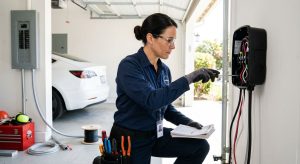
A panel upgrade in Orange, CA is usually triggered by one of two things: the panel is old enough that it’s become a liability, or a new appliance, EV, or heat pump is asking for more power than the current service can safely deliver. Either way, it’s one of the most common electrical projects in the city right now, spanning everything from century-old fuse boxes in Old Towne to 1970s-era 100-amp panels in the neighborhoods around El Modena and Orange Park Acres.
This guide walks through how to tell if you actually need one, what it costs, what the permitting process looks like in Orange, and where rebates realistically fit in.
How to know your panel needs an upgrade
A panel upgrade isn’t always obvious from the outside. A few patterns show up again and again during inspections:
- The panel is a fuse box, or a breaker panel rated 60 or 100 amps in a home that’s added central air, an EV, or major kitchen appliances since it was installed
- Breakers trip repeatedly when multiple appliances run at once
- The panel brand has been the subject of known reliability issues or recalls
- There’s no room left for new circuits — every slot is full
- You’re adding a load the panel wasn’t sized for: an EV charger, a heat pump, a spa, an ADU
None of these guarantee you need a full service upgrade specifically — sometimes a load calculation shows the existing 100-amp service has enough headroom, and only the panel itself (not the amperage) needs replacing. That’s exactly why the assessment comes before the quote, not after.
Age alone is a reasonable trigger too. A meaningful share of homes in Orange were built well before modern electrical demand existed — plenty of the housing stock dates to the 1940s through 1960s, an era when a 60-amp or 100-amp panel was the norm and central air, an EV, and a home office setup weren’t part of the load calculation anyone was planning for. If your home falls in that window and the panel has never been touched, it’s worth an assessment even without a specific symptom pushing you toward one.
100-amp vs. 200-amp: what’s actually different
The number on your panel is the maximum current your home’s electrical system is rated to deliver at once. A 60-amp or 100-amp panel was standard for decades and was genuinely enough for a mid-century home without central air or an EV. Modern households running central air, an electric range, a heat pump, and an EV charger simultaneously ask for a lot more headroom, which is why 200-amp service is now the common target for a full upgrade, with larger homes sometimes going to 300 or 400 amps.
Going from 100 to 200 amps isn’t just a bigger box — it typically means a new panel, new service entrance conductors, and in some cases utility-side work at the meter, which is why it costs more and takes more coordination than a straight panel swap at the same amperage. A qualified electrician runs a load calculation first: they total up the demand from your existing circuits using standard NEC formulas, then check whether that number leaves enough headroom for what you’re planning to add. Sometimes the answer is that your current 100-amp service has more capacity than you’d assume, and a full 200-amp upgrade isn’t actually necessary yet.
Smart panels: a middle-ground option
For homes where a full service upgrade is expensive or complicated — a longer run from the meter, difficult utility coordination, or a tight budget — a smart panel with load management is increasingly offered as an alternative. Smart panel technology is cited as a cost-effective option for a meaningful share of homes with 100-amp panels that have run out of breaker space, since it manages demand across circuits in real time instead of requiring more raw capacity. It’s not the right fit for every situation, but it’s worth asking your electrician whether it applies to yours before committing to the larger service upgrade.
What a panel upgrade costs in Orange
Cost is driven almost entirely by scope. National 2026 pricing data puts a 100-to-200-amp upgrade at roughly $1,500 to $4,000 for the panel replacement alone, or $3,000 to $6,000 when the utility needs to upgrade the service drop, meter socket, or weatherhead too. California labor rates and permit fees tend to sit above the national low end, so Orange homeowners should expect estimates toward the middle-to-upper part of that range rather than the floor — a licensed electrician in Orange, CA can confirm exactly where your home lands after a load calculation.
| Panel Upgrade in Orange, CA: What Drives the Cost | ||||||||
|
“A lot of homeowners assume a panel upgrade means the whole house loses power for the day. In reality we coordinate the outage window tightly with the utility so it’s usually just a few hours, not a lost weekend.”
— Sako, Blue Moon Electrical
Permits and inspection: what Orange requires
Every panel upgrade in Orange needs an electrical permit and a final inspection — this isn’t optional, and skipping it creates real problems at resale when a buyer’s inspector finds unpermitted electrical work. The city processes electrical permit applications through its online Civic Portal, which also lets you schedule the required inspection once the work is complete. Your electrician typically pulls this permit as part of the job rather than leaving it to you, but it’s worth confirming that’s included in your quote.
EV chargers, heat pumps, and rebate-eligible upgrades
Panel upgrades on their own generally aren’t the thing utility rebate programs are designed around. Where they do become rebate-eligible is as part of a larger electrification project — most commonly an EV charger installation. Southern California Edison’s Charge Ready Home program offers eligible customers rebates of up to $4,200 toward the panel upgrade needed to support a Level 2 EV charger circuit. Programs like this change funding availability and eligibility criteria fairly often, so treat any specific rebate figure as a starting point for a conversation with your electrician rather than a guaranteed number — confirm current terms before counting on it in your budget.
The practical upside is that if you’re already planning an EV charger or a heat-pump HVAC system, it’s worth having the panel conversation at the same time rather than as an afterthought, since the eligibility review and paperwork are part of that combined project.
Panel upgrades in Old Towne’s historic homes
A meaningful share of Orange’s housing stock predates modern panel standards entirely. Homes in and around Old Towne sometimes still have their original fuse box or an early breaker panel that was never fully brought up to current capacity. For these properties, the panel upgrade conversation often overlaps with the wiring conversation — if the branch circuits feeding the panel are original knob-and-tube, the panel is only part of the picture. A qualified electrician assessing an Old Towne home should be looking at both at once, not just swapping the box and calling it done.
Exterior equipment changes — a new meter location or a panel relocated to an exterior wall — can also intersect with the city’s historic preservation review if the home sits within the Old Towne Orange Historic District and the change is visible from the street. It’s a separate process from the standard building permit, so it’s worth flagging early if your project involves anything visible from outside. In most cases the panel itself is relocated to the same interior or side-of-house position it already occupies, which avoids triggering that review at all — another good question to raise with your electrician before the quote is finalized.
Sub-panels and ADUs: when you don’t need a full service upgrade
Not every capacity problem calls for replacing the main panel. If your existing service has headroom but a specific area of the property — a detached garage, a workshop, or an accessory dwelling unit — needs its own dedicated circuits, a sub-panel fed from the main panel is often the more targeted and less expensive fix. This comes up often in Orange given how many properties have detached structures on the lot, from garages converted to workspaces to full ADUs added for rental income.
The load calculation your electrician runs at the start of the assessment is what determines which of these you actually need. It’s worth being upfront about everything you’re planning to add — not just the EV charger you know about now, but the ADU you’re considering for next year — since sizing the work around a five-year plan is cheaper than upgrading twice.
What to expect on installation day
A straightforward panel swap is usually a one-day job. Power to the home is off for a portion of that day while the old panel is removed and the new one is installed and connected, and the utility handles reconnection at the meter if the service size is changing. Your electrician should walk you through the expected outage window before the day arrives so you can plan around it — freezers and refrigerators are the main practical concern for a same-day outage, and most upgrades don’t run long enough to put food at risk.
Choosing the right electrician for the job
A panel upgrade touches your entire home’s electrical system, so licensing and permit history matter more here than on a smaller job. Ask directly whether the quote includes the permit and the final inspection, whether a load calculation is part of the assessment (not just a visual look at the existing panel), and how they handle an unexpected finding — like deteriorated service entrance cable — that shows up mid-project. A contractor who answers those clearly before you sign anything is a good sign of how the rest of the job will go — it’s worth confirming directly with whichever panel upgrade service in Orange, CA you’re considering before work starts.
It’s also reasonable to ask for the make and model of the panel they plan to install, and whether it’s rated for the future loads you’ve mentioned rather than just the loads you have today. A panel sized exactly to your current needs with zero spare breaker slots tends to force a second upgrade sooner than one with a little room built in — a small difference in upfront cost that saves a repeat project a few years down the line.
How long a panel actually lasts
There’s no fixed expiration date on a panel, but most electricians treat 25 to 40 years as a reasonable working lifespan for a well-maintained panel, shorter if it’s been overloaded repeatedly or exposed to moisture. That means plenty of Orange homes are sitting on original 1980s or 1990s panels that are approaching the end of that window even without an obvious failure symptom. A panel doesn’t need to be actively failing to be worth replacing proactively, especially ahead of a sale or a big appliance purchase.
A panel upgrade in Orange, CA is one of those projects that’s easy to put off until something forces the issue — a failed inspection at sale time, a breaker that won’t stop tripping, or an EV that needs a circuit the panel can’t support. Getting ahead of it with a proper load calculation gives you options instead of a scramble — you get to choose the timing, the financing, and whether an EV or a heat pump gets folded into the same project, rather than making that decision under pressure from a failed inspection or a tripped breaker at the worst possible moment, when you’re negotiating with a buyer or standing in a dark kitchen instead of planning calmly. Blue Moon Electrical’s electricians in Orange, CA handle panel upgrades across Old Towne, El Modena, and the rest of the city, with permitting and historic-district coordination built into how the job is scheduled.