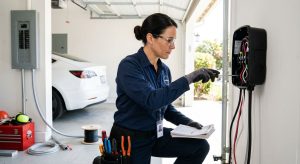
Whole house surge protector installation in Orange, CA is one of those projects homeowners rarely think about until after something expensive gets damaged. A single grid-level voltage spike, sometimes from a utility switching event and sometimes from something as ordinary as a nearby lightning strike, can travel through your home’s wiring and damage every electronic device plugged in at once, not just the one connected to a power strip.
This is especially relevant right now for Orange homeowners who have recently upgraded a panel, added an EV charger, or installed solar, since all of that new equipment represents a bigger investment sitting behind the same panel that a power strip alone cannot protect.
It is worth thinking of surge protection the same way you think of insurance itself: the cost of prevention is small and predictable, while the cost of a bad surge event hitting an unprotected panel can be large and unpredictable, landing on multiple appliances and devices at once rather than just one.
What a Whole House Surge Protector Actually Does
A whole house surge protective device installs directly at your electrical panel, or sometimes at the meter, and monitors the incoming power for voltage spikes above safe levels. When it detects a surge, it diverts the excess voltage safely to ground before it can reach the circuits feeding your outlets and appliances. This is a fundamentally different approach than a power strip surge protector, which only protects whatever is plugged directly into it, and only from smaller, more localized surges.
Point-of-use protectors, the kind built into power strips, still have a place for sensitive individual electronics like a computer or a home theater setup, but they are not a substitute for panel-level protection. A large surge, like one caused by a lightning strike on nearby utility infrastructure, can exceed what a power strip is rated to absorb, while a whole house device is sized specifically to handle that scale of event.
What Puts a Home at Risk
- Utility switching events. Grid operators routinely switch loads and reroute power, and these switching events can send brief but significant voltage spikes down the line.
- Lightning strikes. A strike does not need to hit your house directly. A strike on nearby utility lines or even the ground near your property can induce a surge that travels through your service line.
- Large appliance cycling. Air conditioning compressors, pool pumps, and other high-draw motors create smaller internal surges every time they cycle on and off, which add cumulative stress to connected electronics over years.
- Downed lines and grid faults. Storm damage or equipment failure elsewhere on the grid can occasionally send an irregular voltage spike toward homes on the same circuit.
Orange’s electrical grid experiences the same utility switching activity as the rest of the region, and homes with recently added EV chargers, solar inverters, or smart home systems have meaningfully more at stake if a surge does get through, simply because there is more sensitive electronic equipment connected to the panel than a home had a decade ago.
Cost of Whole House Surge Protection
Whole house surge protector installation is one of the more affordable panel-level upgrades available, generally costing a small fraction of what a full panel upgrade runs, since it does not involve replacing the panel itself, just adding a device at the panel or meter. The device itself, plus labor for a straightforward installation on an accessible panel, is typically a same-day job. Homes where the panel is difficult to access, or where the panel is also being upgraded or replaced at the same time, may see the surge protector bundled into that larger project’s labor and permit cost rather than priced as a fully separate line item.
Power Strip vs. Whole House Surge Protection
- Only protects devices plugged into it
- Limited surge capacity, wears out over repeated small surges
- Plug in, no electrician needed
- Best for a single sensitive device, like a computer
- Protects every circuit in the home
- Rated for larger, grid-level surges
- Installed at the panel by a licensed electrician
- Best for protecting the entire home’s electronics and appliances at once
Many homes use both layers together for the strongest overall protection.
Homeowners Insurance and Surge Damage
Most standard homeowners insurance policies do cover sudden, accidental surge damage to appliances and electronics, but coverage details, deductibles, and claim thresholds vary meaningfully by carrier and policy. A whole house surge protector reduces how often you need to rely on that coverage in the first place, since it is addressing the problem before it damages anything rather than after. For homeowners who have added significant electronics investment, like a home theater, networked smart home devices, or EV charging equipment, that upfront protection is often worth more than the modest cost of the device and installation.
How Surge Damage Actually Shows Up
Surge damage rarely looks dramatic in the moment. Most homeowners do not see sparks or hear a bang. Instead, a surge event tends to show up as a slow accumulation of small failures: a smart thermostat that stops responding a few weeks after a storm, a refrigerator’s control board that fails earlier than expected, or a string of minor electronics failures that seem unrelated until you consider they all happened around the same grid event. This gradual pattern is part of why whole house surge protection is easy to underestimate. There is rarely a single dramatic incident that makes the case for it; instead, it is a slow tax on your home’s electronics that most people never trace back to its actual cause.
U.S. insurers paid an estimated $1.65 billion in lightning-related homeowners insurance claims in 2025 according to the Insurance Information Institute, a category that includes the power surge damage lightning sends through home wiring, separate from fire damage claims. The Institute also noted that rising home electronics ownership is part of why the average payout per claim keeps climbing, since a modern home simply has more sensitive equipment connected to its panel than a home from a decade ago. That distinction matters because a whole house surge protector specifically targets this category of loss, which a smoke detector or fire alarm does nothing to prevent.
How Long Does a Whole House Surge Protector Last
Whole house surge protective devices are rated to absorb a certain cumulative amount of surge energy over their service life, after which the internal protective components degrade and the device should be replaced. Most quality devices are rated for many years of typical use, but a single very large surge event, like a direct lightning strike on nearby infrastructure, can use up a meaningful portion of that rated capacity in one event. Many devices include a visual indicator light that shows whether the unit is still providing active protection, which makes periodic visual checks a simple way to confirm the device has not silently failed after absorbing a major surge.
This is one of the practical reasons to have a licensed electrician periodically check the device during any other panel service call, rather than assuming a surge protector installed years ago is still functioning simply because it is still physically present at the panel.
Ideal Timing: Pair It With Other Panel Work
The most efficient time to add whole house surge protection is during any other panel-related project, since the electrician is already at the panel and the labor overlap reduces total cost compared to two separate visits. This makes it a natural add-on if you are already scheduling a panel upgrade, an EV charger installation that requires panel access, or a solar interconnection.
As our electrician Steve puts it, “If we’re already inside your panel for an upgrade or a new circuit, adding surge protection at the same time is a small incremental cost. Coming back for a separate visit later to add the exact same device costs more in labor for no real benefit.”
“A power strip protects the one thing plugged into it. A whole house surge protector protects the refrigerator, the HVAC system, the EV charger, and everything else on the panel at the same time, which is why we recommend it as a baseline, not an upgrade.”
— Steve, Blue Moon Electrical
What Installation Involves
A licensed electrician installs a whole house surge protective device by connecting it to your panel’s bus bar and grounding system, typically mounting it inside or directly adjacent to the panel enclosure. The installation itself is quick on an accessible panel in good condition, though it does require briefly de-energizing the panel, so it is done with the same care and safety precautions as any other panel-adjacent electrical work. Most jurisdictions, including Orange, require this work to be performed by a licensed electrician, and depending on scope it may be included under the same permit as other panel work happening at the same time, which keeps the paperwork simple rather than requiring a separate permit application for what is a relatively small addition to the panel.
Signs Your Home Could Benefit From Added Protection
- You have added an EV charger, solar, or a home battery system in the past few years.
- You have noticed appliances or electronics failing more frequently than expected for their age.
- Your home experiences frequent power blips, flickers, or brief outages, which often accompany utility switching events.
- You have significant investment in home theater, networked smart home devices, or a home office setup.
- Your panel does not currently have any surge protection installed, and you are not sure when it was last evaluated.
Does a Surge Protector Replace Good Wiring Practices
No, and this is worth being clear about. A whole house surge protector addresses voltage spikes coming from outside sources, like the utility grid or lightning. It does not correct internal wiring problems, like loose connections, aluminum wiring that has not been properly mitigated, or an undersized panel. If your home has any of those underlying issues, a surge protector is a valuable addition, not a substitute for addressing the wiring issue itself. A licensed electrician evaluating your panel for surge protection is also a good opportunity to flag any of those separate concerns if they are present, since the panel is already open and accessible during that visit.
Think of it this way: good wiring and an adequately sized panel are the foundation, and surge protection is the layer on top that handles the events no amount of correct internal wiring can prevent, since the source of the surge is outside your home’s electrical system entirely. Homes need both, not one instead of the other.
Planning Your Installation
If you are considering whole house surge protection for your Orange home, the most efficient approach is to mention it whenever you are already scheduling other panel-related work, or to request it as a standalone visit if nothing else is currently planned. Either way, a licensed electrician can confirm your panel is a good candidate for direct installation and give you a clear, upfront price before any work begins.
Blue Moon Electrical’s licensed electricians serve homeowners throughout Orange with straightforward surge protection installation and transparent, written pricing, so you know exactly what you are getting before the work starts.
Related Electrical Work to Consider
If your panel is original to an older Orange home and has not been evaluated recently, this is a good time to also consider whether an electrical panel upgrade is needed alongside surge protection, since an aging panel and inadequate surge protection are often found together. If you are adding EV charging as part of the same project, EV charger installation is another natural pairing, since new charging equipment is exactly the kind of investment worth protecting at the panel level.
Whether you are protecting a recent upgrade or simply closing a gap in your home’s electrical protection, Blue Moon Electrical’s team can evaluate your panel and give you a clear plan for whole house surge protection in Orange, CA.